 Cassandra.org
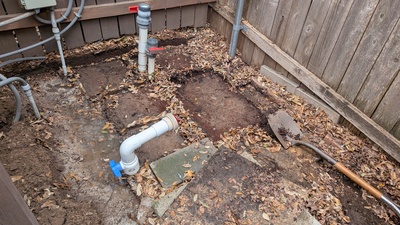
Before
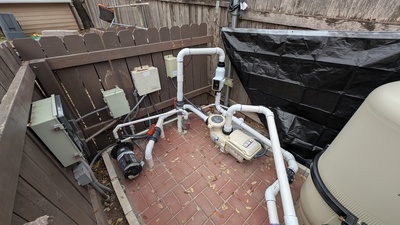
After
Background
The last couple years I have been on a quest to find a solution to the problem of being able to go away for a month without having to worry about my pool's chemistry. When I used chlorine tabs, I could do at most two weeks.
In the past, I have had a friend add extra tabs while I was away, but that solution does not work if they are also out of town. I also dislike having to put that burden on a friend. It is also true that using chlorine tabs too much also messes up your water chemistry and leads to other problems (many of which I had dealt with).
In the past I have also hired a pool company a couple times, both with less than ideal results, so my trust level is very low. One left a dead animal in my trash can. The other contributed to burning out my pump.
First Failed Attempt
For better chemistry and in hopes that I could automate chlorine addition, I bought a peristaltic pump and attempted to automatically pump liquid chlorine into the pool. This was part of the Pool Chlorinator Project. After 9 months of trying to get that to work, I declared it a failure. Mechanically, everything worked great and in theory, it should have worked. However, after much experimentation, I could never get it to reliably keep the chlorine level up. I am still stumped as to why with my only theory that somehow that pump adds the liquid chlorine too slowly and it gets consumed faster than it can contribute to raising the chlorine level.
I should also mention that buying liquid chlorine in bulk and hauling it around was not something I was looking forward to be doing indefinitely. So the project being a failure saved me from that.
Salt Water Pool Decision
For my failed liquid chlorine injection project, I had done a ton of research. I also consulted the highly respected Trouble Free Pools forum. One recommendation was to save my time and money and just convert to use a Salt Water (Chlorine) Generator (SWG). At the time, I was already invested in the liquid chlorine solution enough that I needed to see it through. However, in the back of my mind, I feared he was right. That stayed with me during the long, drawn out attempts to get the injection pump to work.
A number of years ago I had looked into a salt water pool conversion and came out on the side that the salt water cons outweighed the pros. A minor negative is the extra corrosiveness of the salt water. The bigger one for me was that it was yet another mechanical system to maintain. However, what I had built with the liquid chlorine injection project was yet another mechanical system to maintain.
If an extra system is inevitable, then it is no longer a negative for a SWG. So what about the the corrosive salt water? That too is very overblown. I also learned that even if you do not add salt to your pool, salt is a by product of use chlorine of any type. In fact, when I measured my pool salt level after a year of using liquid chlorine, it was 2,400 ppm. The SWG system only needs 3,600 ppm of salt. Thus, the argument is not salt versus no salt, it is about salt versus a little less salt.
The Domino Effect
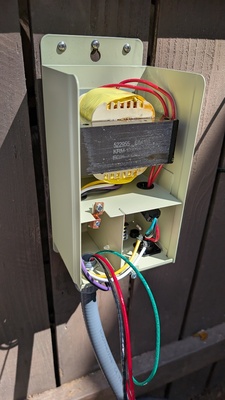
SWG Transformer
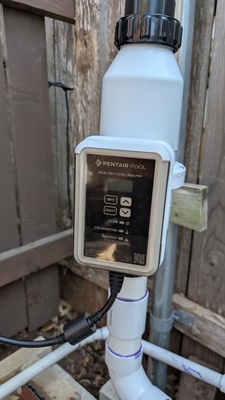
SWG Cell
With no appreciable negatives left, I decided I'd give the salt water conversion a go. The unit is about $1,500, which is not that much more than I invested with the liquid chlorine injection project. Once committed to to converting, I set about doing all the research and planning for this project (which was extensive).
New Pump
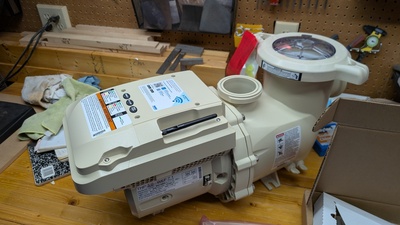
New Pump
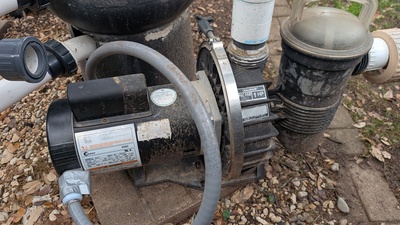
Old pool pump
One of the other negatives of a SWG is that it only generates chlorine when water is flowing: i.e., when the pump is running. If chlorine demand is high, like it is in the heat of summer, the pump will need to run 12 or more hours a day. I have a 30+ year old system and its corresponding old-style, inefficient, single speed pump. I had actually converted to a two-speed pump many years ago, but the low speed of that pump might not provide enough flow for the SWG as it needs a minimum flow for it to work and running for long periods on high speed it going to be significant increase in my electric bill. Modern pool systems use variable speed pumps, which are much more efficient and much better suited for running a SWG system.
Thus, the decision to go with a SWG implies I needed to also buy a new pump.
New Electric Circuit
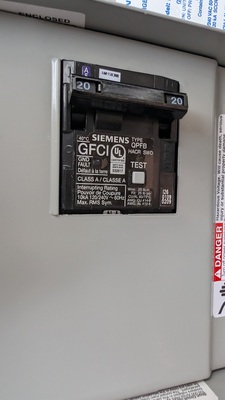
New circuit and subpanel
But these new pumps come with new electrical needs. It really should be on a dedicated circuit, but the current circuit is shared with the booster pump. None of my pool equipment is GFCI protected either, but it really needs to be. Further, the newer pumps have more sophisticated and sensitive circuits, so adding a surge protector was also in order.
Thus, the decision to go with a SWG implies I needed to a new pump which, in turn, implies I need an new GFCI and surge protected electrical circuit.
New Filter
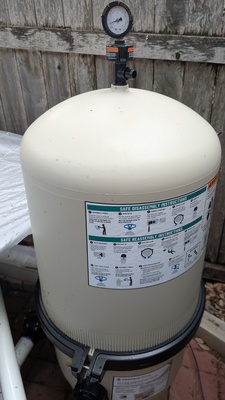
New pool filter
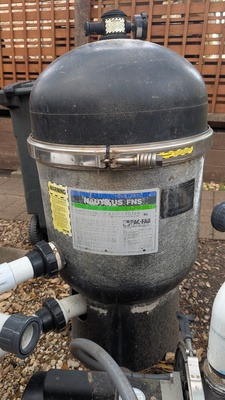
Old pool filter
Replacing the pump also mean re-plumbing the pool filter. I had just re-plumbed the filter less than 18 months before as part of the Pool Plumbing 2024 Project. That involved much time spent searching for the proper o-rings and unions given how old my filter was. I never found exactly the right parts and gerry-rigged a solution I felt was not going to last a long time. Since I did not want to be doing yet another pool plumbing project in the next few years, it made sense to consider buying a more modern filter.
My old filter was a diatomaceous earth (D.E.) filter which is messy to maintain and not ideal to be draining that into the local ecosystem. Using a cartridge filter is a lot simpler to maintain and not as messy or ecologically questionable. My old filter's fiberglass shell was also showing signs of wear and occasionally leaks. The sum total of all of these issues was that it seemed folly to put in a new pump and retain the old filter.
Thus, the decision to go with a SWG implies I needed to a new pump which, in turn, implies I needed to also buy a new filter.
Electrical Bonding
Lack of GFCI protection was not the only way in which my electrical setup was deficient. Modern codes require all pool equipment to be 'bonded'. The idea of bonding is to ensure everything is at the same electric potential. e.g., Anything conductive that a person may touch while in the pool, or out of the pool while wet, should not result in a potential difference that causes electricity to flow through their body.
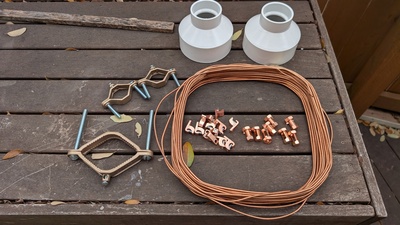
Parts for electrical bonding
On at least three occasions over the years, I have had various inspectors and electricians point out that my equipment (and metal hand rails) were not bonded. I always just marked this as a very optional improvement and did nothing. Doing nothing was maybe not terrible, but converting to a salt water pool made doing nothing a much riskier proposition. The reason is that by it nature, a SWG has two metal plates in your water flow and is actively putting an electric potential between those plates.
Without the SWG, the danger of electric shock is there if some piece of equipment fails and shorts out in the water. Skipping the electrical bonding was not so dangerous on a day-to-day basis and only because an issue in a failure state, but with an SWG, the electric system is always connected to the water.
Thus, the decision to go with a SWG implies I needed to a new pump which, in turn, implies I also needed to add bonding to all my equipment and the metal objects around the pool.
Pavers
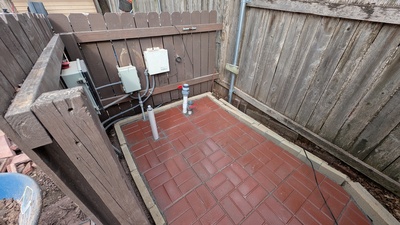
Pavers completed (alt)
The area of my yard where all the pool equipment sits is just a dirt area with a few paving stones and concrete blocks. These pavers and concrete blocks were just put down somewhat randomly over the years and just place on top of the soil. They have sunken down over the years, some almost completely covered in dirt. Roots from trees regularly crawl their way into the pump base, once requiring a hour effort to extract it and cut back the roots. Since the new equipment would necessarily be located in different locations, I would be needing to dig out these blocks and re-arrange them. To avoid all the issues I've previously experienced, it only made sense to add pavers to the entire area and do it the right way with geotextile fabic, gravel base, sand, etc.
Thus, the decision to go with a SWG implies new equipment which implies I needed to also dig out the pool pad area and add pavers.
Sunken Wall
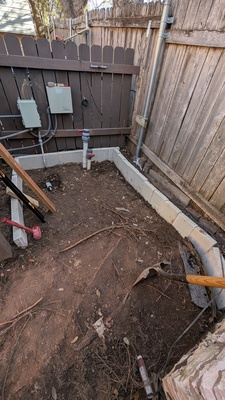
Sunken Wall
The pool pad area where the pavers would be placed is on a slope and next to a fence at the property line with a slope down about 9 inches. I did not want to install pavers up to the property line and needed to have some way to bound the area of the pavers and prevent them from migrating. It would have some heavy equipment on it, so simple edging of the area was not suffient, especially in the face of erosion during heavy rains. A way to do this is to dig the edge deeper and create a (sunken) retaining wall.
Thus, the decision to go with a SWG implies new equipment which implies pavers which, in turn, implies building a sunken wall.
Suction Line Relocation
When I did the original reconfiguration of my pool pad area in 2010 (see Pool Pad Reconfiguration Project, my main goal was to spread the equipment out so that I could easily work on each item without being a contortionist. The previous layout made working on the equipment very inconvenient, awkward and hard on my back. At the time, I just lived with the existing suction (intake) and return lines: where they emerged from the ground was fixed and a constraint I worked around. Unfortunately, the suction line comes up in the middle of the area, and most inconveniently, right where you would be stepping as you enter or leave the area. i.e., a trip hazard.
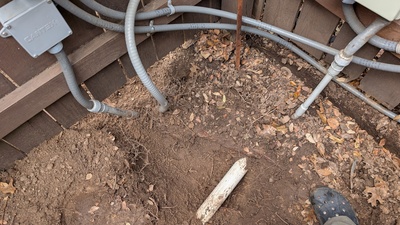
Buried suction line
I always disliked the suction line location and with the new pump, this original location would be less than ideal for routing the plumbing. Additionally, the main valve on the suction line was faulty and leaked when closed. This gave me three solid reasons to consider relocating the suction line. Given I was already committed to digging out the area for six inches for the pavers, there was never going to be a better opportunity to dig a little more and put the suction line out of the way and better set up for the new pump location.
Thus, the decision to go with a SWG implies new equipment which implies new plumbing routes which, in turn, implies relocation of the suction line.
Equipment Purchase and Delivery
Some of the main requirements I had:
- I did not want a pump that depended on an phone/app to control it (an app as an option for convenience was OK though).
- I wanted to oversize the filter so that I would need to clean it less often.
- I wanted to oversize the SWG so that it would last longer and have less frequent maintenance.
After researching which equipment to buy, I began favoring quality over price, so wound up at the high-end of Pentair equipment. I sent a request for quotes to five reputable companies. Four of them said that Pentair does not allow them to sell it directly to consumers. They were correct...what a racket. Their warranty's are also not in effect unless you purchase it through a reseller/pool company.
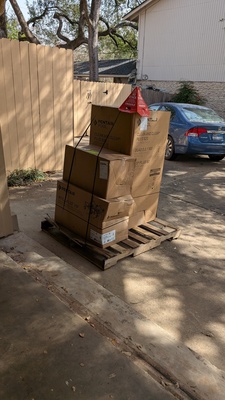
New equipment on pallet in driveway
My approach was to tell the companies that, coincidentally, I had just started a pool company, so sign me up. Three balked at that idea, but one was willing to play that game. The one company that was willing to sell directly to me must either have had stock from before Pentair imposed that rule on them, or else was playing that same game but hiding it from the customer (and Pentair). I went with the second best offer at Polytec Pools because they have a better reputation and seems better supporting DYI installs.
The equipment was drop shipped surprisingly quickly (from California), but looked worrisome when it arrived. A lot of box crushing visible. Fortunately, Pentair packages them very well with plenty of space, so nothing was damaged inside.
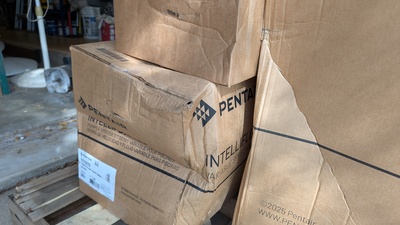
New equipment box damage closeup
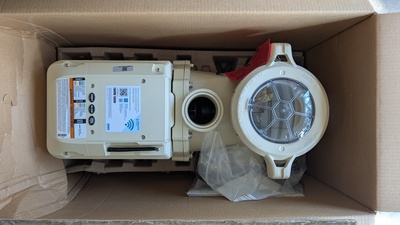
Undamaged pump in box
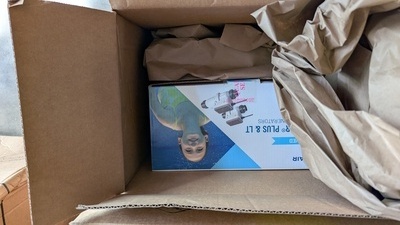
Undamaged SWG in box
New Electrical Circuit
Since my DYI electrical skills stop at electric panels, I needed to hire an electrician to add the new circuit and GFCI breaker. I used a company that I had previous good experiences with doing repairs. For this project they also did good work, but they were not always very responsive and there were many days spent waiting for replies.
A constraint I was working with in sequencing the phases of this project was to minimize the amount of time I did not have a working pump to circulate the pool water. Since the new pump needed the new circuit, until the new circuit was installed, I was at risk of the electrician's schedule extending the outage time. Thus, I wanted to get the new circuit in before disconnecting the old equipment. I was now sitting on all the new equipment waiting for the electrician. That lasted a week.
When the electrician arrived, he ran into an issue in pulling the wires for the new circuit. They got stuck somewhere underground, possibly in some hidden junction box. He suggested I dig to find the obstruction because they charge a lot when they have to dig themselves. I appreciated his honesty and recommendation.
Eager to get this project moving, that evening I started digging and tracing the underground conduit from the pool pad to the house. I found that under my deck, there was a 90 degree turn that was most definitely the thing impeding getting the 12 gauge wire to feed through. Luckily, this was reachable by just removing a few deck panels.
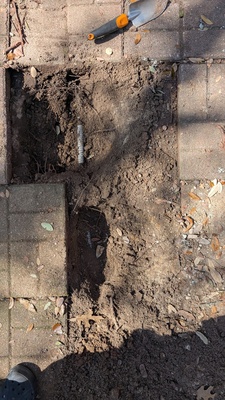
Electric line under pavers (closeup)
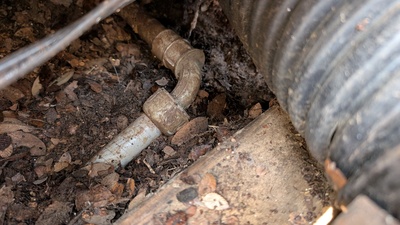
Elusive electric line under deck
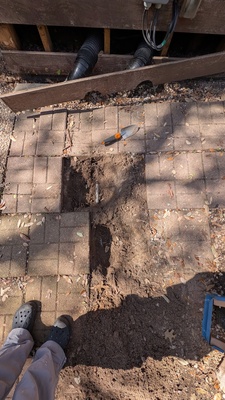
Electric line under pavers
The issue now was that the electrician needed to come back to complete the work. Last time, it took a week before they showed up. I was not wanting to wait another week and now that I had the shovels out and some momentum, so I decided to start the project first thing the next day. I hoped the electrician arrived by the time I needed to hook up the pump. It was a minimum of three days work I needed to do, and likely closer to five I estimated, so they had time.
New Equipment Orientation
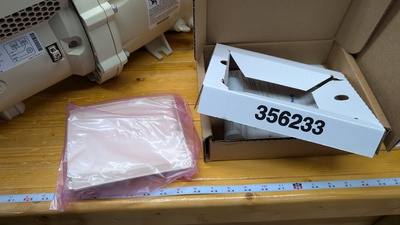
Unboxed pool pump touchscreen
Unboxed new pool pump
The night before starting the manual work of the project, I took some time to unbox all the new equipment and started reading the manuals to orient myself. I was days away from installing any of this, but wanted to get more familiar with it, especially the electrical connections and plumbing geometries.
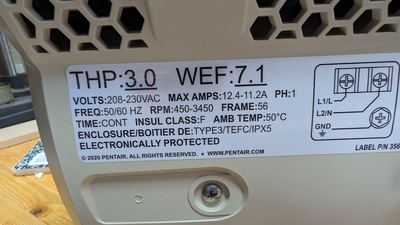
New pool pump spec label
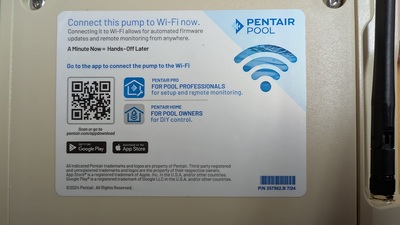
New pool pump app label
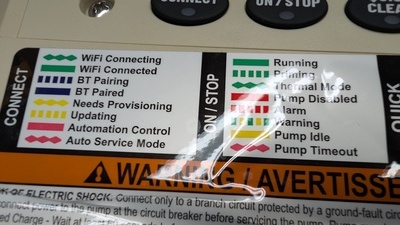
New pool pump legend label
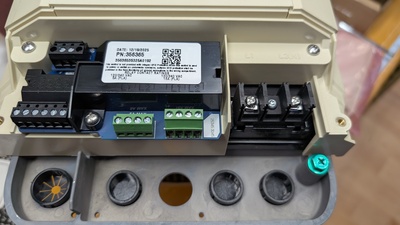
New pool pump hookup area
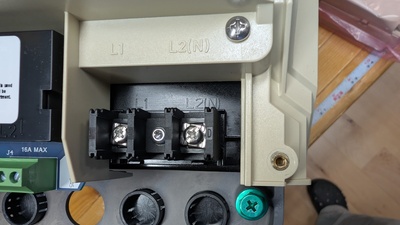
New pool pump electric line terminals
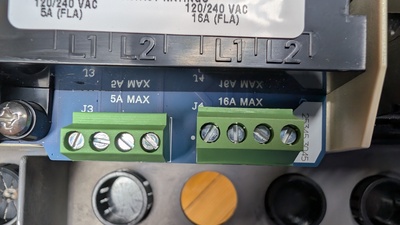
New pool pump relay terminals
Pool Pad Demolition
I first removed the booster pump (for the pool vacuum) which was the only piece of equipment I would be keeping. Next I was eager to dig down to find the route the suction line took underground. Although relocating it was in the plan, exactly where to move it had not been decided and it was going to depend on how it ran underground. Fortunately, the suction line ran in a path that made it easy to just cut and emerge out of the ground in the corner of the pool pad area.
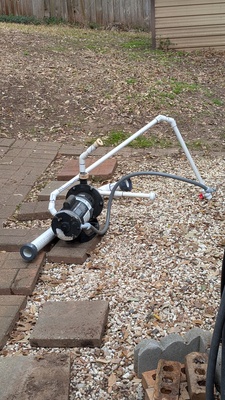
Booster pump removed
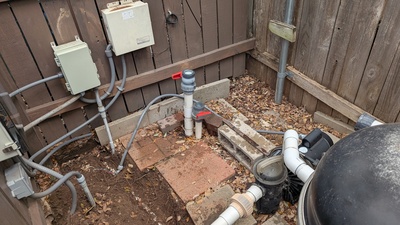
Initial equipment teardown
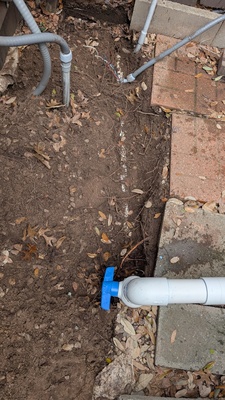
Underground suction line
I made a mistake at this point. I should have drained the filter housing earlier (it contains a lot of water). Or I should have directed the drain away from the pool pad. Having already dug a trench to find the suction line, all I got was a small lake and a lot of mud.
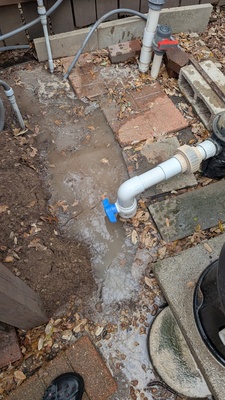
Filter flooded ditch
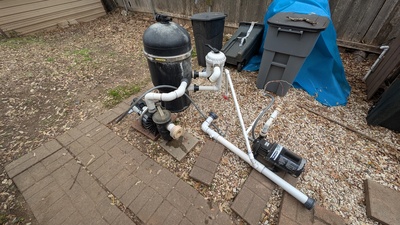
All equipment after removal
Pad area after equipment removal
The next exploratory part of the project was map out exactly the location and height for the pavers and its sunken retaining wall. The retaining wall required digging an 18 inch perimeter trench and I needed to find all the potential obstacles. I found mystery pipes, limestone layers and large tree roots. I had to work around all of these meaning the retaining wall would not be as deep as I liked in all places. However, for the one side by the slope and fence, I was able to get the full depth.
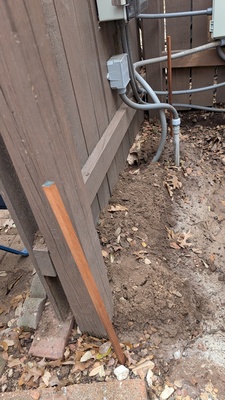
Stakes for reference levels
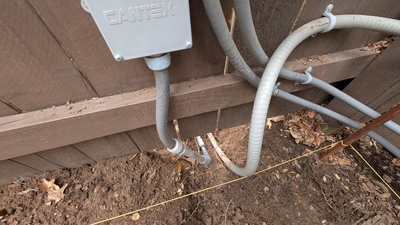
Electric feed lines from ground
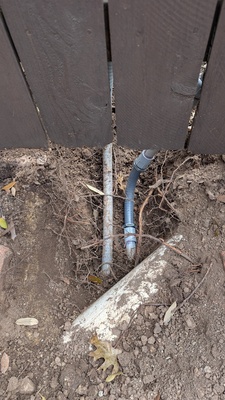
Electric feed lines under pipe
Suction Line Relocation
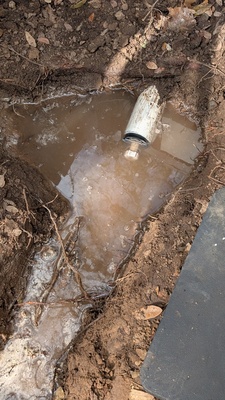
Suction line after cut (closeup)
Suction line before cut
I had not yet worked out exactly how the new equipment would be laid out. I had drawn a candidate plan, but disliked the way the plumbing routed. I could not make any more progress on the pavers until I committed to the location of the suction line. However, the corner was the natural place that was easiest, so I did that and hoped for the best. Worst case, the above ground sucntion line plumbing gets a little convoluted.
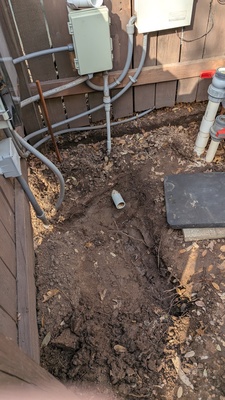
Cut suction line
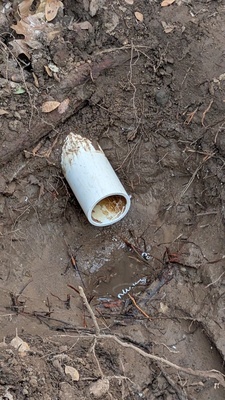
Cut suction line: dried and clean
Submerged Wall
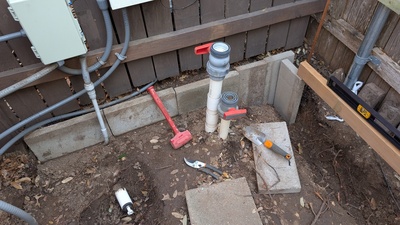
Submerged wall initial layout
Trenching and building the submerged wall was like going through an obstacle course. Roots, rocks, conduit, pipes, etc. Getting this wall installed was the most important part. The top of this wall would be serving as the reference points for all the layers needed for building up to the pavers.
An important step in laying this out was to build in a slope (1 inch vertical for every 4 feet horizontal). The pad lies on a slope and in the vicinity of an area that becomes a flowing river in heavy rains. Thus, ensuring that water does not pile up in the pool pad area is very important.
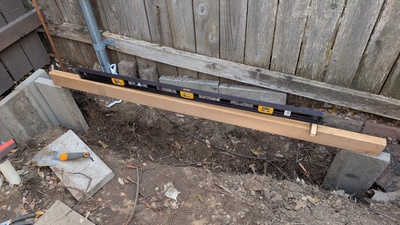
Submerged wall level finding
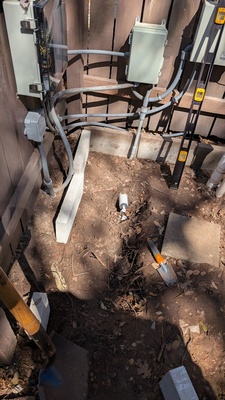
Submerged wall starting corner
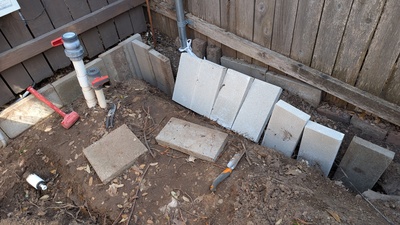
Submerged wall - stones lined up
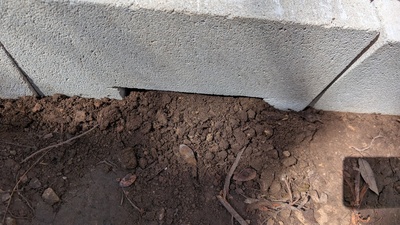
Small cutout for mystery pipe
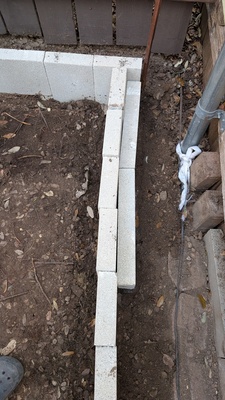
Backing layer for submerged wall
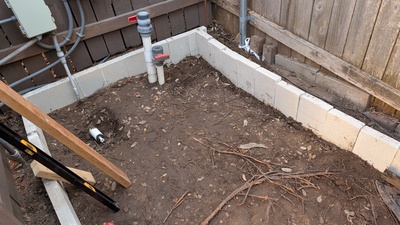
Submerged wall - all sides done
I needed to add a 90 degree elbow and a riser to the cut suction line before leveling the ground. However, a pipe sticking out of the ground would have been an annoying obstacle while doing all the digging. Thus, I waited until all sunken wall was done and ground nearly level before added the extra plumbing and re-burying the suction pipe. Note that at this point I had no idea how high the riser needed to go as the paver height and plumbing layout had not yet been established. Thus, I ran an extra long pipe upwards with the plan to cut it when doing the equipment plumbing.
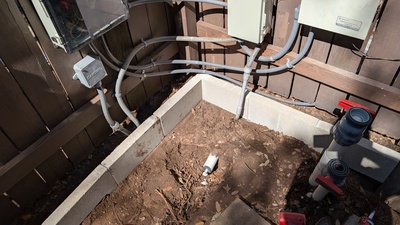
Submerged wall - two sides done
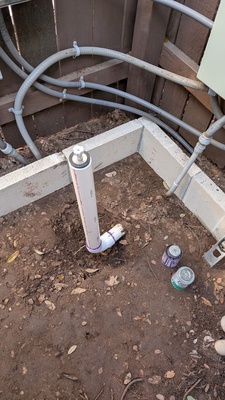
Suction line elbow and riser
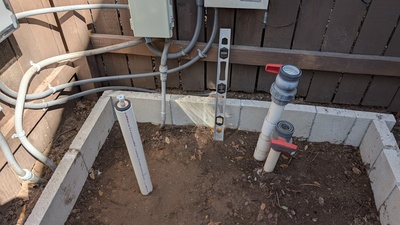
Suction line hole filled
Pavers
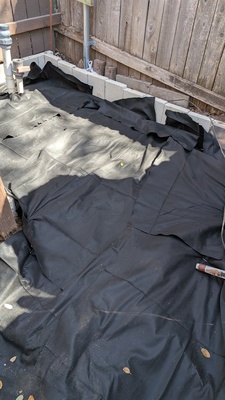
Laying down geotextile fabric
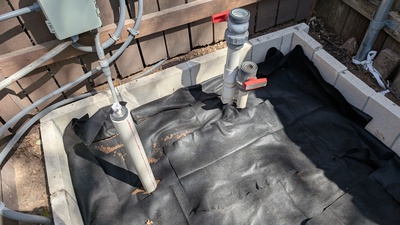
Laying down geotextile fabric (alt)
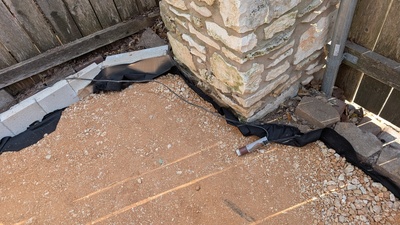
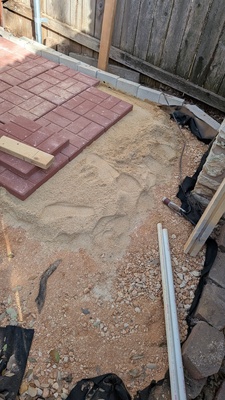
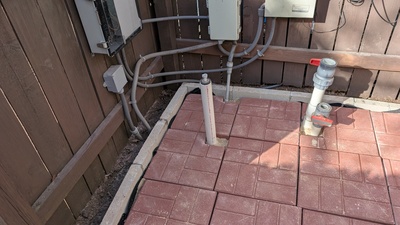
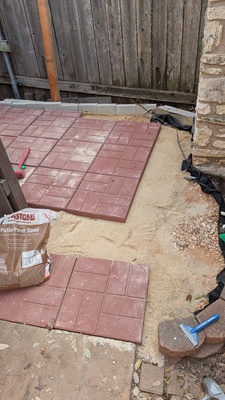
This followed the standard steps for pavers: layer of fabric, 2 inches of gravel base, compact, 2 more inches of base and compact again, 1 inch sand, level sand, place pavers then add polymeric sand in joints.
One thing new I learned is that the landscape fabric I used in previuous projects, which is what is readily available in big box hardware stores, is not a good idea to use for pavers. A non-woven, geotextile fabric is far better, but a bit more costly.
I am not keen on the paver base I get from Home Depot. It is often too sandy or too rocky depending on the bag. However, it is cheap and they deliver, so I have always used it.
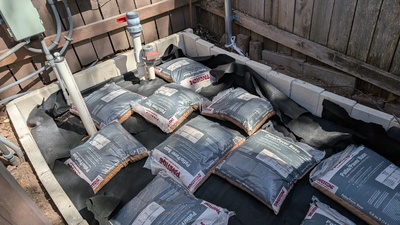
Paver base bags in place
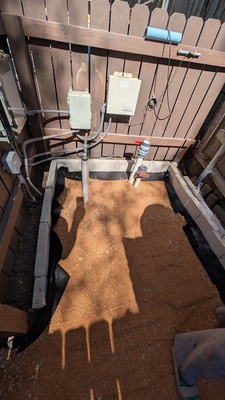
Paver base finished
Paver base finished (alt)
This was the first time I successfully used the PVC pipe and screed to get a uniform one inche layer of sand. It only worked for the big areas though.
Sand and pavers in progress
Pavers in place
Pavers in progress
Due to all the obstacles and challenges of building the sunken retaining wall, I wound up with the two side wall being slightly curved. I had only noticed that after it was mostly done and I had no motivation to dig it up and straighten it. The price to be paid for those mistakes and that decision came now. The paver stones themselves are stubbornly linear. I had to carefully manage gaps and custom cut pieces to match the uneven sides.
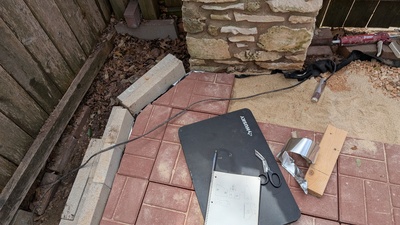
Pavers in southeast corner
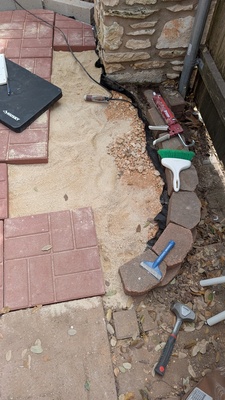
Sand and pavers near small wall
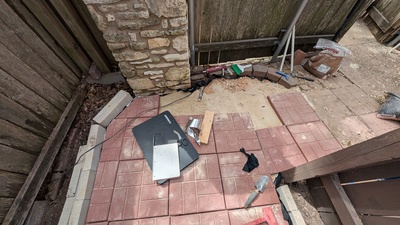
Pavers in south area
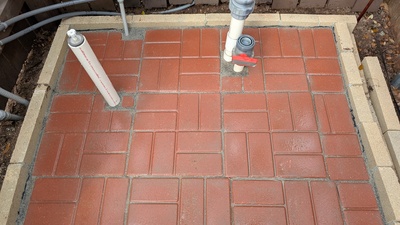
The biggest paver lesson I learned during this project was using polymeric sand. In all the previous paver projects I did, when they said to put sand in the cracks between the pavers, I assumed it was the same sand the pavers lay on. I think that is OK and can work, but that sand will wash away over time and need replacing. This time, I ran across the mention of polymeric sand between the pavers. It was a revelation. It fills the cracks better, you then lightly wet it, and it semi-hardens so it does not wash out.
Pavers completed (alt)
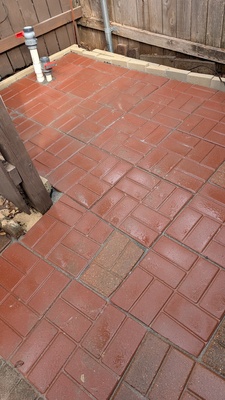
Polymeric sand wetted
Pavers completed (closeup)
I hate digging, so for me, the hardest part of the project was done. The rest would be far more interesting and less physically demanding.
New Equipment Layout
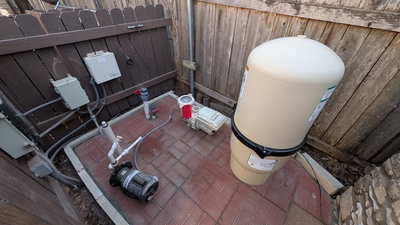
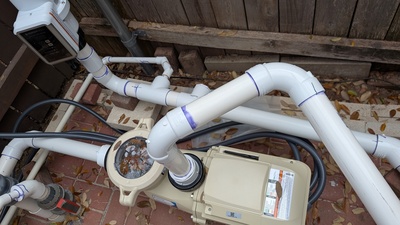
After the new equipment being in my garage for two weeks, I was excited to move them to their new home. I had abandoned my original layout which had simpler plumbing, but created more obstacles. I came up with a new plan that made moving around and access easier, but resulted in slightly more convoluted routing of pipes. The main constraining complication in the layout was the pump. You need to have a straight run of at least 12 inches of suction line. You need to access the front of the pump frequently to empty the basket. You needed to access the pumps back end as that is where the control panel is. Then the return line from the pump need to run to the filter in a way where that pipe is not obstructing pump access nor access to any of the other equipment.
Initial equipment layout
Filter label
Filter label (in new pad area)
New Plumbing
I approached the plumbing in sections following the flow. I started with the pipes from the suction line to the pump intake. I also used sweep 90 degree elbows and 45 degree elbows exclusively. These are better for water flow. I could only find these locally at a wholesale pool supply place, but luckily they were willing to work with my idea that I just entered the pool business.
For the main main suction line valve, I opted for a high-end union valve. If this valve ever has a problem like the old one, I can simply rebuild it with new gaskets/ball without needing to cut pipes and redo plumbing.
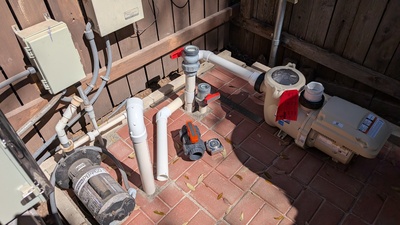
Suction line positioning
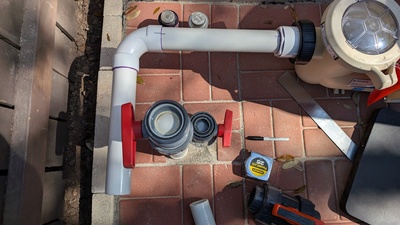
Suction line behind return lines
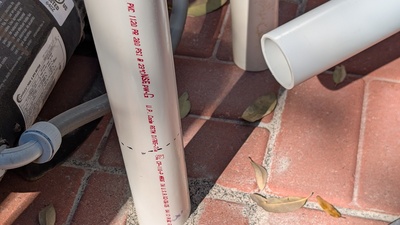
Suction line riser dotted cut line
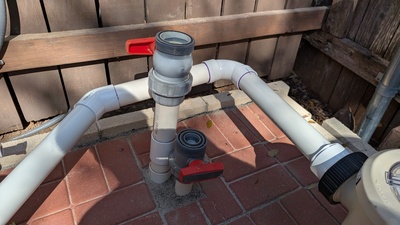
Suction line glue in progress
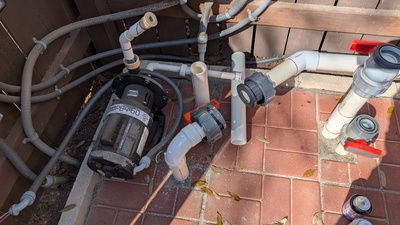
Main suction union valve installed
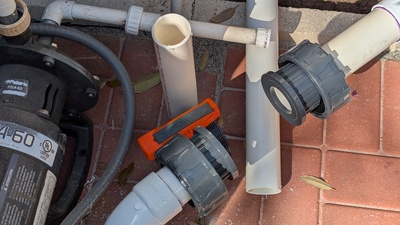
Main suction union valve closeup
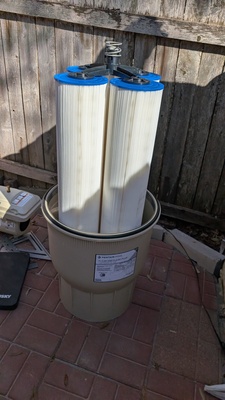
New filter insides
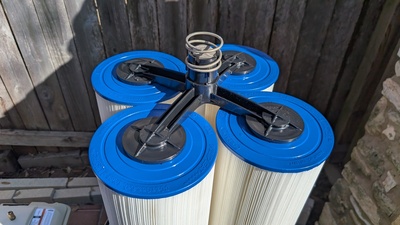
New filters top
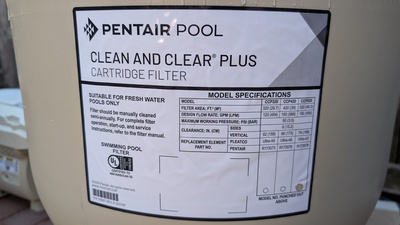
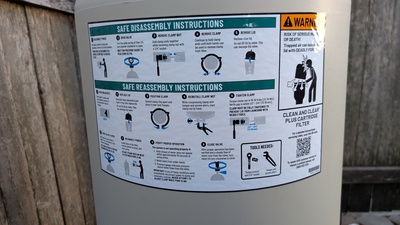
Cleaning the filters is hopefully a once or twice a year event at most. I wanted to open up the filtrer to both have alook inside and make sure I understood the process for opening and closing the filter. Four very large filters that need hosing out every 6 to 12 months. Should last many years.
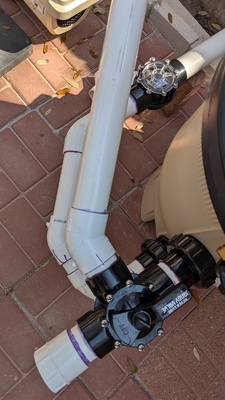
3-way valve - top view
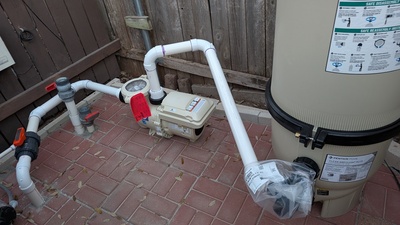
Pump to Filter line installed
Next was the pipe from the pump output into the filter. This needed a 3-way valve so that I could use the pump to drain the pool out to the street. When we get a lot of rain, the pool can overflow which is no good for the coping and deck, so to lower the water level, I want to be able to turn on the pump and divert the water to a hose that runs to the street/sewer. No need for this water to flow through the filter, so this valve is placed between the pump and filter.
Next up was the small section that goes from the filter output to the back side of the pool pad. The return pipe run on the back side of the pool pad, behind the pump, has a lot going on (see below). This small section was need to get the filter output pipe running to that area, but also including a check valve to prevent the flow going backwards through the filter or through the pump, both of which would be undesirable. My pool pad is below the pool's water line, so back-flows are a real danger. As with the 3-way valve, the check valve needed to be disassembled before gluing in the pipe. You want to avoid glue getting on the moving parts, so you take the moving parts out.
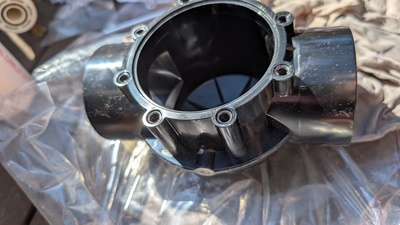
Check valve disassembled
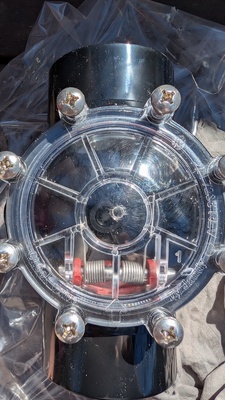
Check valve closeup
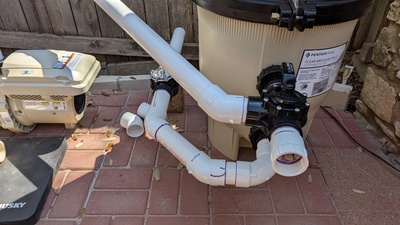
Check valve installed
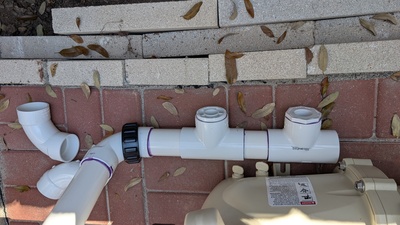
Booster and bonding tees assembly
From the filter (after the check valve) the flow goes into the new SWG and then returns to the pool. However, there are two additional things that need to happen before the SWG (along this back pipe run). The first is a tee junction that will have a screw-in chunk of brass that will be used for the electrical bonding: this will bond the water itself.
After the water bonding fitting is another tee junction, this one is the branch off to power the vacuum's booster pump. You want this to branch off before the SWG so you are not sending just produced high chlorine concentrations into the booster pump's mechanicals.
After those two tees, the main line goes to the SWG. The manual says that it is better to install the SWG cell/unit vertically. I can do that. It also says to have 18 inches of straight run before the SWG so its sensor can see a clean flow of water. I can do that too, though this leads to a fairly high run of pipe. I plumbed it according to these recommendations and almost immediately regret it.
The SWG is heavy and woulds be awkward to use for laying out the plumbing. I had bought a custom spacer that is the same length as the SWG and with the same union connections. It was mainly for being able to run the system in case you need to remove the SWG for maintenance, but it was worth the price just for its help in allowing me to place it for plumbing measurements.
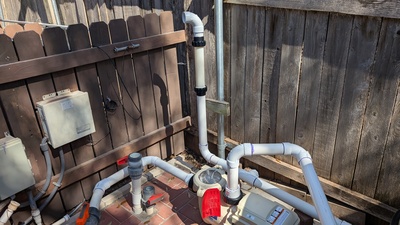
Filter to SWG line installed
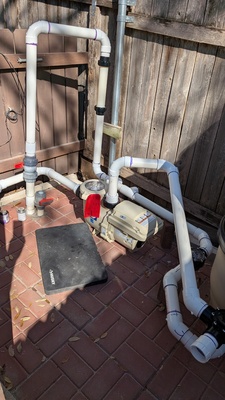
SWG spacer and SWG to return line
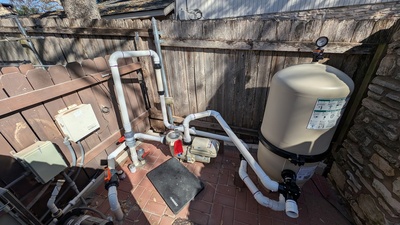
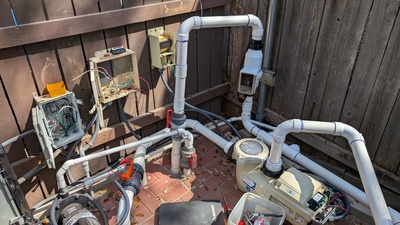
Main lines finished
Now I had the entire main flow plumbed: from suction line to return line. The last thing was adding the pipes from the tee coupling to the booster pump. This uses only 3/4 inch pipe (rest is 2 inch) so it is a lot easier and straightforward to do that.
Reducing SWG Pipe Height
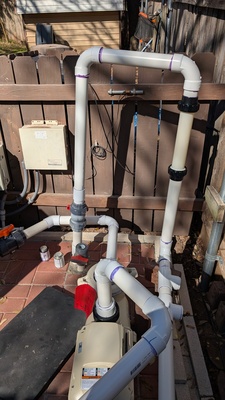
Riser for SWG (too tall)
At the end of plumbing day, I had everything glued up, but I hated it. Rather, I hated the monstrosity that was the four foot high tower of pipes needed for the SWG. The SWG itself is about 20 inches, so add 18 inches of required run-up to that, plus the space needed for the elbows and ground clearance, and you wind up with the pipe run that needs to extend over four feet high. This had three issues: 1) It was wasteful in having all that pipe (and the implied flow impedance) going up, just to come back down. 2) It just plain looked ugly; 3) It rose above the 4 foot pool pad fence whose job is to visually hide the pool equipment.
That night I did further research about the real need for the 18 inch straight run into the SWG. I saw pictures of many installations, none of which had that amount of leading pipe run and all working perfectly fine. I found out that the recommended range is 12 to 18 inches, and that those represent worst case. The fact that I was using a sweep 90 degree turn meant that I was in much better shape and could reduce the run out needs. I decided that 6 inches would be more than enough and it would bring down the height considerably.
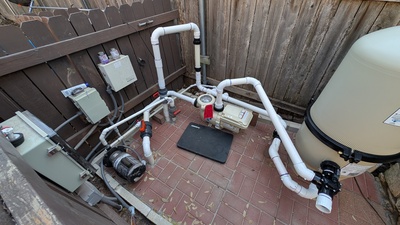
Riser for SWG reduced
The next day, I went about reducing the height of this SWG pipe stack. I hurt me to be cutting into the work I did the day before and adding patch couplers to my beautiful, new, clean plumbing job. But that pain was less than having to live with that piping monstrosity.
SWG Install
I would not need the SWG for at least a week. I had raised the chlorine level fairly high to buy myself some time while I had no working pump and you need to wait for it to come back in range before turning on the SWG. Also, I needed to add 4.5 bags of salt to the pool and give it a couple days to mix evenly.
I was now ready to open the valves and check for leaks. This would just be static pressure leak testing since I did not have the pump's electric wired yet. However, if I did the leak check with the SWG spacer in place, I would need to drain the system to put in the SWG later. Thus, even though I would not be using the SWG right away, I wanted to install it now and make it part of the leak testing.
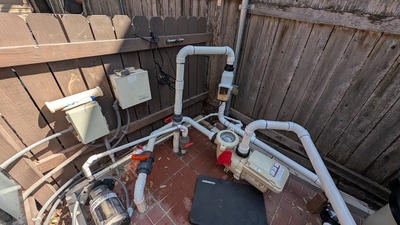
SWG cell installed
SWG cell closeup
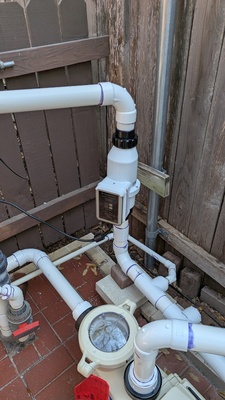
SWG and Pump
Equipment Electrical Hookup
I was still waiting on the electrician to return to add the new pump circuit, but I figured I could wire up everything else and just leave the wire pigtail in the area where the new sub-panel was going. There was a fair amount of wiring work to be done.
I bought the pump version that contains an I/O board with two relay controls. One is a 5 amp circuit for controlling things like my SWG. The other is a 15 amp circuit for controlling things like my (beefy) vacuum booster pump. Thus the main power comes into the pump, then power comes out of those relay connections to power the SWG and booster pump.
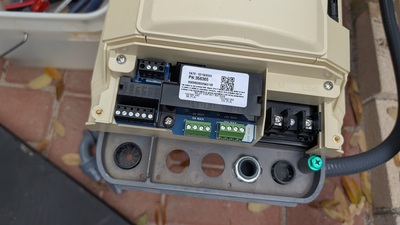
Pump electrical connection area
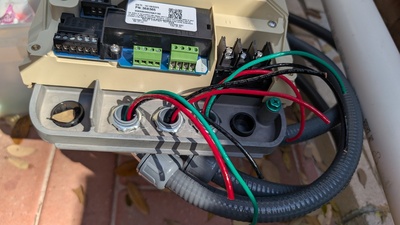
Booster and SWG lines for pump relays
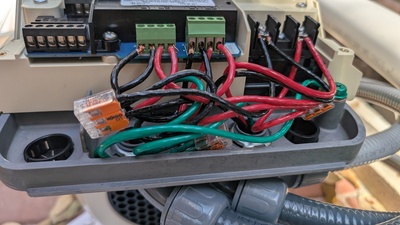
Pump connections (alt)
SWG Electrical
SWG Transformer closeup
The line from the pump to the SWG does not run to the SWG cell that is in the plumbing. The SWG has a transformer that is quite heavy and that is generating the necessary voltage used in its electrolysis process. That transformer is wall/fence mounted and takes the electric lines. The SWG cell has a special wired that also goes to that transformer box.
Booster Pump Electrical
Box for booster contactor (from relay)
The high amperage relay line from the new pump to the old booster pump also does not go direct. It could do this, but that means that when the booster pump (violently) starts, that surge and electrical stress is passing through that relay board and the new pump's electronics. Even though it was designed for this, and will work, over time that extra stress will add up. The better way to do this is to use a contactor (beefy relay). The new pump is then just serving as a low amperage control signal and the main amperage and strain is handled by the contactor. Thus, the pump's high amperage relay goes to a fence mounted box with a contactor instead of directly to the pump.
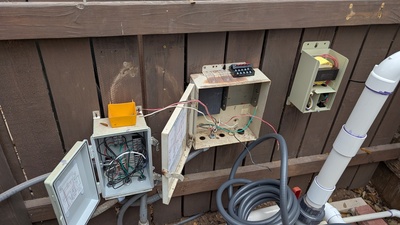
SWG Transformer and Electrical Boxes
All wires routed in flexible conduit
Pump wire routing closeup
Electric Epiphany
As I was working on the electrical hookups, it occurred to me that I did not have to wait for the electrician to see if the new pump worked, if anything leaked under pressure, or to add the salt to the water. I already have the original 230V circuit (which will continued to be used by the booster pump). Without GFCI, it was just slightly more dangerous to use the old circuit. Without the surge protection, there as a little more risk. With no electrical storms in the forecast, the risk of using the old circuit was minimal and the benefit of getting on with it was high. I just needed to make some easy to add/remove jumpers so that the swap to the new circuit would be easy.
Redo Pavers from Electrical Line
When I did the digging to locate where the new electric circuit wires were getting hung up, it was in an area adjacent to the pool pad. This area already had pavers from the Side Paving Stones Project some of which I had dug up. Now was the time to redo those pavers and it also provided a way for me to add thje polymeric sand to that area as well.
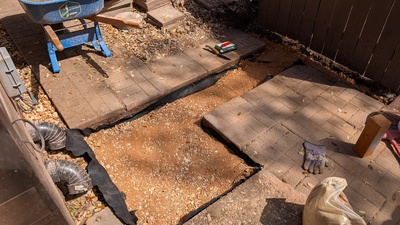
Paver base down in existing paver area
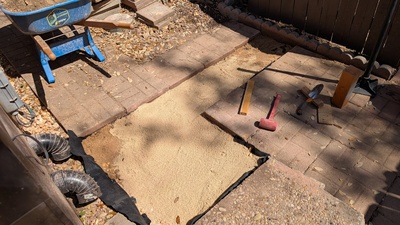
Sand down in existing paver area
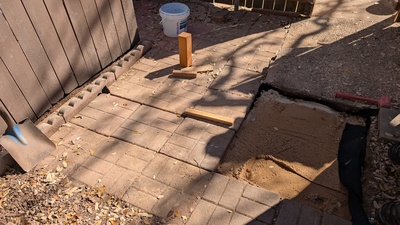
First pavers in place
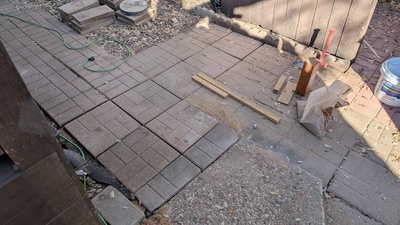
All pavers installed
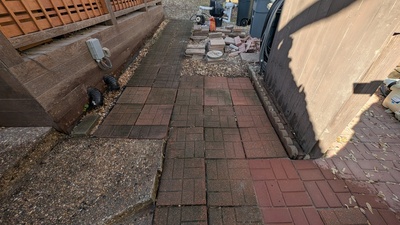
All pavers installed (north view)
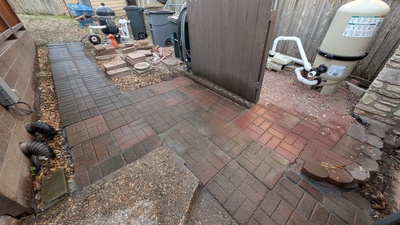
Polymeric sand added
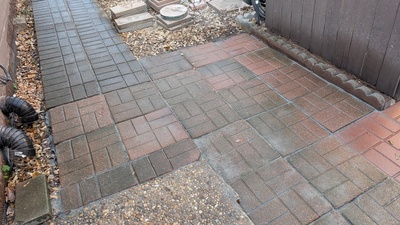
Finished walkway pavers
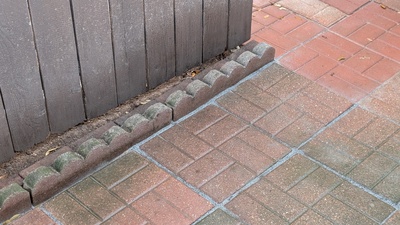
Finished walkway pavers (closeup)
Adding Equipment Shade Tarp
PVC becomes brittle over time, more so when exposed to UV light. Direct sunlight is harsh on most things, including the pool equipment. As some cheap insurance, I decided to add a sun shade to the pool pad area. I wanted something that was easy to take off and put on and used some bungee like cord (UV rated) and a tarp with screw hooks. I borrowed this idea from my previous Pool Chlorinator Project. Though that project was a failure in producing chlorine reliably, the tarp scheme I designed for it was a good one.
Equipment tarp retracted
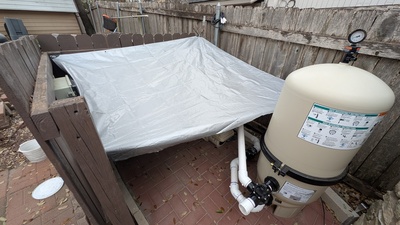
Equipment tarp deployed
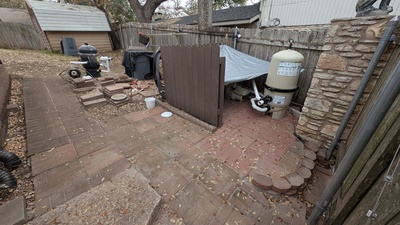
Equipment tarp (wide view)
New Electric Service
The electrician did finally show up and complete the job. Installed a subpanel, a GFCI breaker and the special surge protector I had bought.
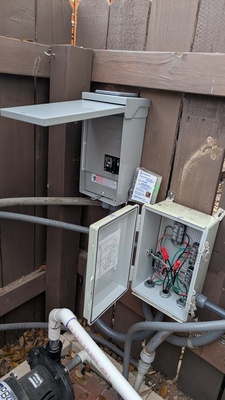
New subpanel and GFCI breaker
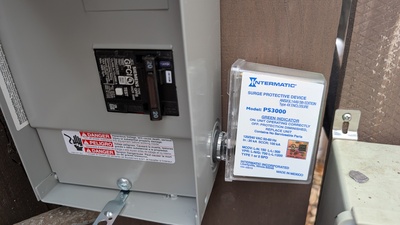
New subpanel and surge protector
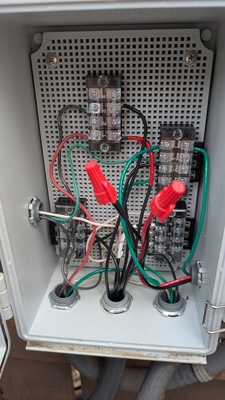
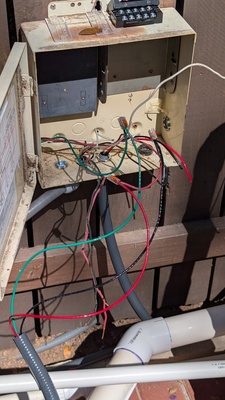
Pool pad main junction box
Electrical Bonding
Last major build step was adding the electrical bonding. Since no one was swimming in the pool yet (too cold), there was zero risk in it not being bonded for the few days I was running the new equipment.
Electrical bonding parts
The proper design for this has a single uninterrupted main "bonding trunk" made of #8 AWG solid copper wire. All equipment is then a branch off that trunk. I had to not only bond all the equipment in the pool pad area, but the two metal hand rails and the metal post light by the pool. My pool pad is over 50 feet from my pool, so this meant buying 100 feet of #8 AWG wire.
Worst of all: more digging. I couldn't just lay a wire on the ground without it being a trip hazard, or fodder for a lawn mower. Luckily, the electric code allows the copper bonding wire to be direct buried and it does not have to be buried very deep. Even though I did not use any conduit (PVC pipe) it was recommended to put conduit around it at the points where it enters the ground. This makes it more obvious where it transitions underground and protects it from predators such as a weed whacker.
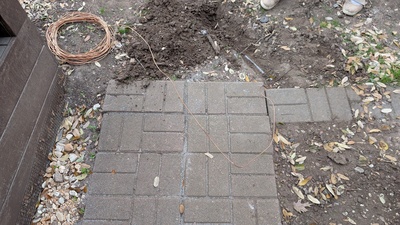
Running bonding trunk to pool
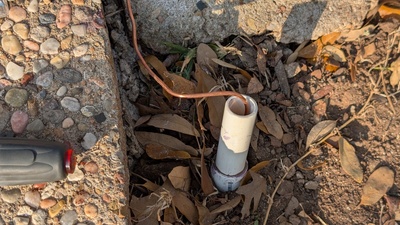
Bonding trunk emerging from ground
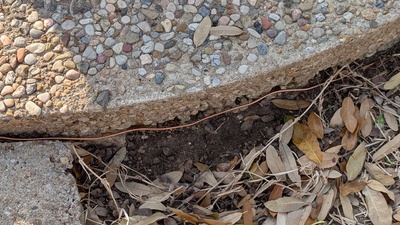
Bonding trunk running along deck
Once the bonding trunk was in place, it was time to add all the branches to the equipment. This started with the special water bonding part we plumbed into the flow line. Modern pools bond the water more directly as part of the installation process and walls/rebar of the pool, but when you lack that deep infrastructure connection, bonding the water through this metal piece embedded in the plumbing is acceptable.
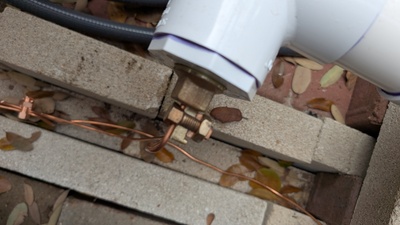
Water bonding closeup
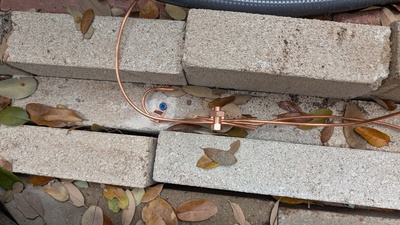
Bonding anchor and split nut
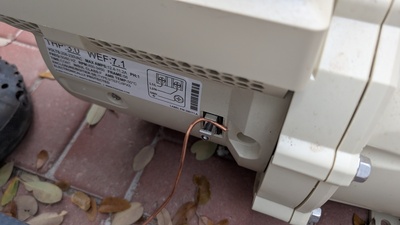
Pool pump bonding connection
I also bought some anchors to hold the bonding trunk in place around the perimeter of the pool pad. Generally, it is better if it does not just lay there freely.
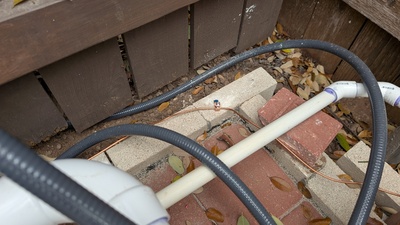
Bonding trunk anchored in corner
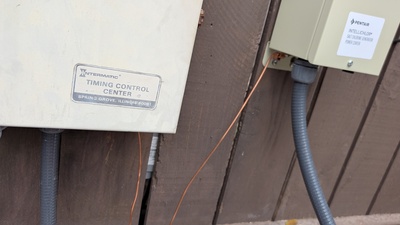
Electric box bonding connections
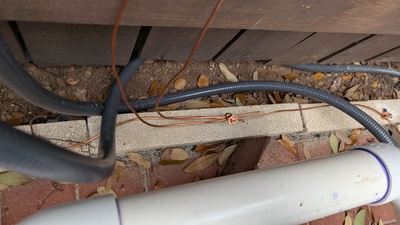
Bonding t runkk anchored to sunken wall
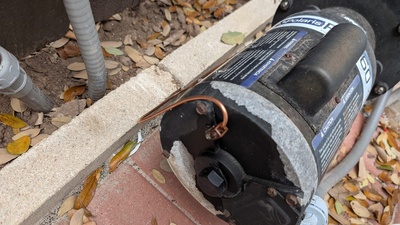
Booster pump bonding connection
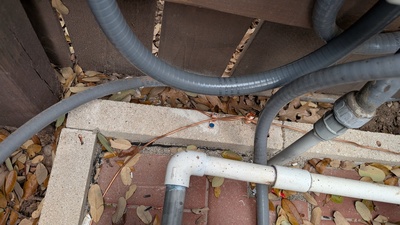
Bonding trunk leaving pad area
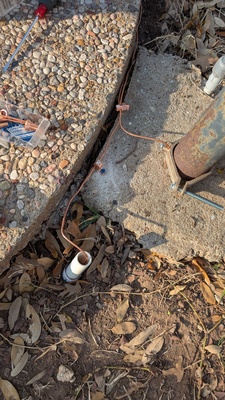
Post light bonding
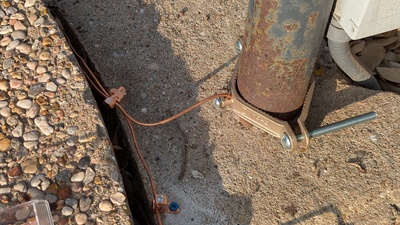
Post light bonding connection
Next in line was out by the pool itself. There is a metal post light that is next to the pool decking. It is close enough to need bonding.
Handrail Bonding
The most complicated and dreaded part of bonding was the two metal hand rails. First, it was these pieces that required the digging to get the bonding trunk from the pool pad to the pool itself (I hate digging). Second, the branch bonding wire needed to traverse the pool deck which meant either a trip hazard (unacceptable) or cutting a slot into the deck (undesirable). Third, the proper clamps to connect the wire to the rails is bulky and jagged, so a risk of pain or cuts on your feet as you walk the pool deck of use the ladder (unacceptable).
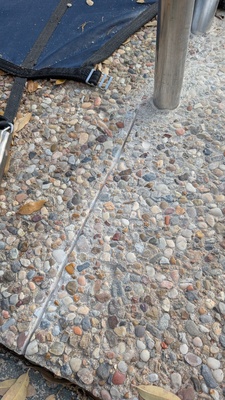
Cut channel in deck for bonding wire
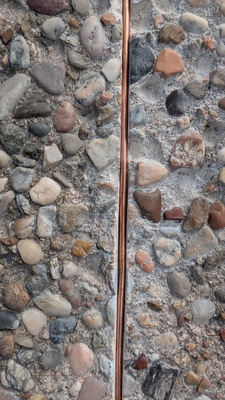
Bonding wire and deck channel closeup
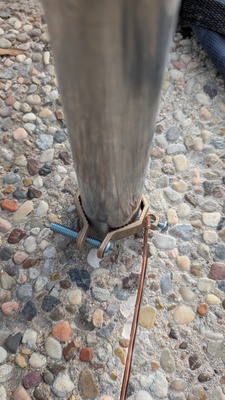
Rail bonding clamp closeup
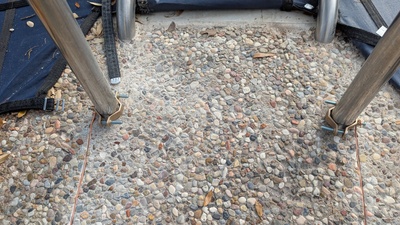
Both rails bonded
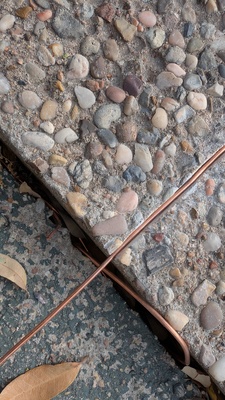
Rail bonding wire and trunk
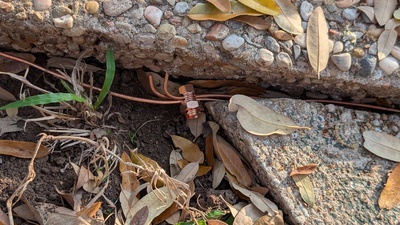
Rail bonding wire trunk tie in
Bonding the rails was just half the problem. I labored on trying to design a way to cover the rail clamps (where I learned the new vocabulary word "escutcheon"). There was no off-the-shelf escutcheon that would fit over the clamps, they were all too shallow (and often stupid expensive). I would have to custom make something out of PVC. I went to Home Depot looking for some parts to make some Frankenstein escutcheon I designed, but then I spotted a beautiful sight. The 4 inch to 2 inch PVC reducer bushing seemed like it would be the perfect solution. I carefully checked its measurements to what I needed, and it worked. I would need to cut it in half to put on since the rails are cemented into the deck, but other than one cut and gluing back together, none of the complicated forming I planned was needed.
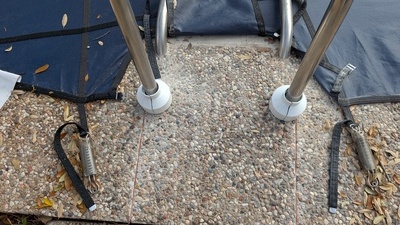
Rail escutcheons to hide clamps
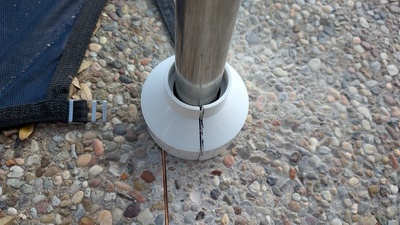
Rail escutcheon closeup
SWG Calibration
I estimated I needed to add 4.5 bags of salt (40 lbs. each) to get the salt to the ideal 3,600 ppm level (it started at 2,400 ppm). I first added 3 bags, mixed it and waited 24 hours. I wanted to verify that 3 bags had the predicted effect since that prediction is the same calculation that said 4.5 bags was needed. It checked out, so I added the remaining 1.5 bags, mixed and waited 24 hours again. Final salt level was right in range.
Now I just needed to wait a couple days for the chlorine level to drop to normal range so I could plug in the SWG and begin to calibrate. There's really two control knobs you have for the SWG: how long you set the pump to run the SWG and on the SWG itself, a percentage setting. The SWG percentage setting (I learned) is not adjusting the magnitude of the electrolysis process, though it gives that impression. The SWG cell either has voltage or it does not: there is no varying of voltage. All the SWG does with the percentage is cycle it on and off at intervals.
I decided that I would set the pump to run the SWG 16 hours a day. I would do that all year long. Then I only had to worry about a single setting: SWG percentage. The chlorine need will change with the seasons, and there is no feedback loop so you need to manually change the percentage as the seasons change.
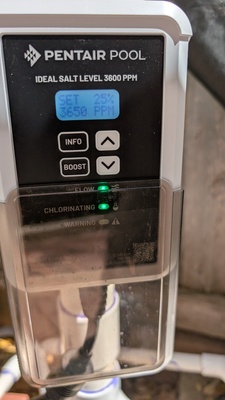
Initial SWG setting and panel
When the moment of truth came to turn on thew SWG for the first time, it's estimate of the salt level was the ideal 3,600 ppm. Nice. I now needed to calibrate it by measuring the chlorine each day as I adjusted the percentage. In the March time-frame, I quickly honed in on it needed 35 percent to maintain the right chlorine level. I should be able to get away with checking chlorine much less often once I know the ranges I need. The SWG system seemed to be working well and behaved very predictably when I adjusted then settings. Now we wait and see how this works over the course of years.
Breaker Issues
In the first two weeks of running the pump, the GFCI breaker tripped twice, both times for no apparent reason. This caused me to look more closely at the model installed and I found it was the wrong one. GFCI breakers are generally sensitive and subject to nuisance trips. The pump I bought also generates a lot of RF that caused run-of-the-mill GFCI breakers to nuisance trip. The pump's manual acknowledges this and explicitly recommends a model that provided better RF shielding. That was the model number I sent the electrician, but the wrong one was installed.
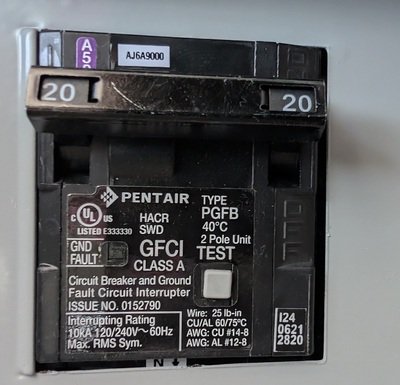
Right GFCI Breaker
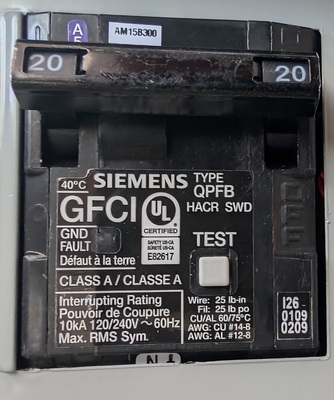
Wrong GFCI Breaker
I then went to try to buy the right breaker myself and it was a confusing mess. There are many similar model numbers, model number schemes and they often change numbering schemes. Finding the right one is tricky, finding the right one in stock even trickier, and finding the right one for a reasonable price impossible. Even when I successfully navigated that gauntlet and ordered it on Amazon, what showed up was the wrong breaker. The model on the packing slip and invoice was right, but the model on the package was different. It was curiously the exact same model and box as the one the electrician installed. So they may have ordered the right part from Amazon too, but wound up with the same wrong part like I did, but failed to look close enough.
I was trying to avoid the expensive Pentair branded GFCI breaker as that costs a premium. That is actually what the manual recommends (no surprises). This is just a re-branded Siemens breaker. However, with all the confusion around the Siemens model number, I broke down and bought the Pentair version due to the unambiguous model numbering. Getting the electrician back to install it was yet another waiting game.