 Cassandra.org
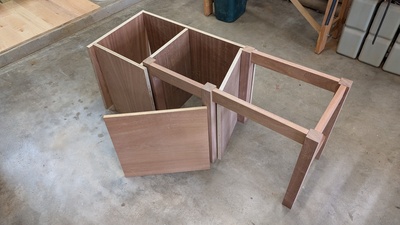
In Progress
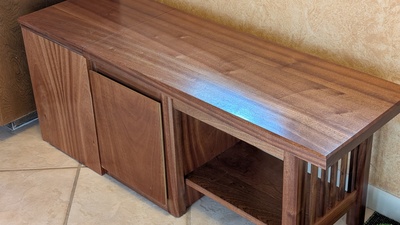
Finished
Background
The side door by our kitchen is the most frequently used door in our house. It is used to access the back yard and is closest to the driveway area where I park my car. Our garbage and recycle bins are also closest to this door.
Inside, by this door we had the following:
- A door mat.
- Footwear (to slip on for going outside).
- A metal trash can (for recycling items staged for the big bin outside).
- A small ottoman (seat for putting on footware).
This area had all sorts of problems:
- The shoes are often scattered and a trip hazard.
- The recycle can is janky in operation and too small for many commonly used things.
- Larger recycle items pile up outside the can because they do not fit, e.g., boxes, empty milk containers.
- The ottoman is meant as a seat for putting on shoes, but is uncomfortably low for someone with bad knees. More importantly, it is usually not available because it is occupied by stuff that does not fit into the recycling bin.
In short: the area is often a disorganized mess.
Last year I started getting better about monitoring our pool chemicals. I bought a new test kit that I needs frequent access, and needed a home for it that was easy to access but out of sight.
With all those problems swirling around in my head, I came up with the idea of building a multi-purpose bench for that area.
The requirements were:
- A place to put the shoes.
- A place to sit to put on the shoes.
- A cabinet for the pool water test kit.
- A place for a recycle bin.
- A place for larger recycle items.
There were constraints though.
- The shoes need to be easy to access, else no one will bother putting them away.
- For years I have wanted a larger recycle bin, but was met with some resistance due to the unsightly look and desire not to accumulate too many things inside. Negotiations netted allowing a slightly larger recycle bin, but it has to be hidden (i.e., enclosed with a top that closes).
- The larger recycle items that still do not fit and pile up need to pile up in a way that still allows using the bench as a seat for putting on shoes.
- The bench cannot be too big and must allow enough free space around the door for a floor mat.
- The bench had to look nice and somewhat match existing furniture.
Design
I used the 3D modeling software Blender to work out the design and dimensions.
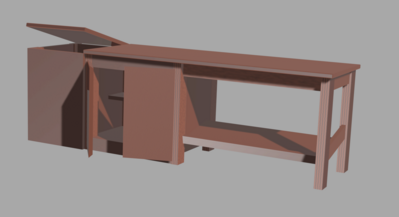
Model render from right
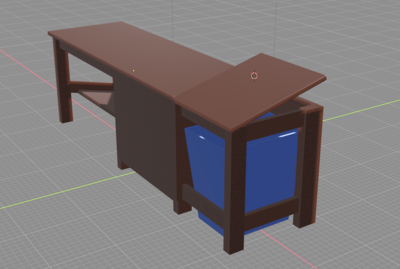
Model render from rear left
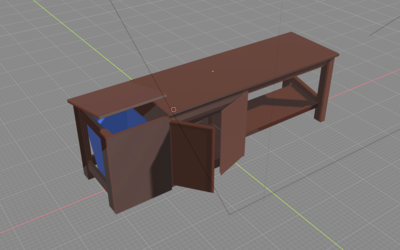
Model render from upper left
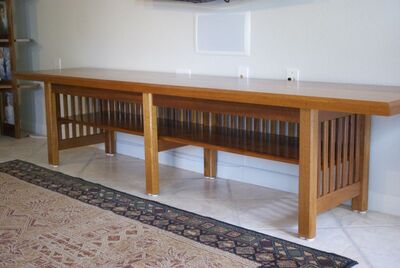
Previous Bench Project
This original design shows a bench longer than the final result, with the recycle bin section open on the sides and the back and the cabinet is bigger with two doors. These would also be revised as the constraint about allowing more open space around the door and room of the door mat came after this initial design. Still, this design was good enough to allow me to give me confidence that I was understood how to build it.
As far as the design of the structure, joinery and overall visual appearance, I based this on the existing benches we have near the kitchen area from the Long Benches Project.
After maping out the parts and their sizes, I took a trip to the local lumberyard to buy the mahogany wood.
Cutting: Legs and Rails
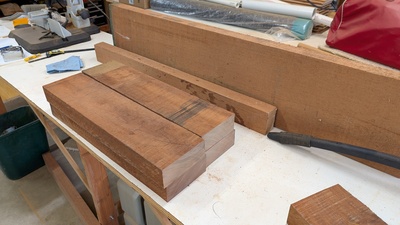
Raw mahogany pieces
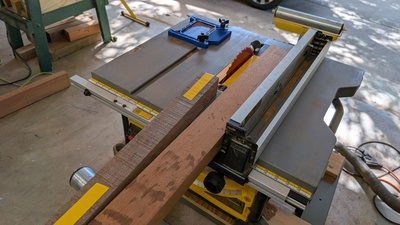
Cutting bench legs
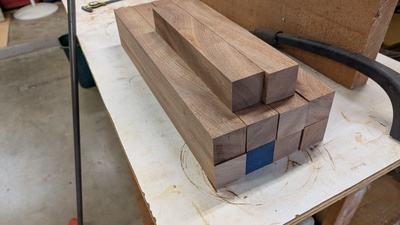
Bench legs after rough cutting
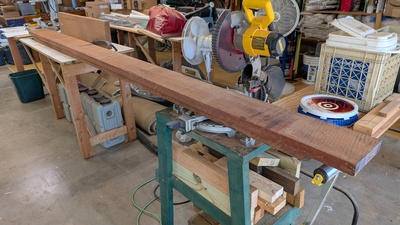
Cutting rough mahogany boards
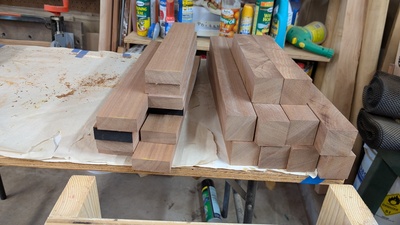
Legs and cross-rails for bench
Cutting: Bench Top and Shelf
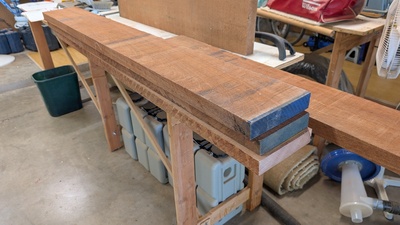
Rough cut for bench top pieces
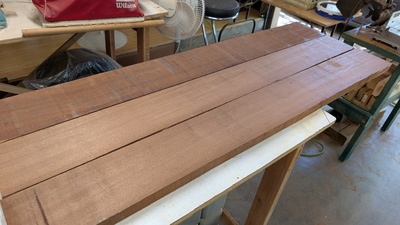
Bench top pieces before planing
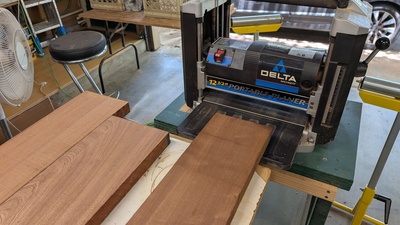
Planing the bench top pieces
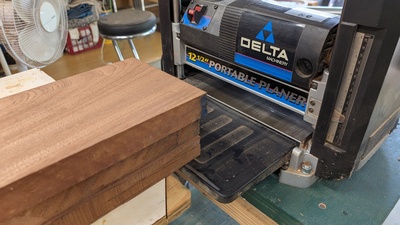
Planer and top pieces closeup
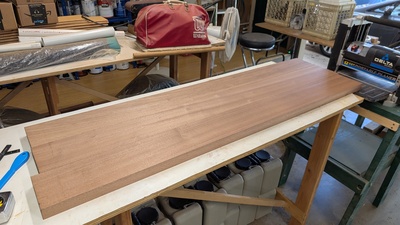
Bench top pieces after planing
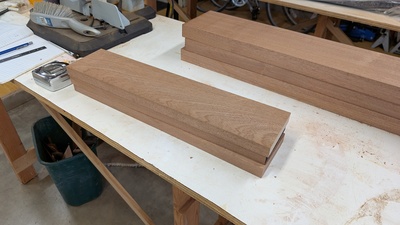
Lower shelf pieces
Joinery: Bench Top and Shelf
I needed to butt join two pieces for the bench top and main shoe shelf given the widths needed. I used biscuits to both help align the parts while gluing and to add more strength the the joint.
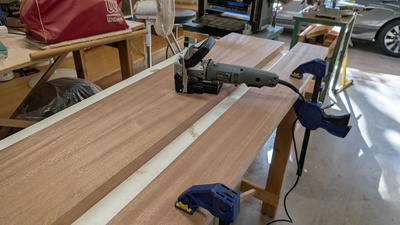
Adding biscuit slots to top pieces
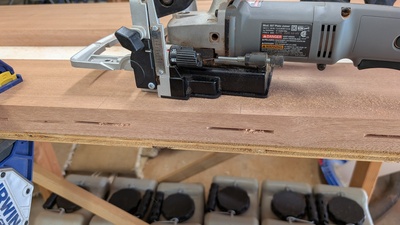
Biscuit slots
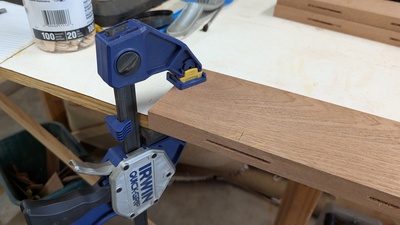
Biscuit slot closeup
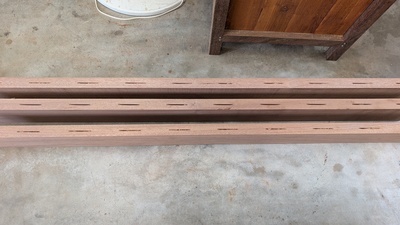
All top pieces with biscuit slots
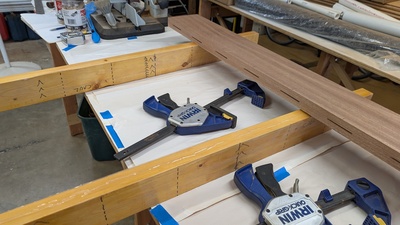
Setting up top butt gluing
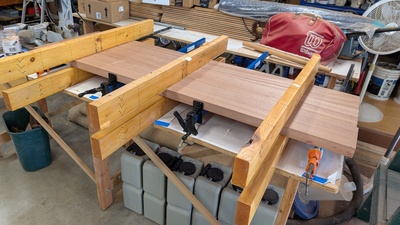
Top gluing setup alignment
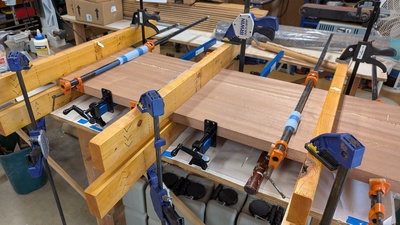
Top clamping after gluing
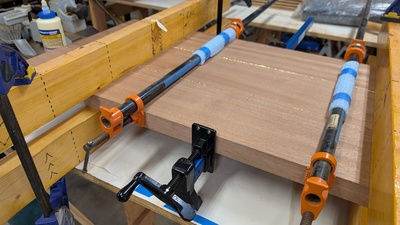
Glued top closeup
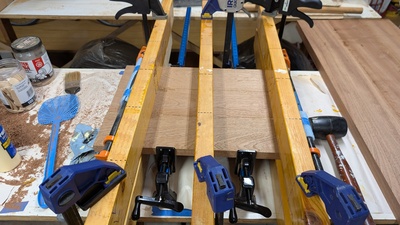
Butt gluing pieces for lower shelf
Joinery: Legs and Rails
I'd use mortise and tenon joinery for the legs and rails: same as on the previous Long Benches Project. Given the bench consisted or three different functional sections, each with slightly different geometry, I marked them to ensure I did not confuse myself.
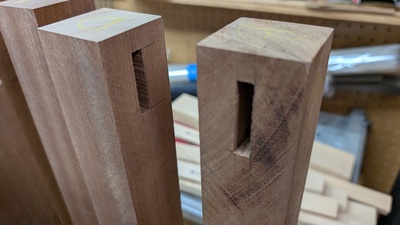
Leg mortises closeup
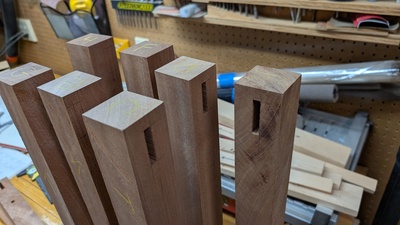
All legs and motises
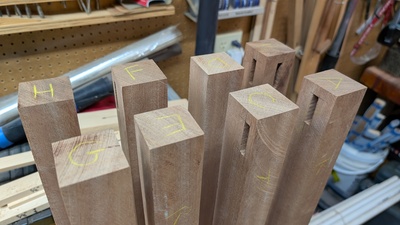
Marking legs for those position
Sides and Cabinet Bottom
The sides and cabinet bottoms were wide enough that single solid mahogany pieces would likely not be available, but even if they were, they would be very expensive. The top and shelf parts were butt joined from narrower pieces for this reason. While I could have done more butt joints to make the sides as wide as I needed, the simpler and more economical solution was to use plywood with mahogany outer layers. The plywood edges would be the most unsightly thing, but for the most part, the edges would all be hidden. For the few edges that would be exposed to view, I would add some mahogany banding.
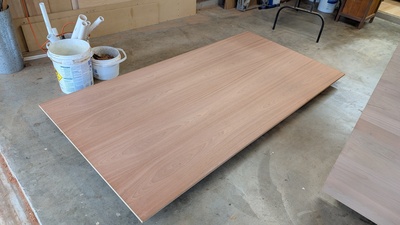
Full sheet of mahogany plywood
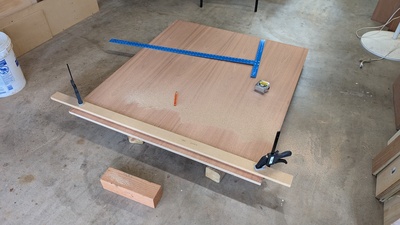
Cutting mahogany plywood
Initial Dry Fitting
At this point I had all the pieces cut to the near final dimensions based on my drawings and calculations. It was time to sanity check all this by doing a simple dry-fitting. This also allowed me to double check the dimensions and exact places where the sides would join as cutting the dado slots for the sides would be the next operation.
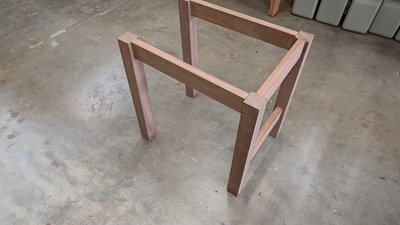
Dry fit partial assembly of frame
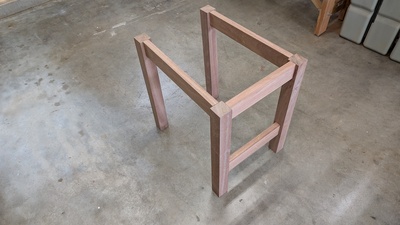
Dry fit partial assembly of frame (alt)
Full frame dry fit assembly
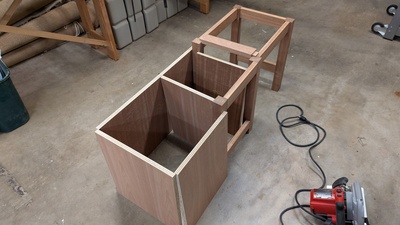
Full frame dry fit
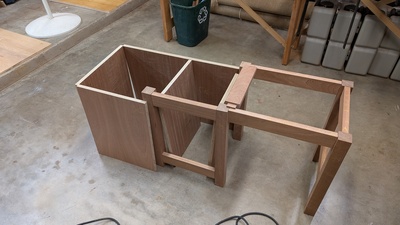
Full frame dry fit (alt)
Joinery: Sides
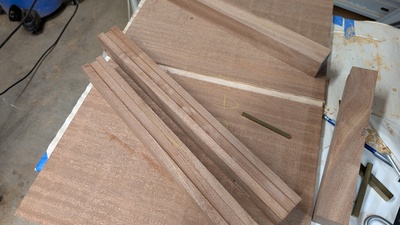
Dado slots on legs for plywood sides
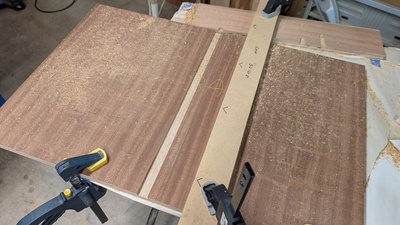
Cutting dado slot for shelf
The sides would be joined (mostly) by gluing the edges into dado slots. It turned out that I needed an extra inche depth for the recycle bin and that resulted in my altering a couple places where the front and back panels are glued to the outside of the legs instead of in a dado channel.
The initial dry fitting was not a complete one as it was before these side dado slots, so things did not exactly align and it was more like a house of cards. Now that the dado slots were cut, I could do the full dry fit which would be stable enough to lay the top pieces for the first overall view of what the bench would look like.
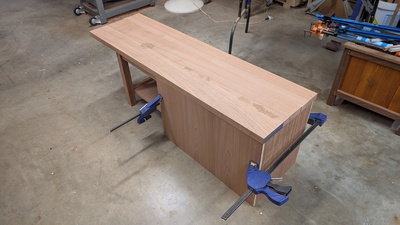
Bench dry fit (reverse view)
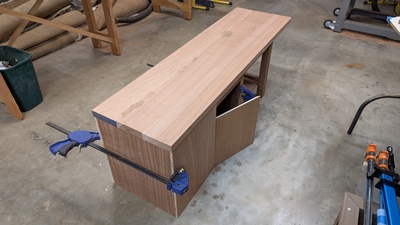
Bench dry fit (left side view)
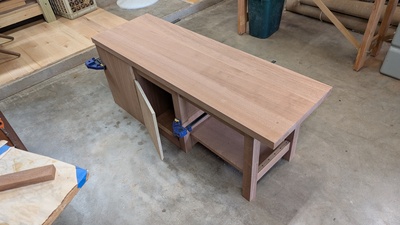
Bench dry fit (right side view)
Slats
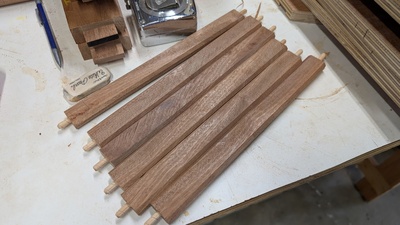
Decorative slats
The open end of the bench with the shoe shelf would add a series of slats for decorative purposes. This was the match the previous Long Benches Project which in turn was inspired by some of Frank Lloyd Wright's furniture pieces.
Refinements
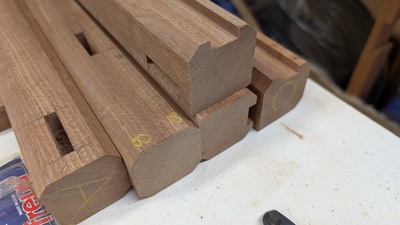
Leg bevels closeup
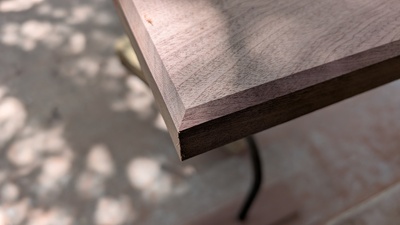
Top bevel closeup
The style motif of the bench would be to use bevels as the way to remove the rough, blocky look.
Sanding
Not the fun part of this project.
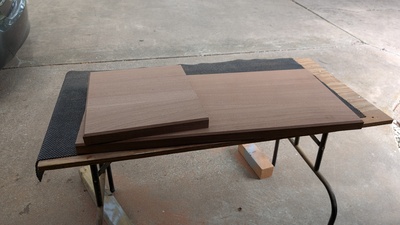
Bench top parts
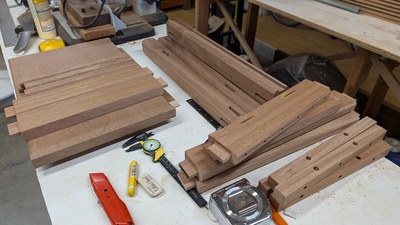
Legs and rails
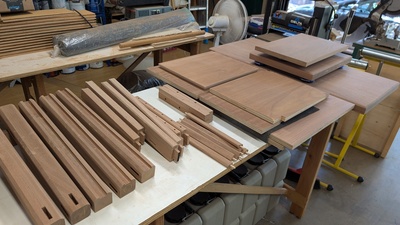
All bench parts
Finishing
This is the point of the project where I need to find enough table space to lay all each part individually so that I can apply the finish, which would be polyurethane in this case. Because I was adding the finish before gluing, I needed to mask off all the surfaces that would be glued.
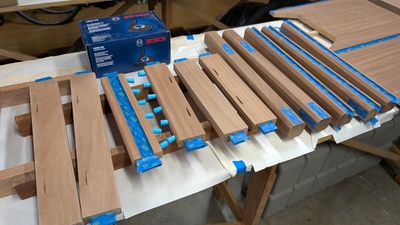
Masking legs and rails
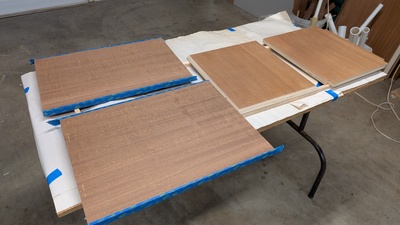
Masking sides
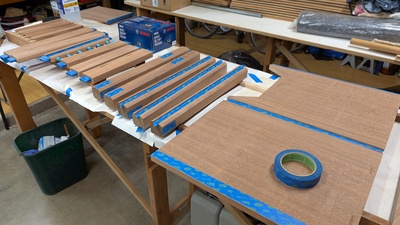
All masked parts
I would be applying three coats of polyurethane, with some sanding between the coats. The first coat goes on a little heavy as the main purpose of that is to soak into the wood and seal it. This can leave drips and always leaves a rough surface as the wood fibers soak up the finish and often detach and stick up. Thus, I need to sand and scrape off excess a little more aggressively than after the other coats.
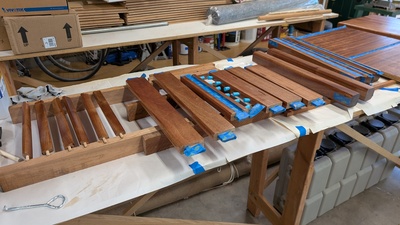
Parts after first polyurethane coat
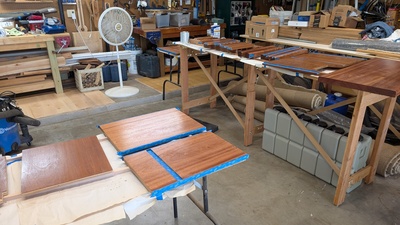
All parts after first polyurethane coat
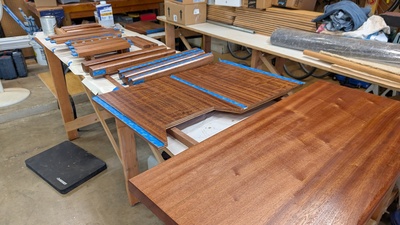
Parts after second polyurethane coat
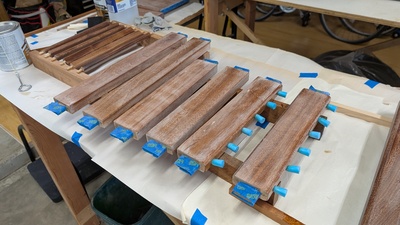
Parts sanded between polyurethane coats
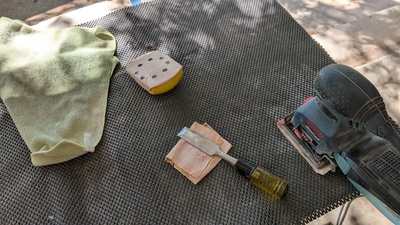
Between coats sanding setup
Subsequent coats go on more carefully and lighter. Note that for areas that cannot be seen, I usually stop after two coats. That is sufficient for sealing the wood and the finish is passable. It takes at least three coats for the finish to really look nice and smooth.
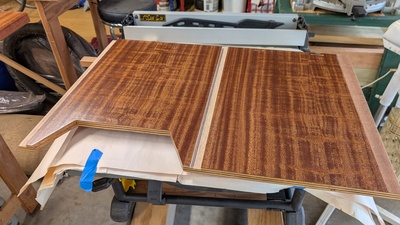
Back after polyurethane
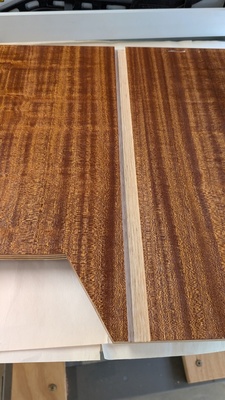
After polyurethane closeup
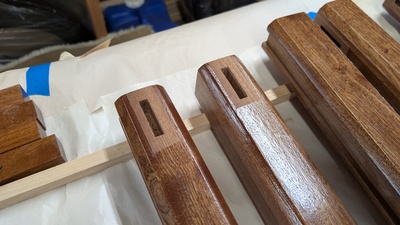
Legs after polyurethane
Assembly
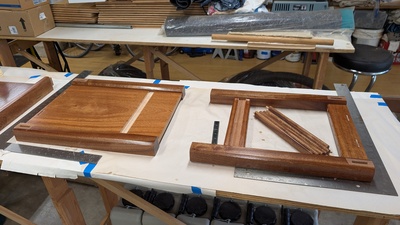
Assembling first sections
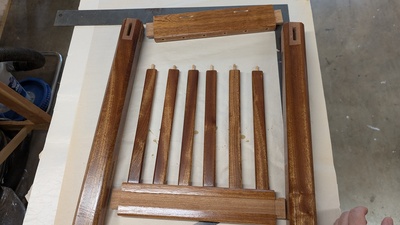
Slat assembly closeup
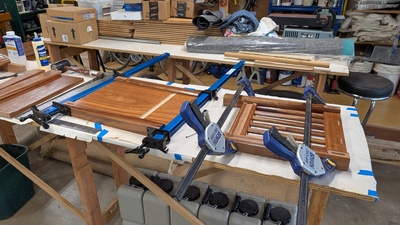
First sections after gluing
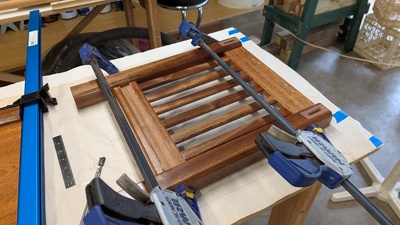
Slat side after gluing
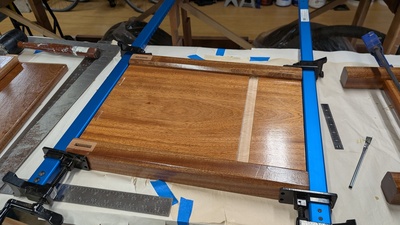
Shelf side after gluing
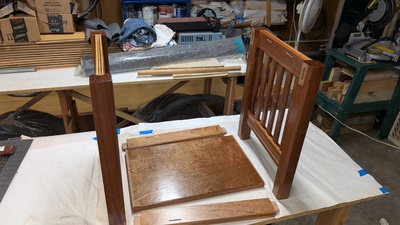
Shelf assembly preparation
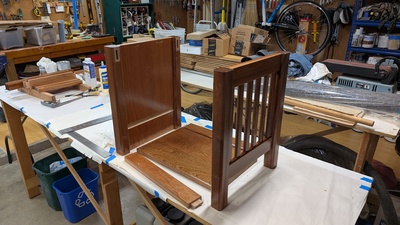
Shelf assembly preparation (alt)
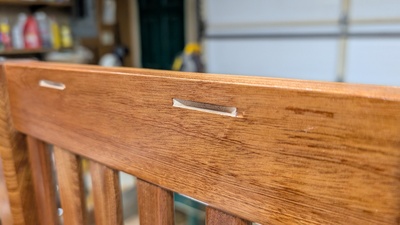
Slots for table top fasteners
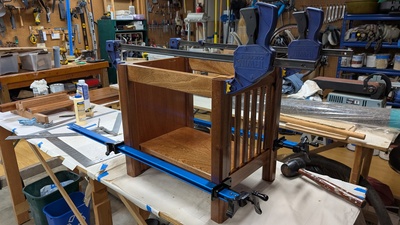
Shelf assembly after gluing
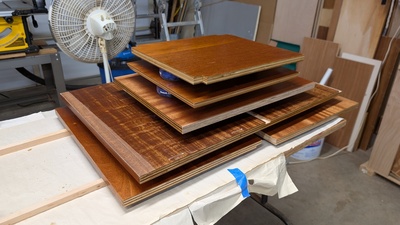
All side and bottom pieces
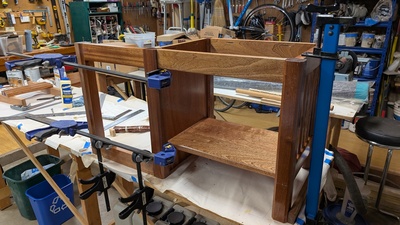
Aligning center cabinet section
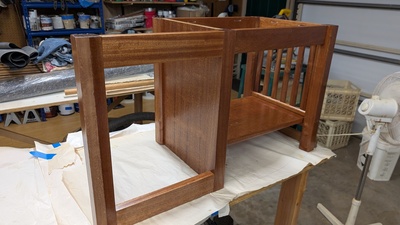
Cabinet door section after gluing
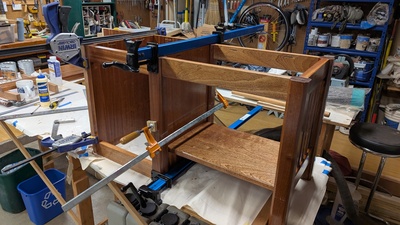
Adding cabinet section sides
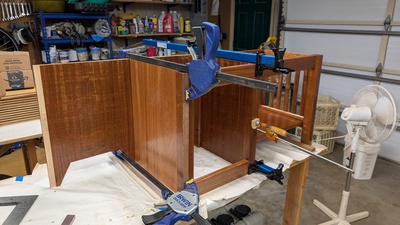
Cabinet sides and back assembly
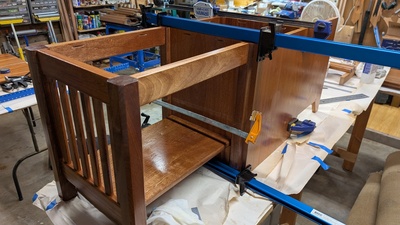
Back assembly and clamping
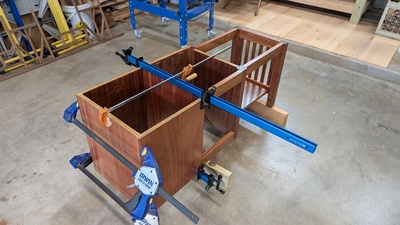
Recycle bin section assembly
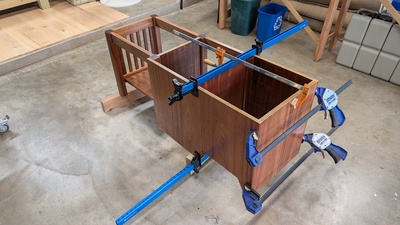
Recycle bin section assembly (back)
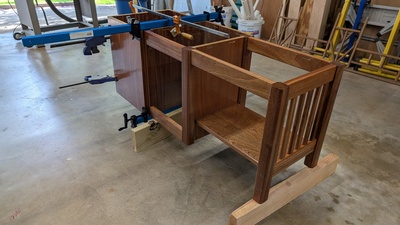
Recycle bin section assembly (alt)
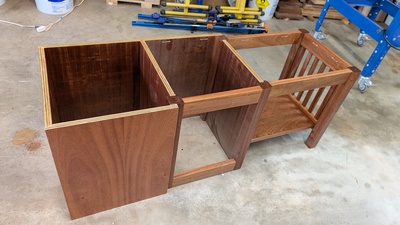
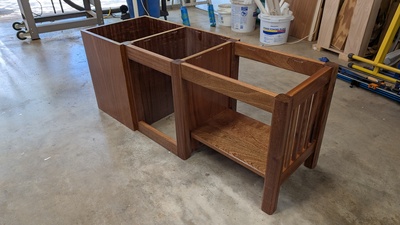
Frame assembly completed (left)
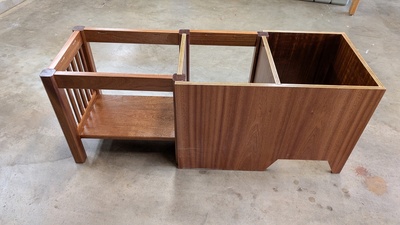
Frame assembly completed (right)
Frame assembly completed (back)
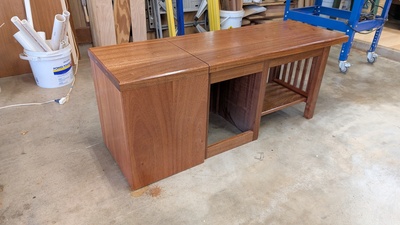
Frame assembly with dry fit top (left)
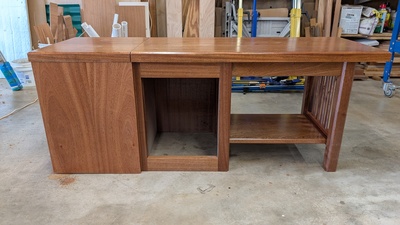
Frame assembly with dry fit top (front)
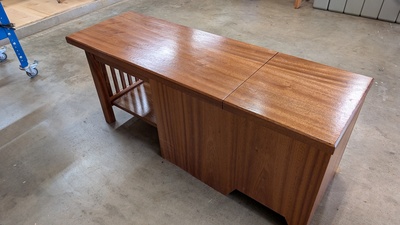
Frame assembly with dry fit top (back)
Recycle Lid Handle
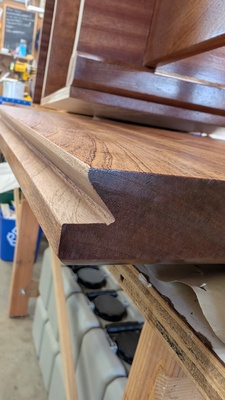
Recycle bin top routed hand grab
The top/lid of the recycle container section would be on a hinge and thus needed some way to grab the lid to open it. Added a handle would be simple, but I did not like that aesthetically. I was trying to make it look like one continuous bench top so that the recycle section was mostly hidden. I handle or anything else that made that section look different would be undesirable. But I also did not want it to be difficult to open, or require some tricky secret handshake (so to speak).
I came up with an idea that I was very happy with. An angled slot wide enough for fingers to comfortably grab, but without changing the thickness of the top. See the picture at right.
Assembly Mistake
Once assembled, I put it on my garage floor and it rocked (not in a good way). At first I attributed it to my garage floor not being flat, which is true in places, but this rocking was a result of a mistake I made.
I assembled the bench on my 2x8 foot work table. The table surface is a piece of plywood with adjustable legs (so that it does not rock). However, at that size, even 3/4 inch plywood has flex, and the workspace not rocking is not the same as the workspace being level. The center legs were adjusted slightly lower than the legs on the end which made the whole surface slightly concave. But this surface was the reference points for assembling, so all legs sat on this concave surface.
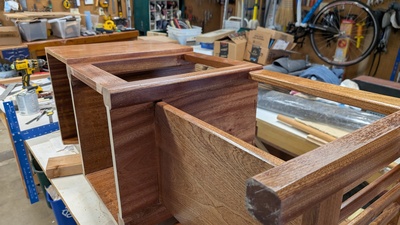
Leveling bench work in progress
Thus, I needed to sand off the bottoms of the middle bench legs so it would not rock. While that was not a big deal, the real issue was that this would mean that the legs on the end would wind up longer than the end sin the middle. So even when the bench was a little flat and level, now the top would have a concave shape and the flat top would need to sit on that.
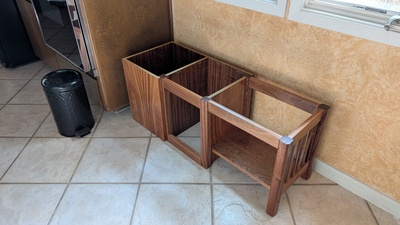
Bench placement testing
The magnitude of this problem was not great, and the actual place where the bench will live itself is not perfectly level. Thus, perfect leveling was not the goal, just finding a good balance was.
Attaching Recycle Bin Cover
I used a piano hinge for maximum strength and it was stainless steel for maximum durability.
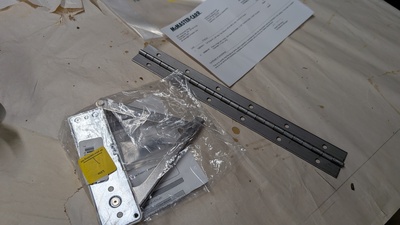
Recycle bin top hardware
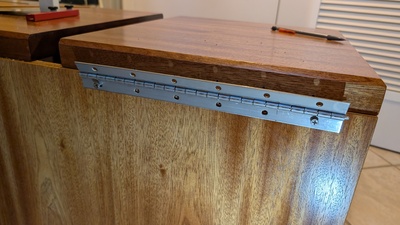
Recycle bin top piano hinge
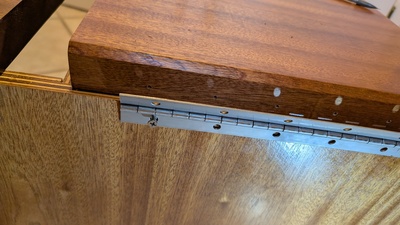
Recycle bin top piano hinge closeup
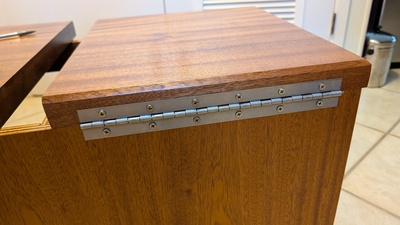
Recycle bin top piano hinge installed
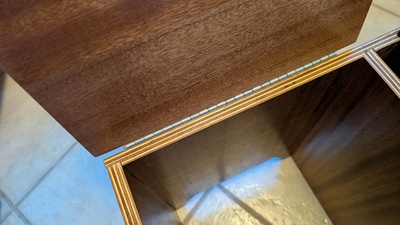
Recycle bin top piano hinge inside
Attaching Bench Top
Since wood expands and contracts, any sufficiently wide pieces of wood needs room to move or else the stresses that build up will crack the wood. This is a well solved problem for wood table tops and they make specific brackets for affixing a table top to its base.
I had used a biscuit joiner to cut slots in the sides and rails to be used for these table top fasteners. The biscuit joiner tool is not made for this, but I find the slots it make to work well. They wind up being wider than needed, but the tool allows me to be precise in their height from the top.
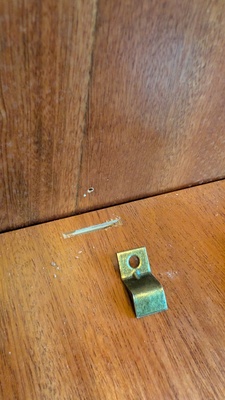
Table top fastener closeup
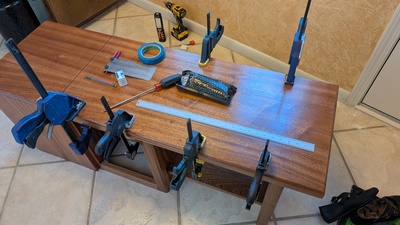
Attaching bench top setup
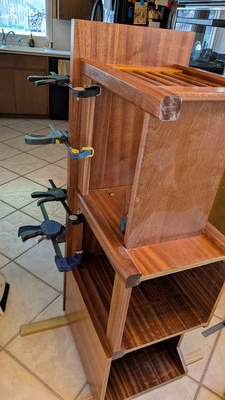
Adding table top fasteners
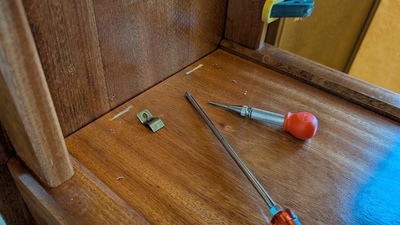
Tools for table top fastener install
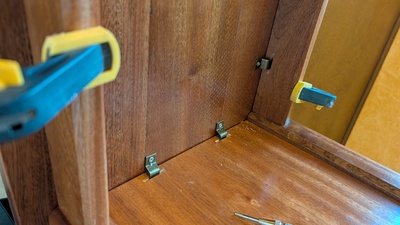
Fasteners after installation
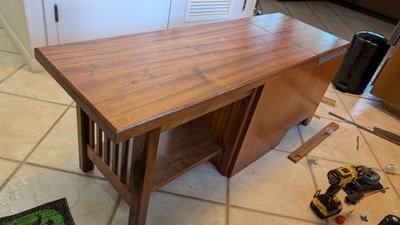
After bench top attached
Adding Cabinet Bottom
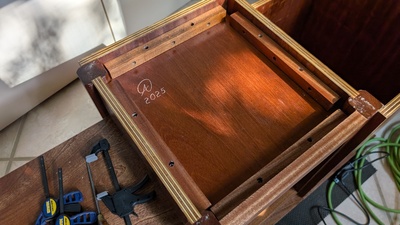
Initialed work
I had deliberately did not attach the bottom panel of the cabinet before as that would have made installing the table top fasteners in the cabinet section more difficult. The cabinet floor would be supported from underneath with some screwed in brackets. Goal here was to not have any screw heads exposed in the cabinet interior with the cabinet bottom smooth.
I usually put my initials and the year on the furniture I build. I find the most inconspicuous location and this cabinet bottom fit the bill.
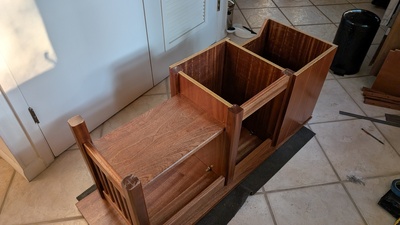
Preparing for cabinet bottom install
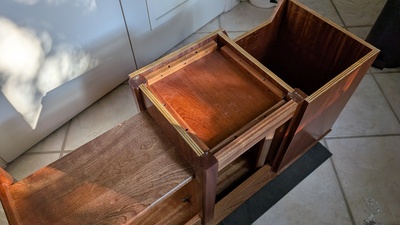
Cabinet Bottom installed (underside)
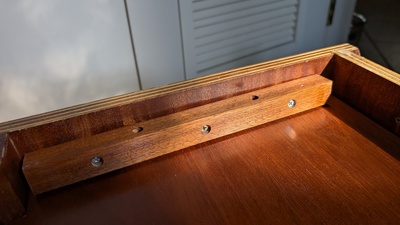
Cabinet Bottom support closeup
Soft Close Hinge
The recycle bin top was pretty heavy at about 7 pounds. With just the piano hinge alone, this would be bad from the sounds of the top slamming down as well as causing wear and damage over time. A soft close mechanism was the answer. I had initially bought a reasonably priced soft-close hinge on Amazon.com, but when it arrived, I could see it was not great quality. The recycle bin section top was fairly heavy and not something this "toy" hinge could handle. Thus, I went to the more serious hardware source McMaster-Carr. That's a great site to get the variations and quality you need, but you have to know what you are doing.
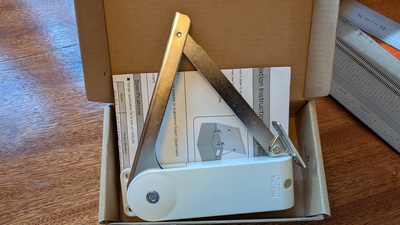
Soft close hinge closeup
While Amazon.com had a bunch of variations, most looking similar and with similar dimensions and materials, the McMaster-Carr site is a long list with variations along multiple dimensions. No matter the application, it has what you need. The only trick is figuring out which one it is. For soft close hinges, it is not enough to know the dimensions, you also need to know how much torque you want. The torque is a function of the weight of the top and the location where the hinge is to be installed. McMaster-Carr does give you the formula, but you have to figure out exactly where the attachment points are going to be in order to do the calculation. I must have gotten it right, because the soft-close hinge I got was just about perfect in its operation.
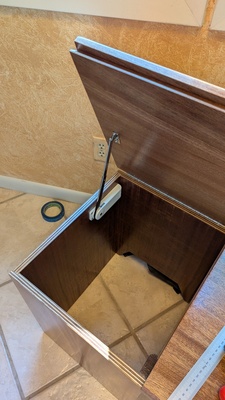
Soft close hinge fully installed
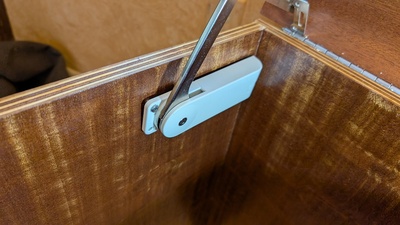
Soft close hinge installed closeup
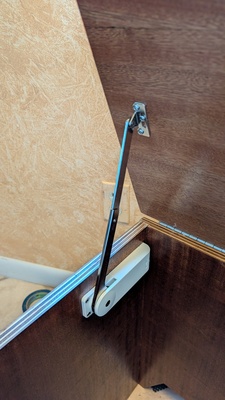
Soft close hinge fully installed closeup
Attaching Cabinet Door
Then last assembly step was attaching the door on the cabinet section. I have a large box of hinges I've accumulated from various projects and these are the same ones that are used on the cabinets throughout my house.
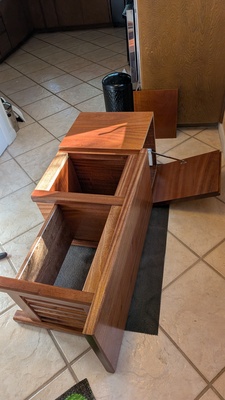
Preparing for door install
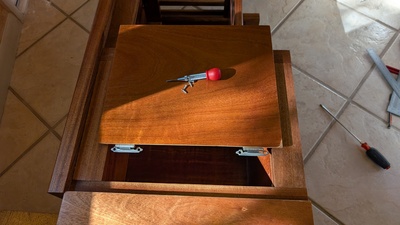
Hinges on door
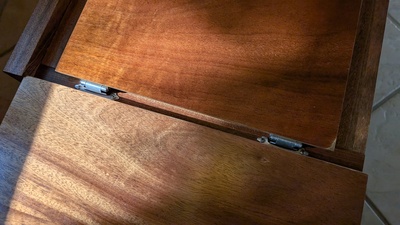
Hinges on bench
Finished Bench
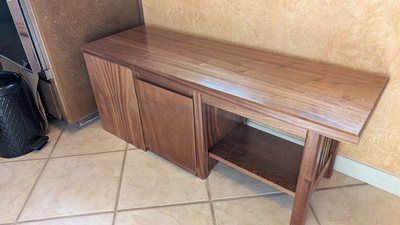
Finished Bench (right view)
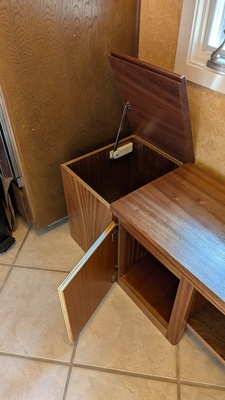
Finished recycle bin section
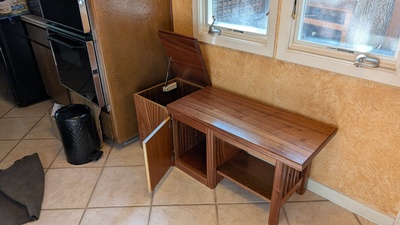
Finished Bench (alt upper right view)
Wall Spacer
Because I added plastic feed to the bench and because it is near the wall on a tile floor, this bench will be subject to moving. To prevent wall and cabinet damage from the bench, I created a spacer that sits on the floor to prevent the bench from getting too close. The biggest risk is that the hinged top edge would dig into the wall if it were too close when someone opened it.
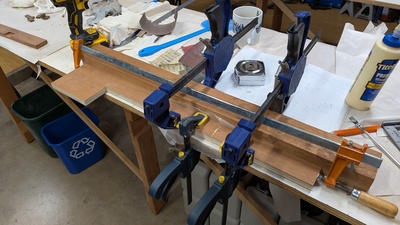
Creating wall spacer
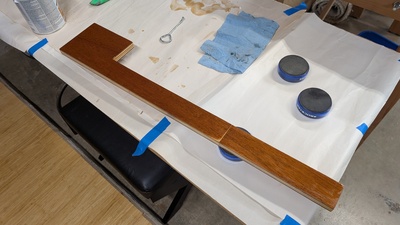
Wall spacer after polyurethane
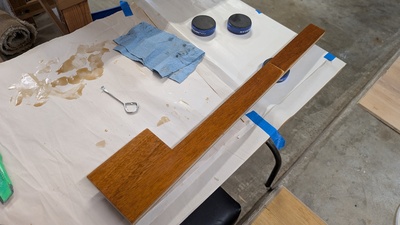
Wall spacer after polyurethane (alt)
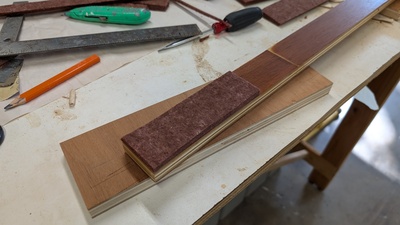
Felt pads for wall spacer
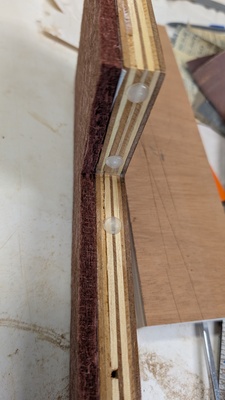
Cabinet stops for wall spacer
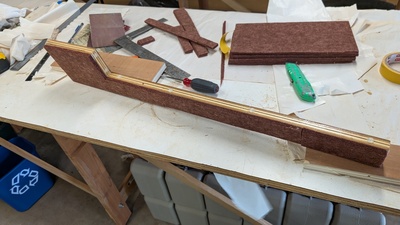
Wall spacer completed
Cabinet Door Bin
The cabinet section's interior is too small for a shelf, so there is limited extra organizational structures I could add. One useful trick to get more organization is to add a bin to the inside of the door. This was perfect for the plastic bottle I use to sample the pool water. The plastic bin I bought did not come with the mounting holes I needed, so I had to drill them out. I always try to avoid depending on adhesives (which is what the bin came with). Most adhesives break down over time and leave residues if you decide later to remove it.
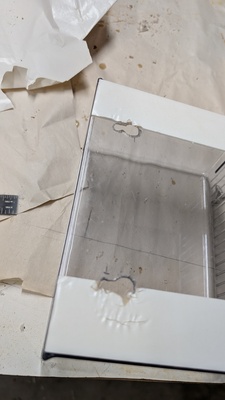
Holes for hanging (closeup)
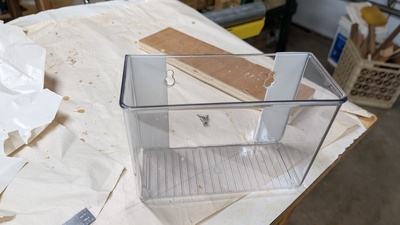
Bin for inside cabinet door
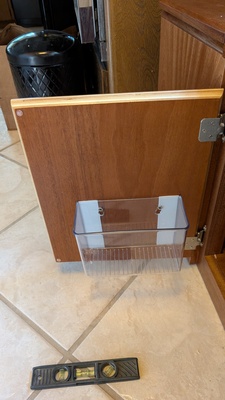
Bin installed in cabinet section
Final Result
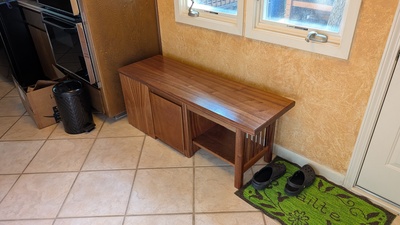
Completed bench (closed - upper right)
Completed bench (closed - right)
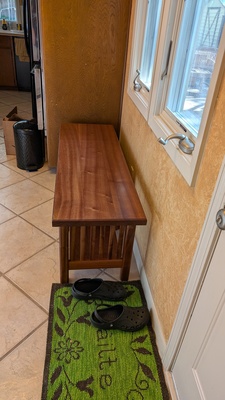
Completed bench (side view)
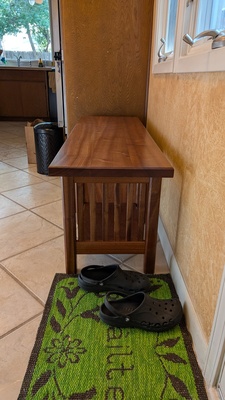
Completed bench (side lower view)
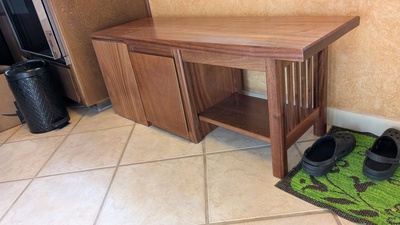
Completed bench (low view)
Previous Bench Project