 Cassandra.org
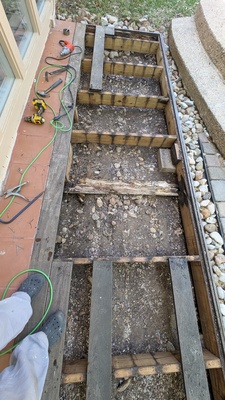
Before
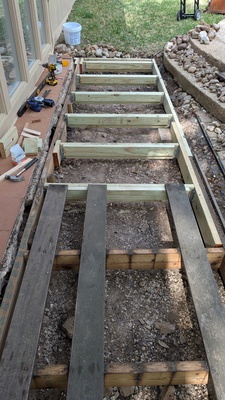
After
Background
This is the third deck repair project done in the last three years. See the Deck Repair 2023 and Deck Stair Rebuild project pages for the others. The tell-tale signs I have a problem is when I step on a deck board and it feels mushy. The screws coming loose is also another sign that the underlying joist has rotted and the screws no longer have anything to grip to. These are very long screws, so when the screws give way, the rot must be significant.
There was one particular deck board seam that would noticeable depress when stepped on. The rest in the area seemed solid, but that does not mean there were not other issues lurking. It took about a year or so from when I first noticed it until I decided to fix it. Beginning this sort of project gives me a lot of dread since you never know what you are going to find once you pull up the deck boards. Almost certainly it was going to be bigger than replacing one bad piece of wood. On the upper end of possibilities was a complete deck rebuild. It required me getting in the right frame of mind to begin the project.
Deck Board Removal
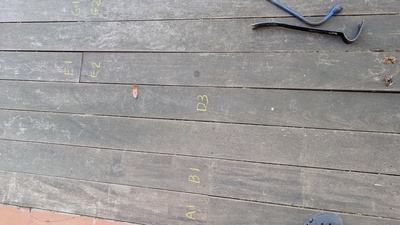
Labeling the deck boards
Even if it was as simple as replacing one joist, I still needed to remove all the boards that intersected that joist. That's a minimum of nine boards to be removed. You might think: big deal, a screw gun makes quick work of taking off the boards. That would be naive thinking.
Originally (in 2013) I paid a crew to install the deck frame and deck boards since I had never built a deck before and it involved demolition of the old deck, adding new cement footers and more. At the time, I thought they did an OK job, but after living with it and repairing it, I've found all sorts of corners they cut and mistakes they made.
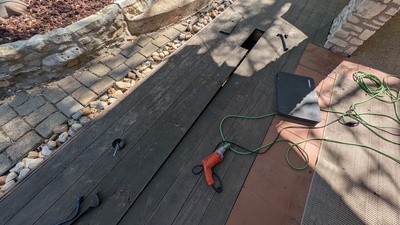
Pulling up the first board
I do recall thinking at the time of install that they seemed to have their screw guns torqued too high. I think that just kept dialing up the torque each time they hit one problematic screw and never dialed it back down. They also did not add a countersink to the screw holes. You must pre-drill the Ipe boards because this wood species are so hard, and they did that, but by not adding a countersink, combined with the high torque, the screw heads often would up buried in the wood. The high torque also meant that most of the screw heads were stripped.
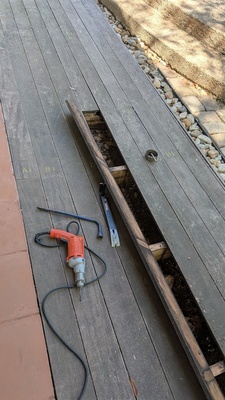
First board removed
The end result is that you cannot simply reverse out most of these screws with a screw gun. Maybe about one in five are in decent enough shape that a screw gun works on them. But even for some of those, if they are buried inn the wood and because there was no countersink, when they come out, they take a big chunk of wood with them. But that only happens with the lucky ones. For all the others, I needed to drill them out.
Drilling out the screws really means drilling out as much of the screw head as possible, then using a crow bar to pry up the boards since you can never really get all of the screw head removed. And then you need some vice grips to extract the remaining screw part from the joists or boards. A thoroughly annoying process that would be unnecessary if the screws were installed properly. And it leaves gaping holes in the deck boards.
Assessing the Damage
Usually, the joist rot begins between the boards where wet debris can sit and decompose. That was the root cause that required the other deck repairs. At first I assumed the same thing here, but as I was staring at the joist I realized this was different. This was certainly the work of some inspects: maybe termites, maybe carpenter ants. I did not see any, so it may not have been actively being attacked.
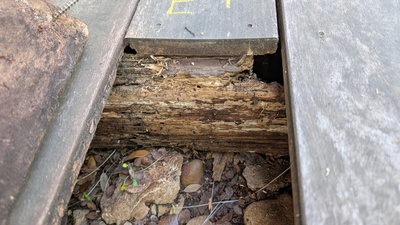
Rotted joist under boards
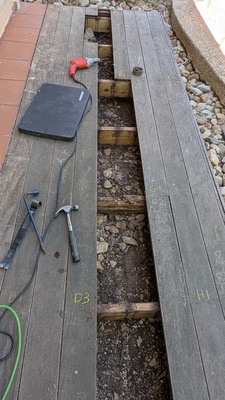
More boards removed
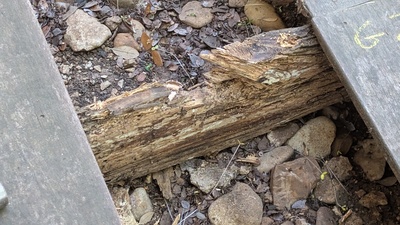
Rotted joist closeup
I naturally feared this joist was not alone and expected to see other joists with insect damage. Curiously, none of the other boards seemed to have this. In fact, most of the neighboring joists seemed in fairly good shape. However, there was a couple others that had the beginnings of the more typical rot I expected.
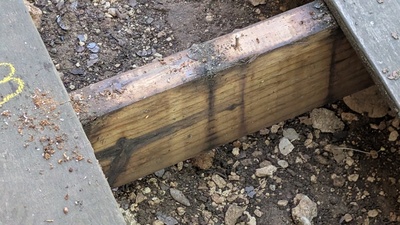
Other joists in same area
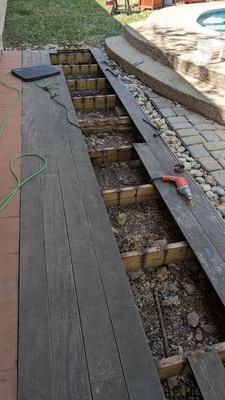
Half of the boards removed
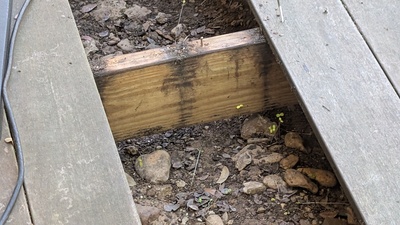
Another joist nearby
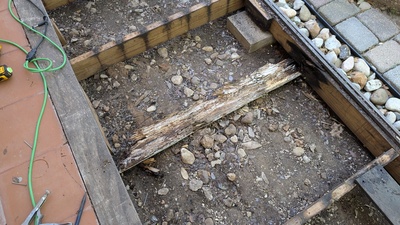
Full view of rotted joist
I also found that one of the boards of the frame had cracked. This was black and cracked right where the really bad joist joined it, so they were clearly related. However, this implied this was not just about replacing a few bad joists. That frame board also needed to be replaced. The board on the opposite side of the frame did not have any major issues, but it did have a couple areas of light rotting that needed to be addressed somehow.
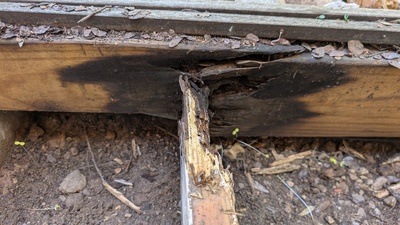
Rotted joist end and frame crack
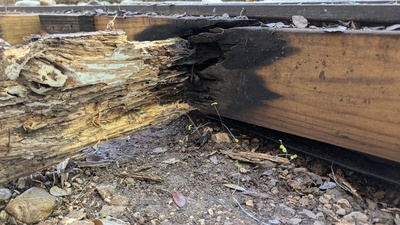
Closeup of joist-frame damage
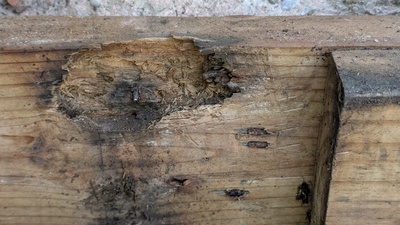
Other side frame damage
I definitely had to replace that frame side with the crack and that made it clear that I should just replace all six of the joists in that area. Three joists were in good shape, one in OK shape, one in fair shape, and the one in the destroyed shape. For the cost of the lumber, it made sense to put completely new joists in place. Thus, I needed to pull up all the boards to expose that entire end of the deck so I could begin demolition of the frame.
Most boards removed (west view)
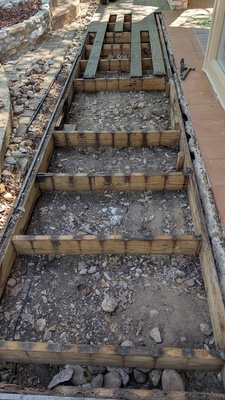
All boards removed (east view)
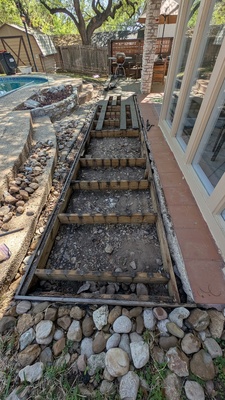
All boards removed (wider view)
There was now the question about whether I should replace both sides of the frame or just the cracked side. It would have been more ideal had I done both, but leaving the one existing frame board would give me a good reference points for the new parts so I could somewhat easily get the leveling and positioning correct.
Frame Demolition
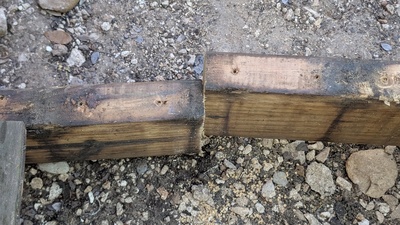
Cutting joists for easier demolition
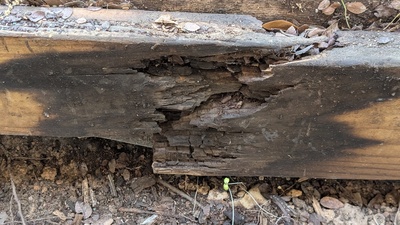
Frame crack and rot closeup
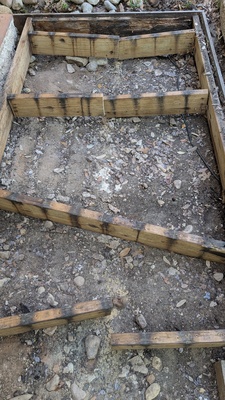
Cut two end joists
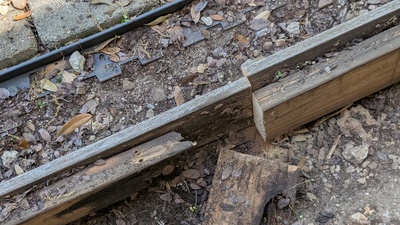
Cutting off frame
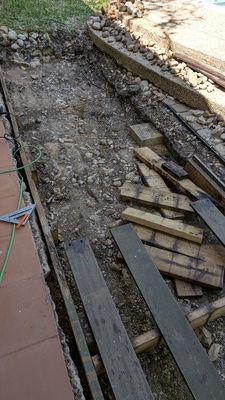
After all bad wood removed
New Frame Building
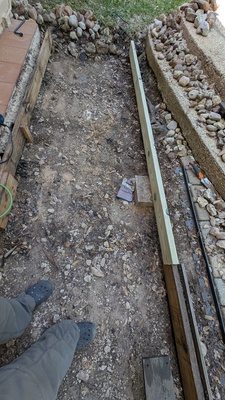
New frame positioning
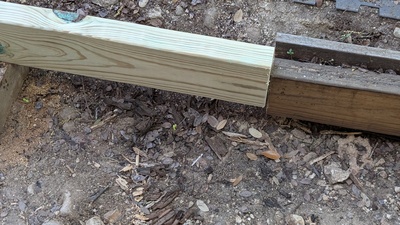
Aligning new frame piece
With the old frame board cracked, I think that section had sunken a little so the frame was lower than it should be. This made aligning the new frame board tricky as I wanted that new one to be at the level it should be, not where the old frame settled to.
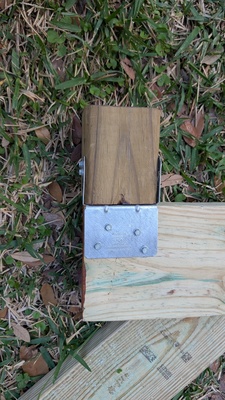
Support brack on frame end
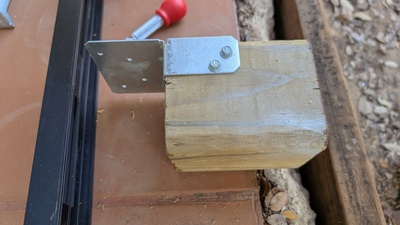
Support 4x4 block and bracket
In the repair area, this is a floating deck. There are some poured cement footers and then the wood just sits on those. Depending on the level, the frame either sites right on top of the cement footer, or a vertical 4x4 piece is used to support the frame. At the ends of the deck, there were two very short pieces of 4x4 under the frame. Both of those needed replacing.
The original installers used nails exclusively for the frame. Lots of toe-nailing of things, which I really dislike. It's structural integrity is suspect and it leads to lots of stress cracking. They toe-nailed the frame to the 4x4 supports and the cracking and subsequent rotting was why they were in bad shape. I would be using galvanized brackets and screws: no nails.
In order to join the new long frame board to the existing one, I needed to add a "sister" board. Sistering just means adding an overlapping second piece and screwing it into both.
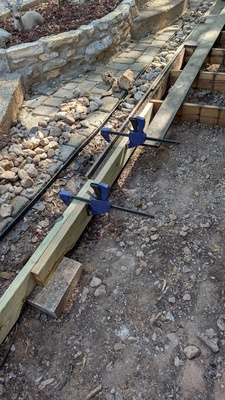
Sistering the new frame board
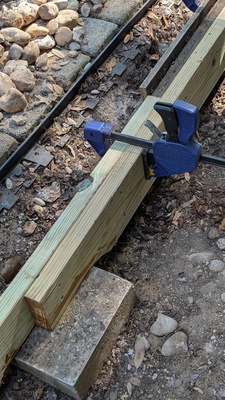
Frame sister board install closeup
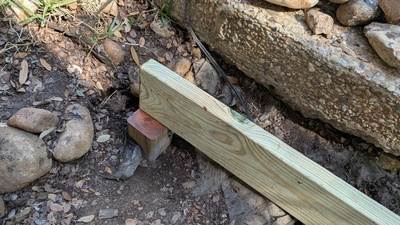
New frame end and 4x4 support
The opposite side frame board end also had some damage and the beginnings of some rotting. This is where the frame end piece and a joist need to be installed, so I needed a more solid area. I put a small extra (sister) board on the end. The new frame and joist just needed to be a little shorter than the originals, so it was an easy fix.
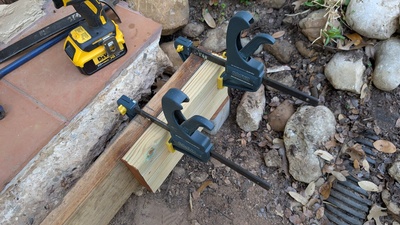
Adding sister board - other frame end
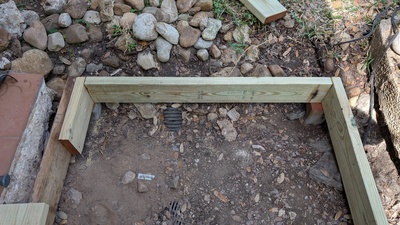
Deck end frame member positioning
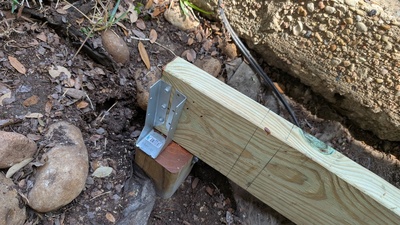
Bracket for new frame member
Treating the Pressure Treated Lumber
Here's something I never understood about how people use pressure treated (PT) lumber. The pressure treating process soaks the wood in chemicals and under pressure to push them into the wood grain. Logically, how deep this pushing goes is affected by a lot of factors. When you cut a piece of PT lumber, you most often can see the extent of pushing and it is not all the way through. This means that if you cut a piece of PT lumber, you are necessarily exposing some amount of untreated lumber.
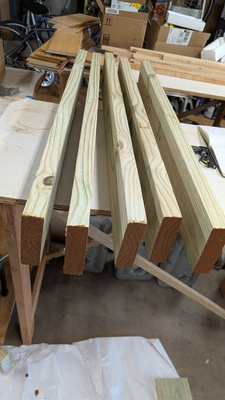
End sealing of new joists
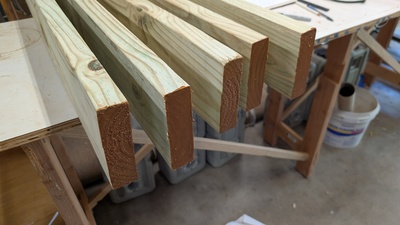
Sealed end of new joists
To me, that is a fundamental problem. By cutting, you have completely undermined the value of the PT lumber. I have since learned that you can buy the chemicals in a form you can apply to the cut ends. It is not under pressure, but at least it is mostly treating the exposed wood. Personally, I've never seen a crew using this stuff. They just cut and nail and I am sure that's what my deck builders did.
I did not want to specifically buy those chemicals, but I did want to treat the ends of the cut PT lumber, so I used some spare deck stain I had. It contains anti-mildewing and other chemicals that will help.
Joist Installation
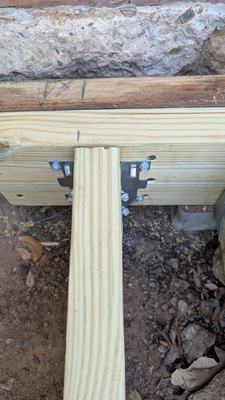
Joist bracket (both sides)
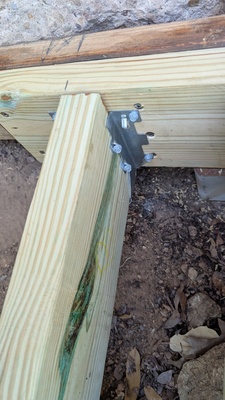
Joist bracket closeup
I used hanger brackets and galvanized screws for the joists. As I mentioned, I am not a fan of nails, and especially toed-in nailing with the entire vertical shear stress on the joist is on a few toed-in nails.
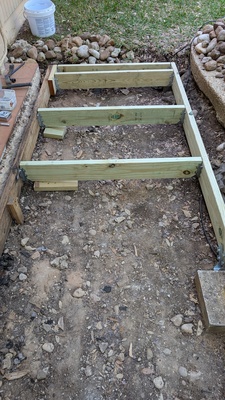
First three joists installed
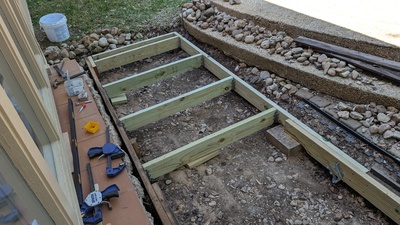
First four joists installed
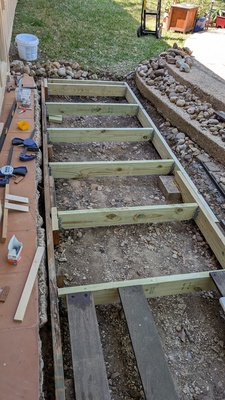
All new joists installed
Frame Extension Board
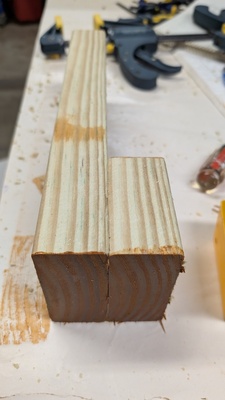
Frame end extension - ends sealed
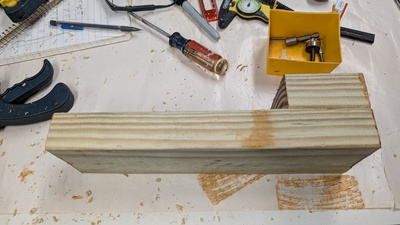
Frame end extension
One of the geometry issues with the deck is that the last row of boards is next to the concrete slab and patio. This is some rough concrete and the frame is far enough away that you can only screw in one side. If you only screw in one side (which the installer did), the board can begin to form a cup, which is undesirable. Those end row boards already showed a little cupping. To slightly improve this, I found that there was enough space at the end of the frame where I could add some wood to extend it. This would at least allow me to screw down both sides of the board at that end.
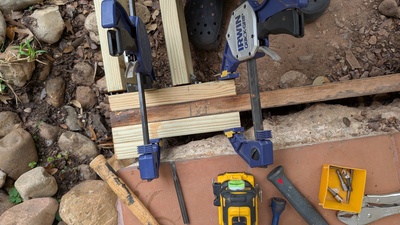
Installing frame end extension
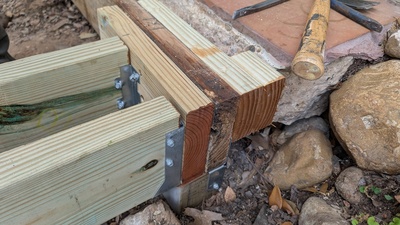
Frame extension - end view
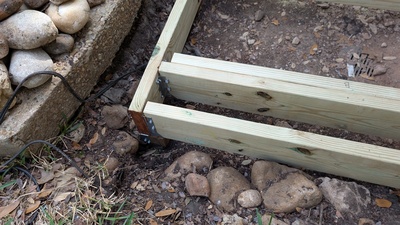
Frame corner completed - details
Sister Boards for Joists
I'd measured the locations of the old joists before removing them because the deck boards are cut to lengths so that the ends always are on a joist. This is needed to ensure you can screw down the ends, else they could warp upwards and be a trip hazard. I wanted to reuse all the deck boards, so recreating the exact joist spacing was crucial. The joists were all 24 inches apart. I measured twice, both sides.
I marked off the joist locations, 24 inches apart on the new frame piece. I then marked the opposite frame member (the original one) by drawing a perpendicular to that mark. From the remnants of the old nail holes, it was obvious that where I marked to put the new joists did not match. Ugh.
I had measure the distances along both of the frame sides and they were both 24 inches apart. The reference point was the joist just before the ones I removed. What I failed to measure was whether that reference joist was actually perpendicular to the frame. It wasn't.
Now I was conflicted. Do I match the original crooked joists or install properly perpendicular ones. Crooked joists offended my sensibilities and fortunately I can up with an easy solution that had some extra side benefits.
The solution was to keep the main joists perpendicular, then add a sister board to each to extend the deck board nailing area. Curiously, the old joist were exactly 1.5 inches off perpendicular, so an extra sister-ed 2x4 would have the sister board align with the old frame side boards and the main joist align with the new frame side boards. Extra deck board screw area is always handy rather than needing to rely on angling in the screws.
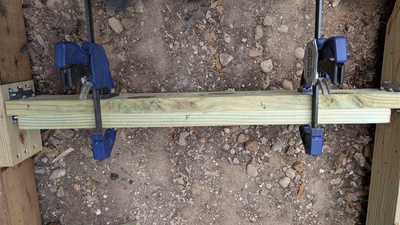
Installing sister board for joist
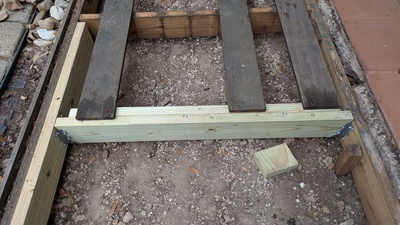
First sister board for joist
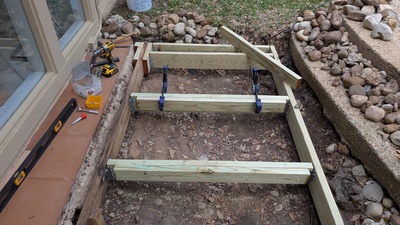
Joist sister board installm in progress
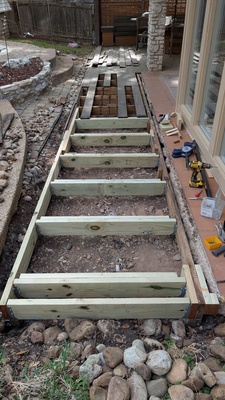
All joist sister boards installed
Framing completed
The old boards being off by exactly the width of a joist seemed too
coincidental to me. I suspect that somewhere toward the other end of the
deck, they nailed a joist on the wrong side of the line and then just
continued measuring 24 inches from the last one so they all wound up at the
same non-perpendicular angle and off by exactly 1.5 inches.
Animal Screen
We've had previous problems with animals are various species making their home under our deck. We mostly fixed this with the Animal Screens Project. At this end of the deck we had large rocks, so did not expect it to be an access way. However, larger animals are string enough to move rocks and smaller ones can find some seems in the rocks. While we were at it, we added the same stainless steel screening to this end to prevent further homesteading.
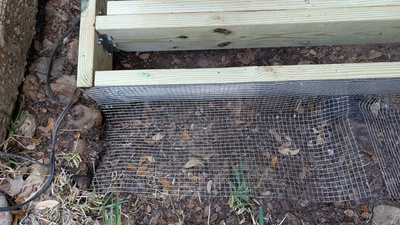
Installing animal screen
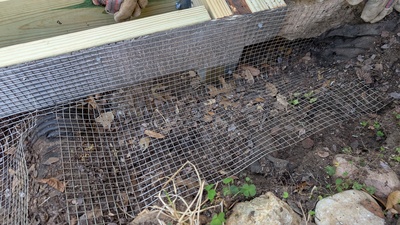
Animal screen closeup
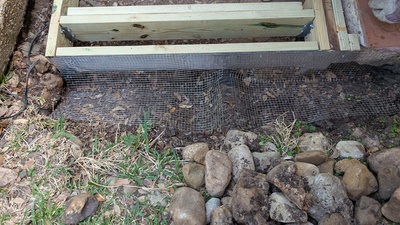
Animal screen cut for French drain
Frame Flashing
When the deck was originally built, the side of the frame was exposed: the ground level was below the deck. An Ipe board was added to the side for visually covering the frame. However, shortly after the deck was built, I added some paving stones as shown in the Deck Perimeter Project. That project resulted in a rock border sitting against the deck side and Ipe board. However, this effectively put the side board in direct ground contact because dirt and debris get in between the rocks. The result was a seriously decayed Ipe board that was not re-usable. The Ipe board was also unnecessary: a very expensive piece of wood that was no longer visible.
Without the Ipe board, my new frame board would be in the same position. Even though this was ground contact rated PT lumber, that only resists rot, it is not impervious to it. As extra insurance, I decided to add a protective barrier to it. I found some flashing used in roofing that had an aluminum layer and put that all along the outside of the new frame.
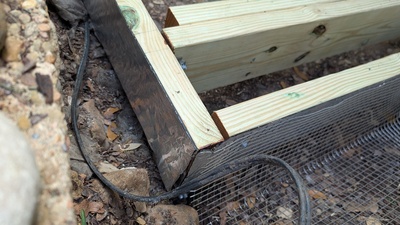
Adding flashing to frame
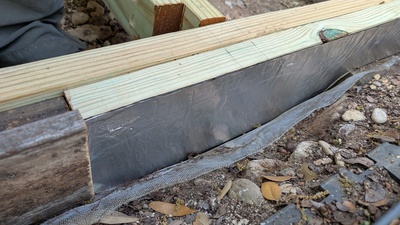
Frame flashing closeup
Joist Tape
You need to leave spaces between the deck boards and debris falls into the gaps. Where the deck board cross a joist, this means the debris sits on top of the joist and begins to rot. That is a common source of deck failure. They make a product called "joist tape" which is the same as electrical tape, only wide enough to cover two-by lumber (1.5 inches thick). I learned about joist tape during the first Deck Repair Project. It should be a crime if you build a wood framed deck without it.
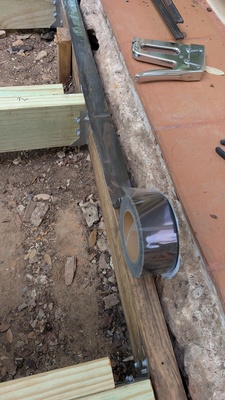
Adding joist tape
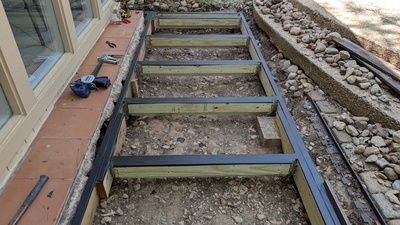
All joist tape installed
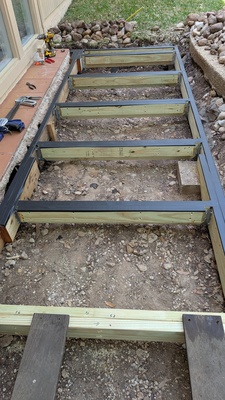
Joist tape installed closeup
Deck Board Reinstall
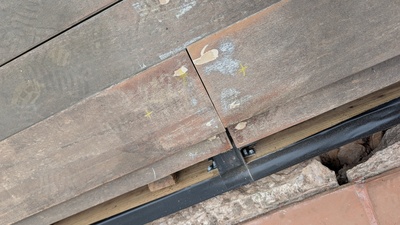
Nearing the end, we put back all the deck boards, but before screwing them down, we needed to fill all the holes that were created during the demolition phase. We used Bondo for this, which was not a good color match, but over time it will be less noticable.
Bondo only give a couple minutes of working time, so I did batches and put it on fairly generously. After drying overnight, I then used an oscillating sander to sand it smooth.
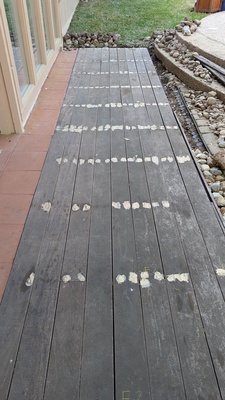
Rough filler applied
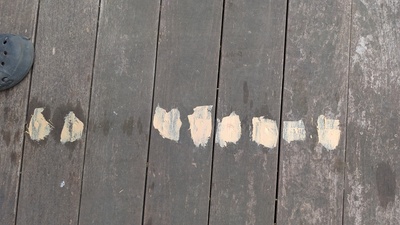
Filler on boards before sanding
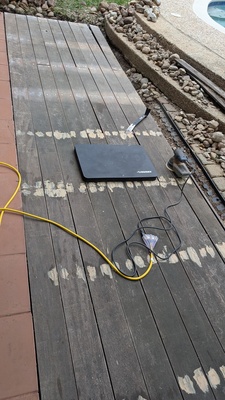
Sanding filler in progress
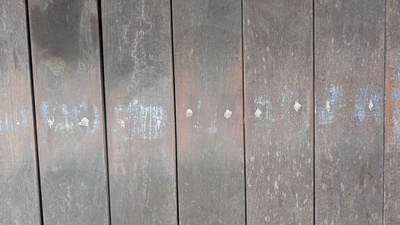
Sanding filler for previous screw holes
Sanded filler closeup
Deck board screw closeup
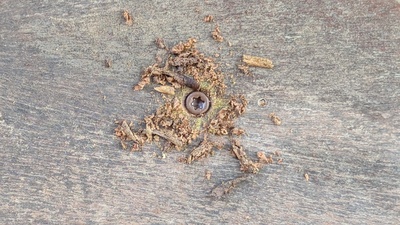
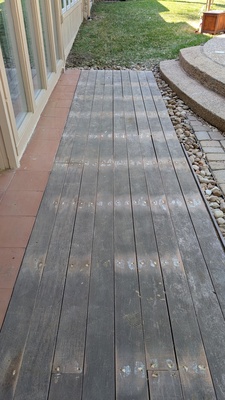
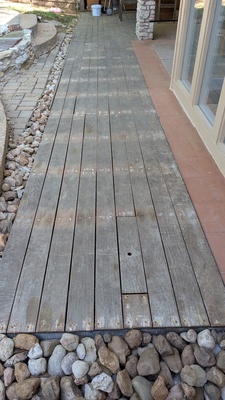
Last step was screwing down all the boards. I carefully marked each drill location to make sure I hit a joist and counter sunk the pre-drilled holes in the Ipe boards. I kept my screw gun torque setting to a reasonable level and not once did I need to crank it higher.
Repair Finished
Repair completed - west view
Repair completed - east view