 Cassandra.org
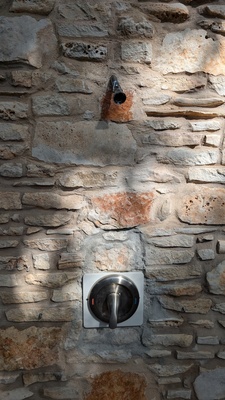
Before
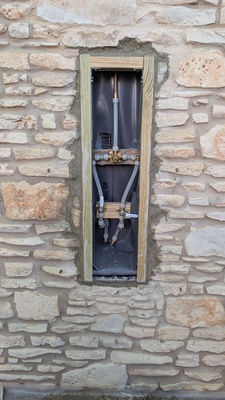
Repaired Plumbing
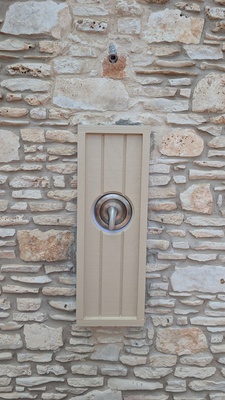
After
Background
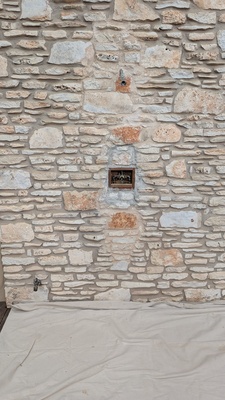
Outdoor Shower
Our house has an outdoor shower with hot and cold water. I am particularly fond of this feature. It is not only handy when you have a pool, but great when you are doing any outdoor projects and get dirty or sweaty enough that a rinse is better than dragging it all through the house.
For the first 10 years or so of living in the house, we had no issues with this. But then it starting to leak. The plumbing is entirely behind the stone facade of the house, so by the time we noticed the leak, I am sure a lot of water was already inside the wall. For the next year or two, being busy with work, we did not use the shower.
In 2011, we decided to invest in some home improvements and hired a general contractor to manage an array of work of different types. Included in the list was repairing the shower, which they did. They had a little trouble finding matching stones and matching the mortar, but otherwise fixed it and it worked fine until "Arborgeddon" in February of 2023.
2023 Repair: Arborgeddon
Arborgeddon was when we got 3 straight days of ice storms with the temperature never rising above freezing during that time. Each day the trees were strained more and limbs broke. But that was only half the damage. The rest of the damage was hidden because the ice was now the only thing holding many tree limbs in place. When the thaw happened, it was raining branches.
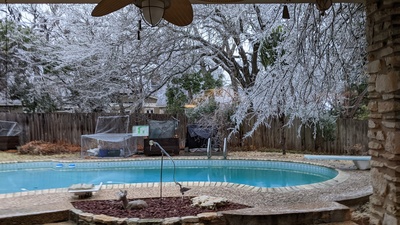
Ice after Day 1 of Arborgeddon
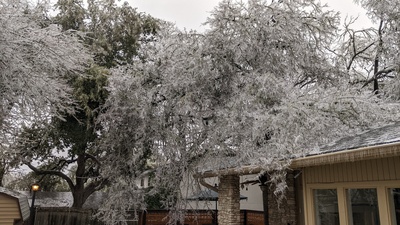
Trees on house during Arborgeddon
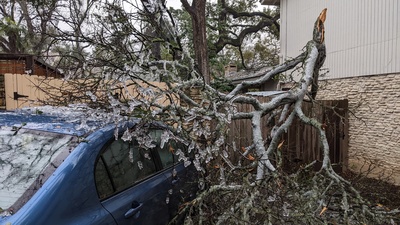
Tree on car during Arborgeddon
After the yard cleanup, tree limbs were piled six feet high along the curb for the entire length of the street and that was throughout the entire neighborhood. It took the city over 3 months to pick it all up.
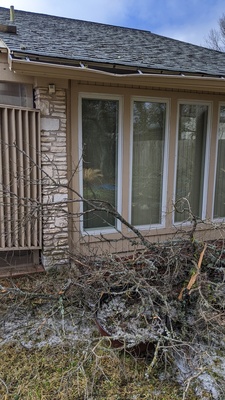
Limbs in backyard after Arborgeddon
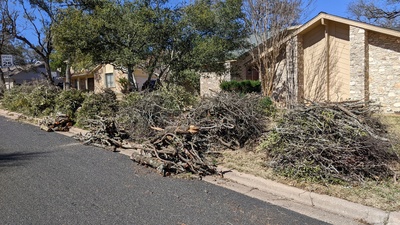
Limbs along street after Arborgeddon
We had a lot of damage to be repaired from the acute issue of falling branches. What we did not find out about until a couple months later was the shower pipe inside the wall had burst due to the extended cold temperature. Luckily it was after the shower control valve, so only leaked when turned on.
Chipping out the stones and doing copper plumbing work are two things I never did before, so I was reluctant and dreading, but eventually got the motivation.
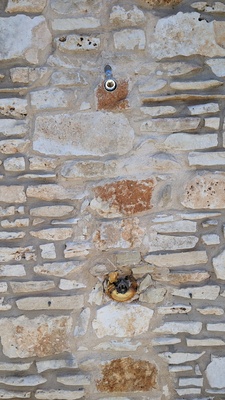
Before 2023 repair
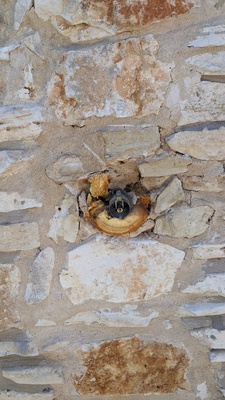
Before 2023 repair (closeup)
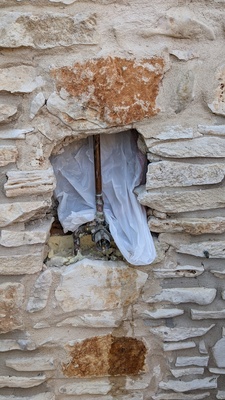
Stones removed (closeup 2023)
The copper elbow had clearly ruptured and so I would need to buy the tools and learn how to solder pipes.
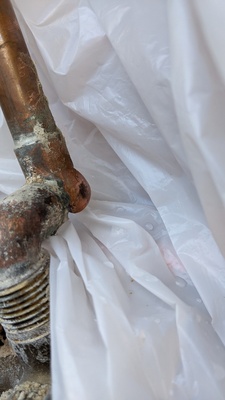
Ruptured elbow (2023)
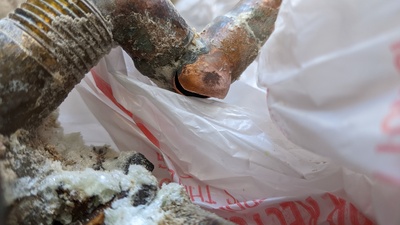
Ruptured elbow split (2023)
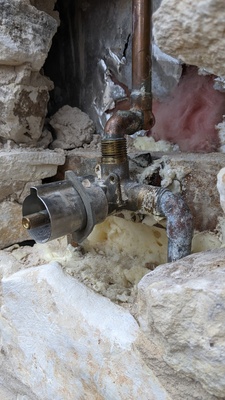
Valve and rupture (2023)
Because this was after the shower control valve, I had a little more leeway as far as risk. Worst case, if I fail, I keep the shower off. I did a decent job and it seemed to hold after pressure testing it.
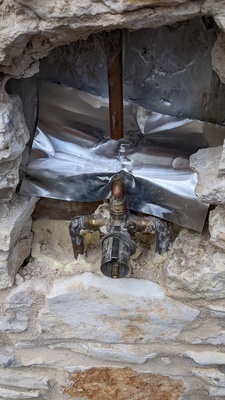
Shielding before soldering (2023)
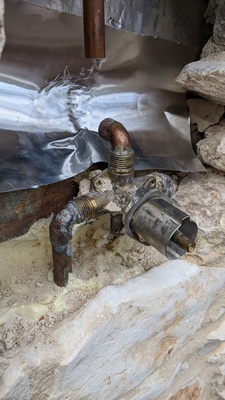
Before soldering (2023)
After the repair, I needed to put the stones back using mortar, which is another skill I lacked. With my wife's help, we managed a passable job of it. Still, the idea that we are covering up plumbing inside the wall with no easy access was unsettling to me. This seems a bad idea to do at any time. That's the way the house was built, and the contractor who first fixed it just tried to leave things as he found it, and now I was doing the same. However, for something that only happens every 10 years, maybe that was OK.
2024 Repair: Nothing but Regrets
In the Spring of 2024, just one year after the previous fix, we found the shower leaking again when we tried to turn it on. Again, water coming through the masonry was our visual clue, but who knows how much water was sitting in the wall. I was urgent to open the wall to at least air it out.
While chiseling out the stones (yet again), I started seeing a leaking in the shower control valve itself. At first I thought I damaged it, but the issue was that the freeze slightly warped the valve body. It was barely making a seal and my jostling it was the final straw.
Now I had a serious problem. There is no shutoff valve for the shower control and now it was leaking. The only remedy was to turn the water off for the entire house. This required a more major plumbing fix and was on the water line side of the house where the risk of using my amateur skills was too high.
I hired a plumber to fix it. He overcharged by a lot and was a complete hack. He took advantage that our house had no water, and his repair work was completely amateurish. The main criteria (besides getting it working) was to add shut-off valves so that if/when there is a problem in the future, I do not have to turn the water off for entire house, and also allow me to work on the plumbing myself on the other side of the shutoff valves.
The "plumber" had found a version of the shower control valve that had built in shut-off valves. This seemed to solve the problem, but not really. Those are made as a convenience for replacing the valve seals. It does not help if you need to replace the valve itself. I learned that later.
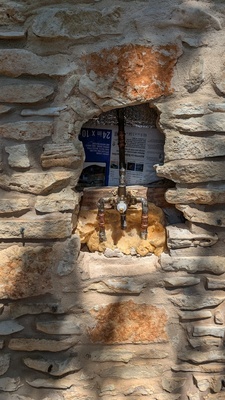
New valve after install (2024)
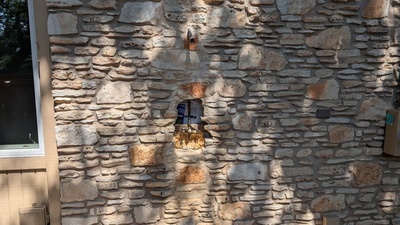
Shower after plumber install (2024)
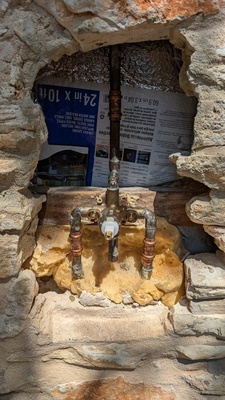
New valve closeup (2024)
The other thing I wanted was to have a way to drain/bleed the shower pipe. I may or may not have mentioned this early in the conversation (I thought I did), but when he was done, there was no way to bleed the line. At that point, I was happy to have the water back on and the repair done.
However, the worst thing the plumber did was to use these crappy Shark-bite and compression repair couplings. These are super easy to use, but are not going to last as long as a soldered copper pipe. Installing them properly might last a decent time, but installing them poorly will only work until the check clears.
Even though there was no bleed line, I thought that at least using the shutoff valves before the winter might help. However, I could not bury the valve behind the stone wall if I needed to to get at them. I decided to make a small enclosure with an access panel so I can better winterize it. I used a spare piece of the material of our kitchen countertop which was Corian as I figured that would be fairly weatherproof. It was a tight space as I was trying to minimize the access area.
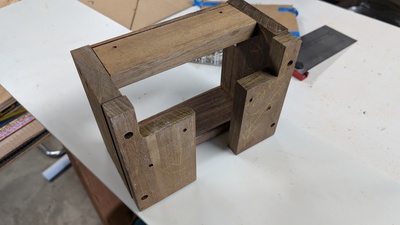
Access enclosure back (2024)
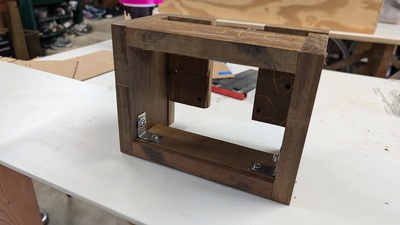
Access enclosure front (2024)
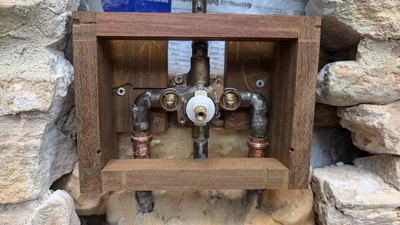
Access enclosure installed (2024)
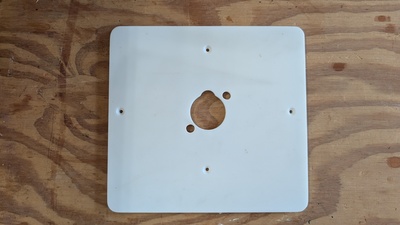
Access cover after finishing (2024)
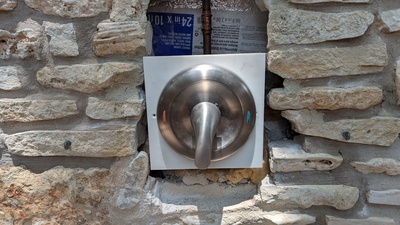
Access cover initial fitting (2024)
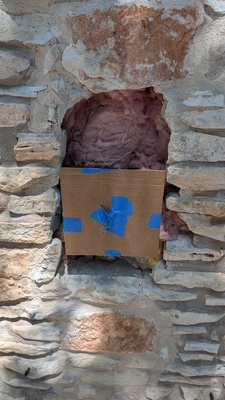
Masked access enclosure closeup (2024)
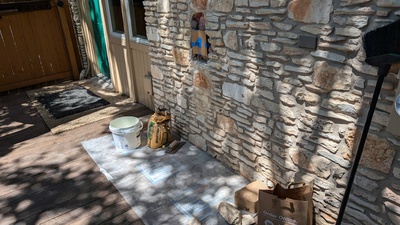
Prepared for masonry work(2024)
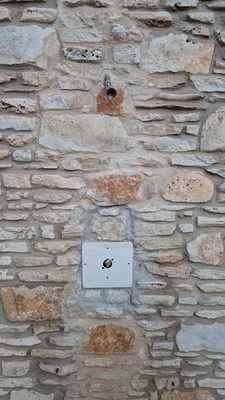
Access cover installed (2024)
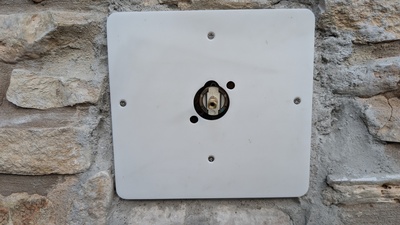
Access cover installed closeup (2024)
Access cover and hardware (2024)
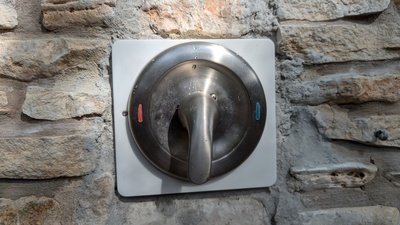
Access cover and hardware closeup (2024)
2026 Repair: No More Nonsense
In the Fall of 2024, I removed the (new-ish) access panel and turned off the shut-off valves. In Spring of 2025, no problems, but we had a mild winter. In Fall of 2025, I removed the access panel and turned off the shut-off valves. In Spring of 2026 ... there were problems .. water everywhere. Ugh! We had a multi-day freeze arlier 2026 which was the likely cause. Multi-day freeze events did not exist in my first 22 years in Austin. We've now had three in the last five years.
After removing the access panel to turn on the shut-off valves, I saw water spraying from multiple locations. This was luckily after the valves. However, this did mean that for the third time in three years, I would need to chisel out the stones and repair the plumbing. At this point, I had more time to spare and decided to do this in a way so that
- I never had to chisel the stone again,
- I would know when a leak happened,
- water from leaks would not saturate the interior wall,
- there would be a proper shut-off valve and
- there would be a way to drain/bleed to shower pipes.
This meant opening up more of the wall than I had previously done. The tiny access enclosure and panel I previously made would need to be a lot bigger. It would need to allow access to all the plumbing behind the wall. Exactly how I would do this I did not know, but I had vague ideas. I could not form a clear picture until I opened the wall and assessed the issue and how all the plumbing was being routed.
Demolition
Shower before stone removal
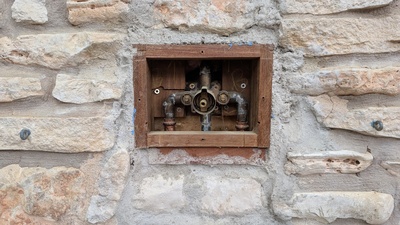
Access enclosure before removal
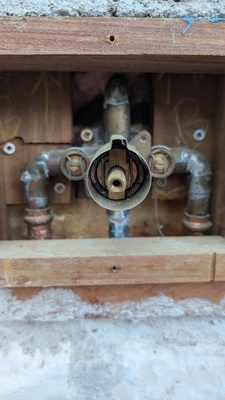
Old valve closeup
After opening the wall, I saw the issue quite clearly. The "plumber" used a crimp connection and the pipe had shifted. Now it is likely that even if properly soldered, the freeze failure point would have been somewhere else, but plumbing that depends on a crimped fitting is shoddy work.
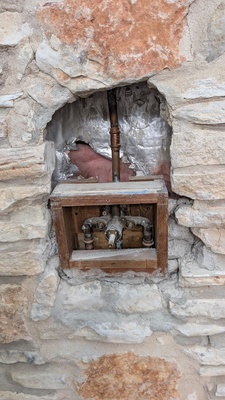
Pipe dislocation
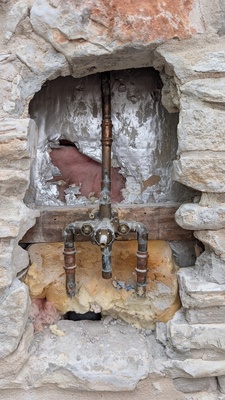
After initial stone removal
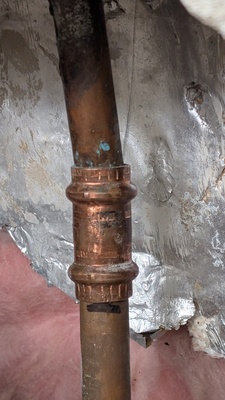
Bad fitting and pipe dislocation
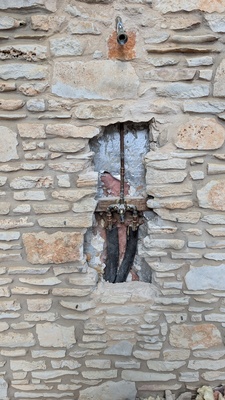
More stones removed
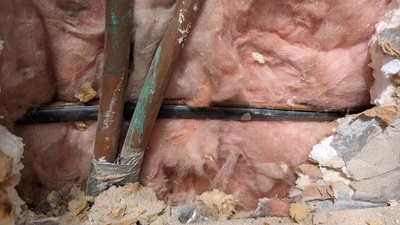
Hot and cold water lines
My intent was to put the proper shut-off valves lower on the incoming water lines. I gradually removed more stones below the valve until I found the right place where I could splice in to add the shut-off valves.
Copper versus PEX
As I was researching the solution, I went back and forth between using soldered copper pipe and PEX. The plastic PEX would be more tolerate of freezes and the fittings might be less risky than joints with my amateur soldering. The flexibility of the PEX also would mean more tolerance for alignment.
I've never done PEX before and the first lesson is that there are two types: PEX A and PEX B. Besides the pipes and connections looking similar, these are completely different and not interchangeable.
- PEX A This relies on the molecular structure of the plastic to have memory and return to its initial shape. You stretch the pipe and a coupling ring using a tool with a lot of leverage, then slip it over metal barbed connector and wait. In a few seconds is shrinks back enough to hold and in 20 to 30 minutes, holds enough to be pressurized (though waiting 24 hours is better).
- PEX B This uses different pipe material (though it looks the same as PEX A) and different barbed connectors (looks different only on very close inspection). The joints are made with rings and a crimping tool. It's easier for DIY and worse in the long-term.
PEX B and its crimped connections was a no-go for me. After flip-flopping a few times on using copper, I decided to use PEX A. However, this did not means I was completely avoiding soldering copper. I would need an adapter in the interfaces between the existing copper pipe and the new PEX A plumbing.
Moment of Truth
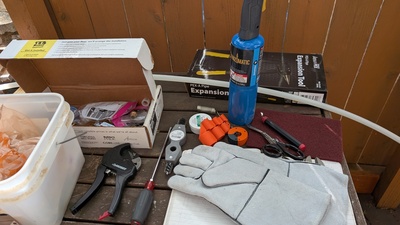
Pipe soldering and PEX tools
Because the failure was after the valve, all the work so far proceeded without needing to turn the water main off. I did as much as I could up to this point, prepared all the materials and tools as best I could and procrastinated a little. But the time had come to shut off the main house water and cut the water pipes feeding the shower. How long would this take? What problems might I run into?
Once cut, there was no turning back and the water could not be turned on until I had the new shut-off valves in place. I'd be doing copper soldering for only the second time in my life and PEX A plumbing for the first time. I could not list all the things that could go wrong, because I did not have enough experience to know.
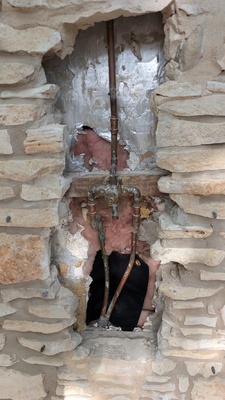
Soldering heat shield test fit
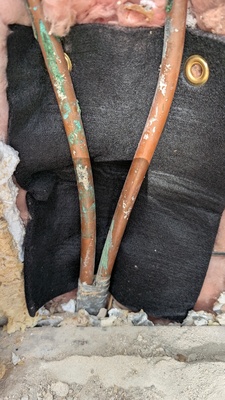
Water pipes before cutting
Water Line Copper-to-PEX Fittings
I watch a lot of YouTube videos of people soldering pipes. I had a firm grasp on the theory and steps, but what I was paying attention to was people's technique: all the subtle movements they are doing that they are not mentioning. How long to hold the torch in place, how to heat it around the circumference? How long on the pipe versus the fitting? How much solder?
With the newly bought heat shield in place and a head full of visualizations, I dove in. Took all of a few minutes and I felt like it went according to plan. Pipes, flux and solder seemed to react as I expected and final solder looked decent.
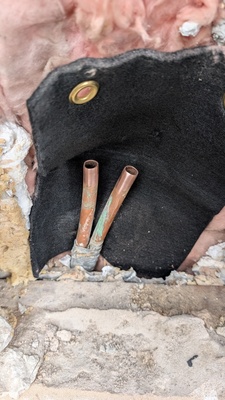
Water pipes after cutting and sanding
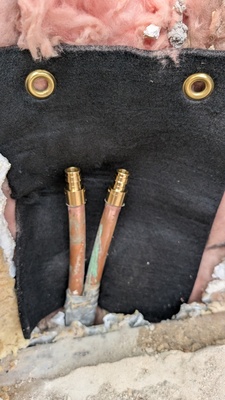
PEX Adapters installed
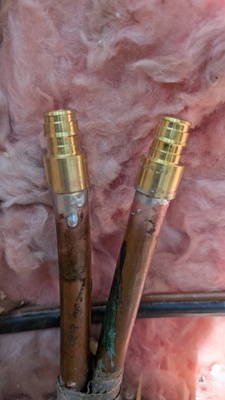
PEX Adapters closeup
However, I would not know if I succeeded until I had the shut-off valves in place. Then I could turn the water on and see if it leaked. And if it did, not only would I need to redo the soldering, I would have to undo all the PEX A plumbing up to the shut-off valves. i.e., A major headache if I messed up and multiple more hours with the water to the house turned off.
Repair Interlude
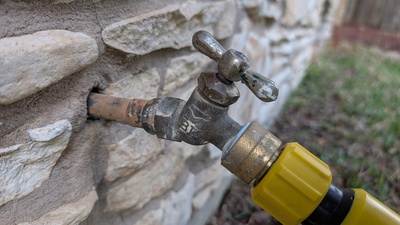
Old leaky hose bib (side)
I needed to wait a few minutes for the copper pipes to cool down before I started adding the PEX A pipes. I had a leaky hose bid that has existed for years. I kept telling myself I would replace it the next time I needed to shut off the water main. Today was the day. Took a few minutes with a wrench and some teflon tape.
Shut-off Valves
The water lines enter the cavity in the back of the wall, but I needed the shut-off valves closer to the front so I could mount them on a cross beam. I originally though that I could bend the PEX A rather than needing a bunch of 90 degree fittings. Once I had the PEX A in hand, it was clear that it was not flexible enough to make up the difference in the space I had. This mean a needed more 90 degree fittings than planned with each extra connection adding risk.
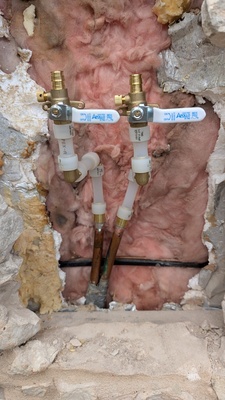
Shut-off valves installed
There are two classes of the PEX A spreading tool: battery-operated and manual. The power tool version is $400. The manual version $100. I am normally keen on buying new power tools, especially when I have a actual need. However, the price difference and the uncertainty of whether I would even do PEX A plumbing again meant I could not justify the extra $300.
Learning on the job, away I want to plumbing PEX A from the newly soldered copper pipe adapters to the new shut-off valves. The theory of PEX A is straightforward, but it has a lot of subtle skills and gotchas that are important. Thus, PEX A is not a fool-proof method. You can screw it up and have leaks just like with soldering. It does not eliminate the need for skill/knowledge, it is just needs different skill/knowledge. With PEX A, you do not have to point and open flame at the wall of your house: so it has that going for it.
Leak Testing
With the shut-off valve sin place, and in the closed position, I could now turn on the water main valve and check all my work. The good news was that my copper soldering was holding up. The bad news was that I had two PEX A fittings leaking. I needed to turn the water back off, cut out the bad connections, redo them and hope these were better.
My work having leaks completely shook my confidence in PEX A. Had there been some obvious reason for the leaks, or if I could pin-point something I did differently on the leaky joints, I would have felt better and learned something. But there was nothing I could think of that was any different. Why did two of the connections leak, while the other ten did not? Redoing them seemed like it would be just as capricious.
There were only two theories about what might have happened:
- We did not rotate the pipe while using the expansion tool. This is possible as it is harder to do well when using the manual tool (the power tool version automatically rotates the tool head).
- The connector's metal barb was damaged. If this was true, then redoing the connection would not solve the issue.
I inspected the connector barbs for damage and did not see any. We focused on making sure to properly rotate the pipe when we redid them. After this second round, we turned the water back on and it seemed to hold. Still, my confidence in PEX A was left on shaky ground.
Shower Head Copper-to-PEX Fittings
I had one more copper-to-PEX adapter to add. This was on the riser pipe going to the shower head itself. I did not want to open up any more of the wall, so I chose to reuse that pipe rather than replacing it. This was on the other side of the valve, so I could do this after the water was turned on.
I would not be able to leak test this joint until all the plumbing was done and I was ready to run the shower. However, this was the best soldering I have done. It felt right doing it and it looked really good too so I had high confidence.
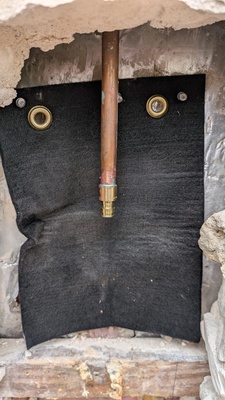
Shower head PEX adapter
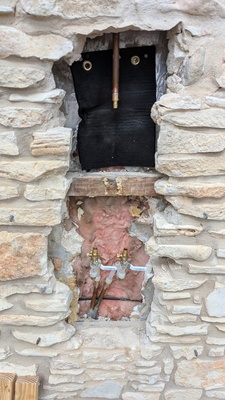
After all PEX adapters installed
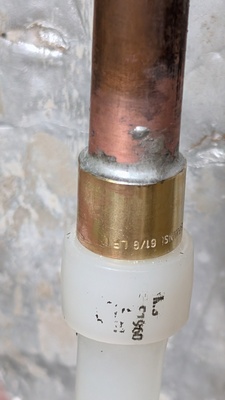
Shower head pipe solder closeup
Widening the Opening
With the shut-off valves in place, water turned on and nothing leaking, I now could do the rest of the work at my own pace. Now I was planning ahead to the size of enclosure I would need to leave. I wanted it to be small to retain as much of the stonework as possible, but it needed to be large enough to encapsulate every joint that could leak or need repair.
To make it simple to build and visually look acceptable, it needed to be rectangular. The stones I had chiseled out did not leave a rectangular opening though. The irregularity of the stonework meant there was no way to chisel and get a nice rectangle. I decided I would need to cut some of the existing stones usingf a grinder tool and diamond cutting wheel. I used a grease pencil to map out the minimum amount of cutting I needed to make an enclosure big enough to contain the plumbing.
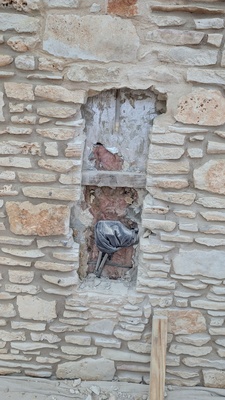
Opening after widening
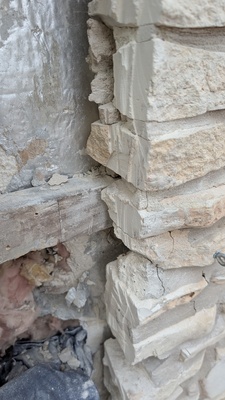
Right side stones after cutting
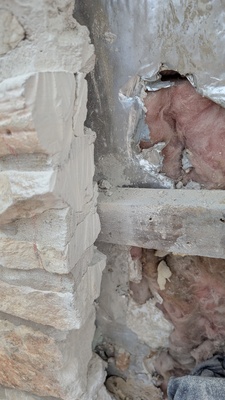
Left side stones after cutting
Enclosure Frame
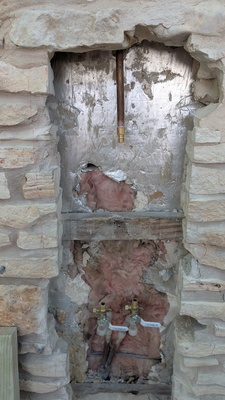
Enclosure closeup
I needed to create a frame in the enclosure space for a few reasons:
- I needed to add a cross beam to mount the new shut-off valves.
- I needed to have a wall to contain the new mortar to close up the hole.
- I needed something to mount the access panel on.
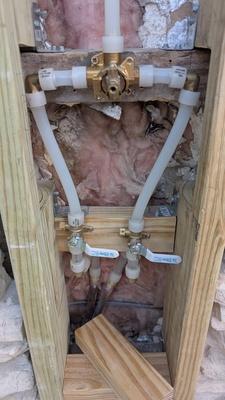
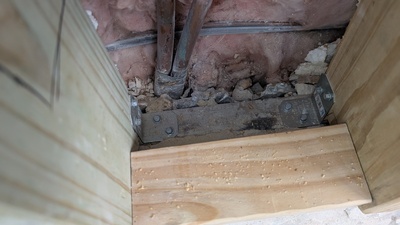
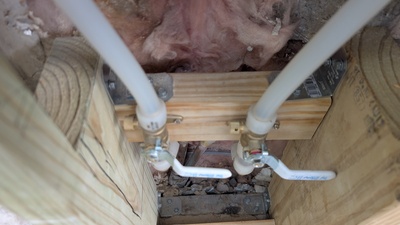
I would use two 2x6 pressure treated lumber pieces for the enclosure frame sides. These would anchor with brackets into the two existing frame cross beams. Between these sides, I would add a top and bottom to complete the frame, and then a cross beam by the shut-off valves so they could be mounted.
Shut-off to Shower Valve PEX
Although I had an idea of how the frame would fit, I did not want to commit to anything until I had all the plumbing done. At this point I was waiting on the new shower control valve. The existing one was not broken, but it was soldered to the old pipes. I needed one that had PEX A barbs instead of copper slip joints.
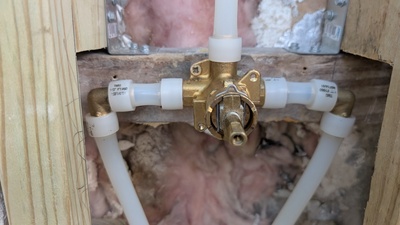
The new shower control valve arrived a day earlier than expected, which was good timing. It was also smart of me to not commit to the framing. The combined with of the value with the PEX A pipe and 90 fitting was wider than I calculated. This was a planning mistake on my part. The total opening was only 11 inches wide, but the two side frame members took up 3 inches, leaving only 8 inches of width for the control valve. It needed about 9 inches.
The solution was to notch the side frame members, though that meant I would have to find a way to prevent the mortar from entering the enclosure.
Shower valve and frame cutouts
Shower valve installed
Frame side lower brackets
Enclosure bottom view
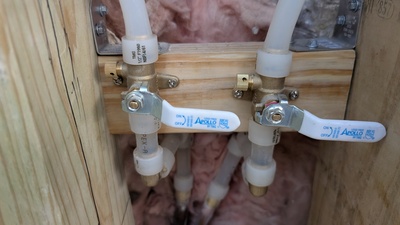
Shutoff-valve support cross beam
After installing the frame sides, I could add the cross beam in the middle and mount the new shut-off valves.
I ran the PEX A pipe from the shower control valve upwards and had the copper-to-PEX adapter solder in. However, I was out of PEX A connecting rings due to the extra ones I had to use when re-doing the leaky connections. After dinner that night, I ran out and bought a few more (these pieces are cheap). I decided to get a flash-light and make that final connection that same night. This would give more than 12 hours for the PEX A to "set" so I could pressure test everything first thing in the morning.
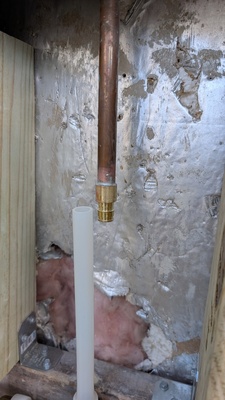
Shower head pipe before connection
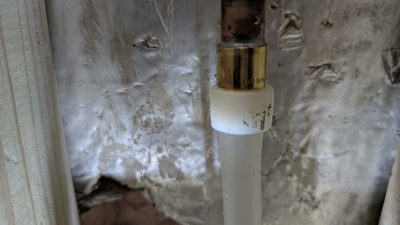
Shower head PEX connection closeup
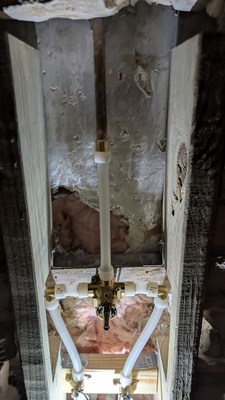
Shower head pipe after connection
Fortunately, when I tested it the next morning, nothing leaked, so my confidence in PEX A increased a notch. The fact that I could make that connection in the dark and in about 30 seconds is a bit of a "pro" for PEX over soldering.
Flashing
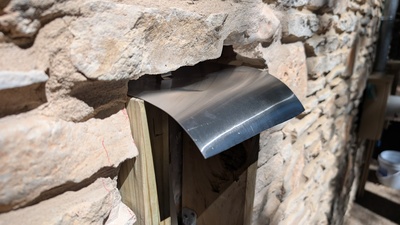
Top flashing cover (rough cut)
Besides the unplanned cutouts I needed to make in the frame sides, there were some other places where I would need to be adding stones and mortar that were at risk of having the mortar enter the enclosure and possible getting on the plumbing/valves. I need to close those gaps but without adding any extra width since space was tight. I opted to add some aluminum flashing to serve as the mortar barrier. I am not sure if that was a good choice or not.
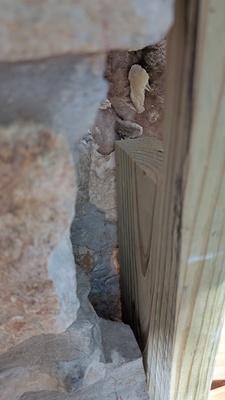
Frame cutout without flashing (alt)
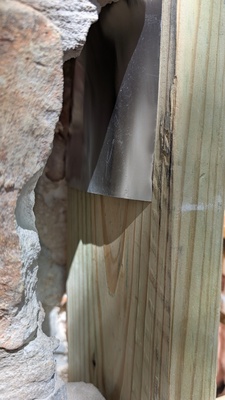
Frame cutout covered with flashing
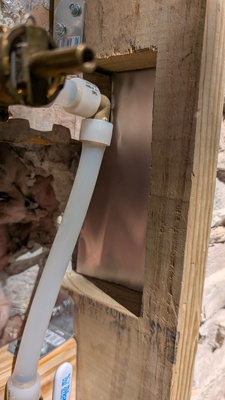
Frame cutout flahing from inside
Waterproofing Enclosure
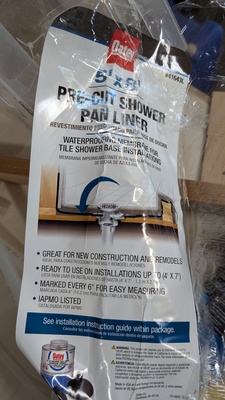
Shower liner package label
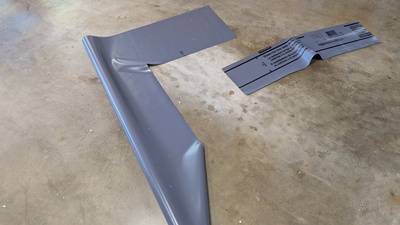
Cutting shower liner
There are a lot of connections in this plumbing and my confidence in PEX A was not high. Past history is also on my mind. If this plumbing has a leak, I do not want it to sit inside the house walls and I want to know about it immediately, not after it soaks through the masonry.
I decided to use PVC shower liner as this would be very weather resistance and has established adhesives for making water-tight seals.
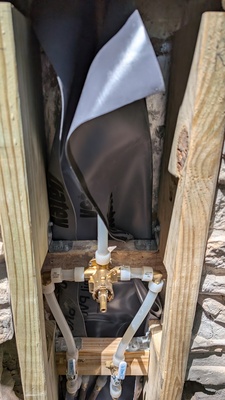
Initial shower liner piece install
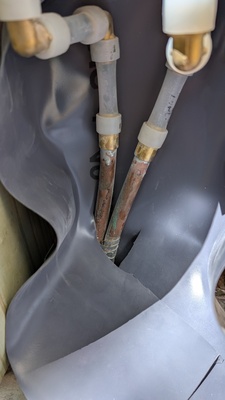
Shower liner bottom transition
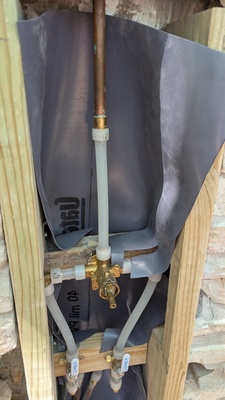
Shower liner during install
Preventing the water from going into the walls is a good start, but we also do not want it to sit in the enclosure. It would be bad for it to sit there (e.g., mold) and it also would not alert us to the leak. Thus, I adjusted the bottom frame cross beam to sit at an angle so it would convey the water to the front of the stone wall. I also sanded a slight "V" channel so it ran towward the center. I would also leave a small gap behind the access panel cover so the water could run out.
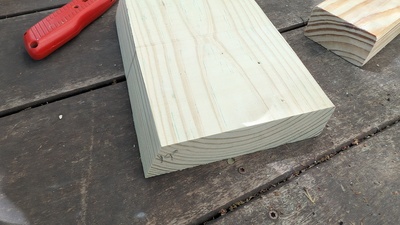
Bottom frame with angle cut
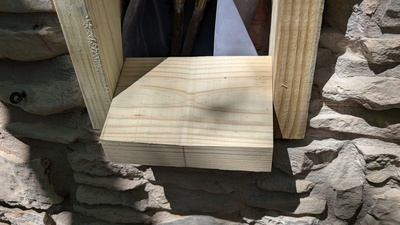
Bottom frame fitting
Frame Completion
Before the final shower liner installation and sealing the enclosure, I needed to complete the frame. All that was left was adding the top and bottom of the frame. I also used galvanized brackets for these.
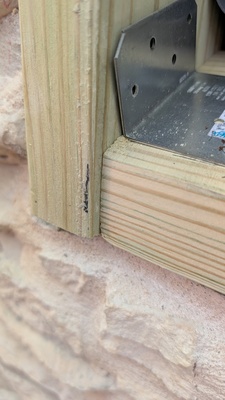
Bottom frame bracket (left)
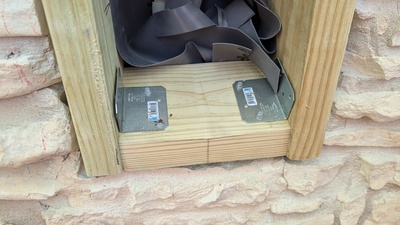
Bottom frame installing
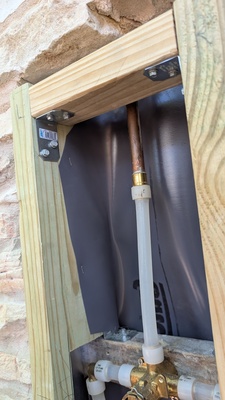
Top frame brackets
Sealing the Enclosure
To hold the shower liner in place I used stainless steel staples. Most of the seams of the pieces of shower liner used the special adhesive make for the PVC shower liner. However, where the water pipes come up, I needed to use a special, flexible and waterproof sealant. I added some foam pipe insulation to the pipes more for supporting the glue than to keep them insulated.
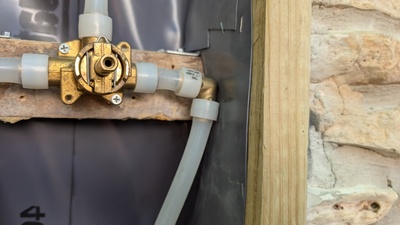
Covering side cutouts with liner
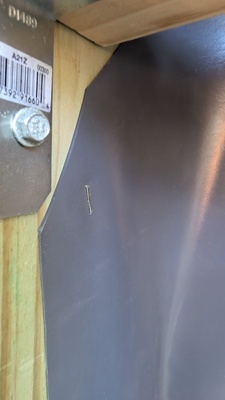
Shower liner staple closeup
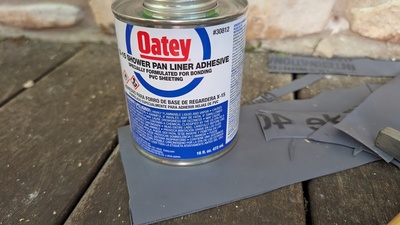
Shower liner adhesive
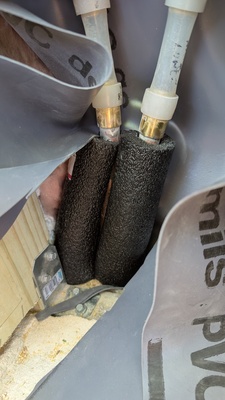
Pipe insulation closeup
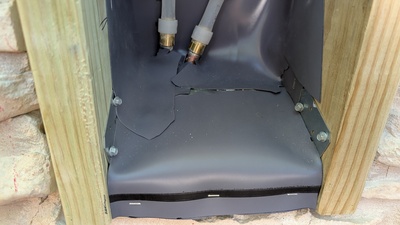
Cutting bottom liner
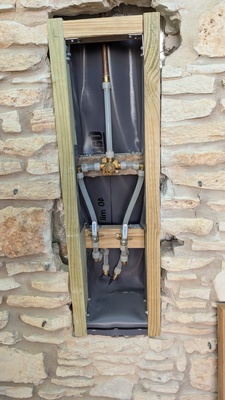
Shower liner installed
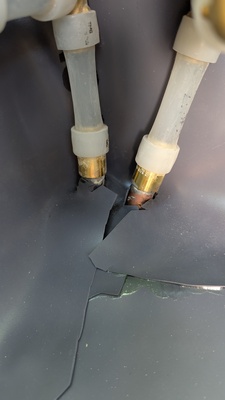
Shower liner pipe gaps
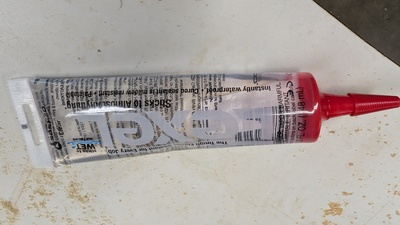
Lexel adhesive/sealant
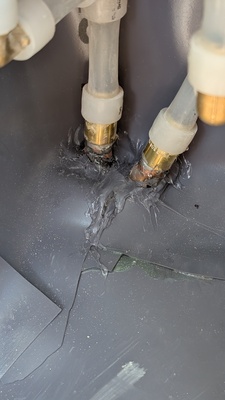
Lexel sealant closeup
Replacing Stones and Masonry Work
There was not any large gaps to be filled with masonry which made it a challenge to find stones that would fit in the existing geometry. I had many large stones from the demolition, but few small ones.
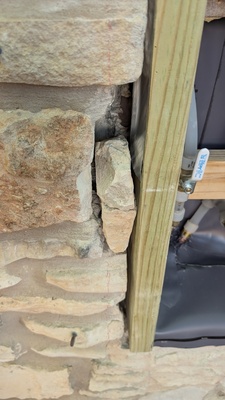
Stone positioning (left)
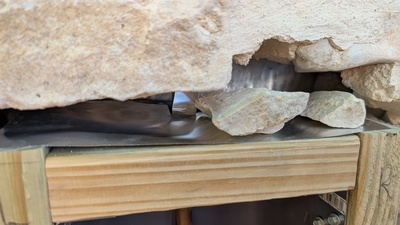
Stone positioning (top - closeup)
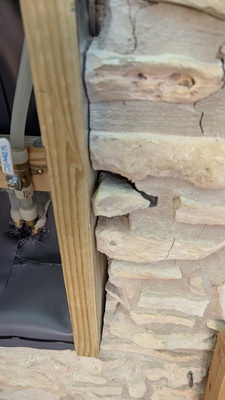
Stone positioning (right)
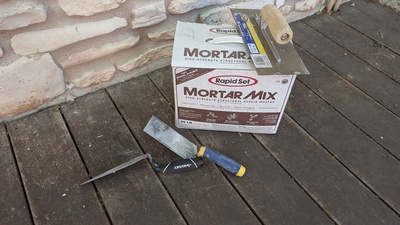
Mortar mix and tools
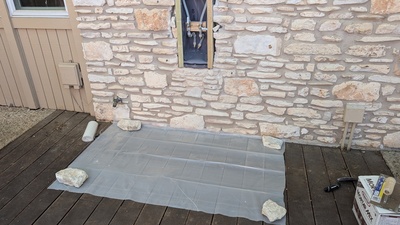
Area prepped for masonry work
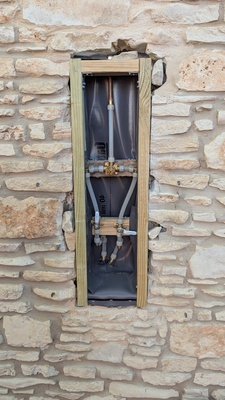
Ready for masonry work
After masonry work
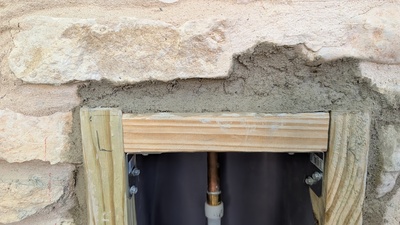
Top masonry closeup
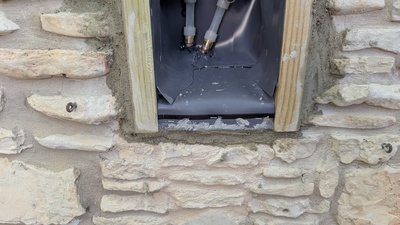
Bottom masonry closeup
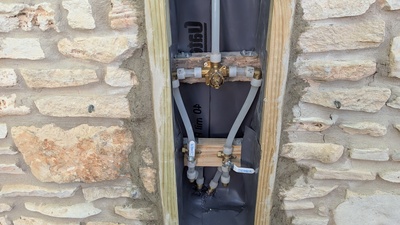
Middle masonry closeup
Shower Controls Adjustment
I focused on mounting the shower control valve in the most stable way directly to the cross beam. The previous valve had a 3/8'' shim, so I expected I might need to recess where the shower control hardware mounted. I could not know for sure where things lined up until after the frame was finished. The uneven stone wall made it hard to know exactly where the previous hardware sat.
However, with the frame in place, I could now measure exactly how far out the shower escutcheon would be mounted and it would need to be recessed. That would complicate the access panel as it could not simply be flat on the frame. However, after some research from suspecting this was not an uncommon problem, I found they make 1 inch extension kits. With an extra inch, the escutcheon would sit nicely on a 1/2 inch thick access panel, so I ordered the kit.
Access Panel
With a focus on being weatherproof and low maintenance, I had bought a sheet of 1/2'' PVC board to be used as the enclosure cover (access panel). I thought I might add some more decorative or matching wood on top of that, or maybe leave it as is. Everything was planned for the panel to be 1/2'' thick.
I cut the panel to size and then used the previous access panel to line up the hole I needed for the shower control stem to go through. I then measured to locate the holes needed for mounting screws that would be used to attach it to the frame.
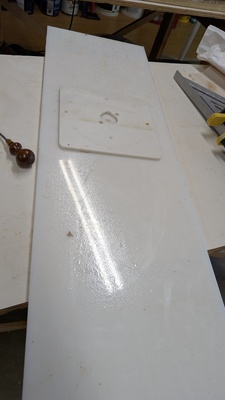
Access panel after rough cut
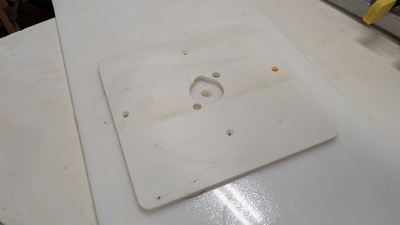
Lining up access panel cutout area
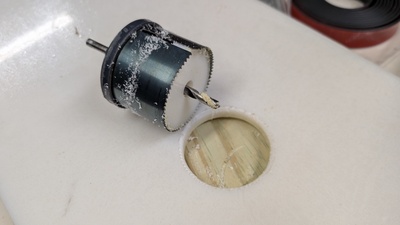
Hole saw and hole in access panel
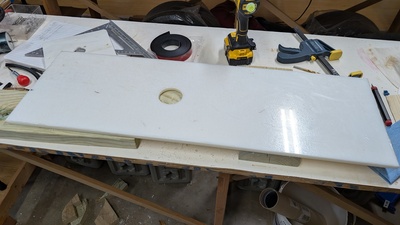
Access panel after valve stem hole
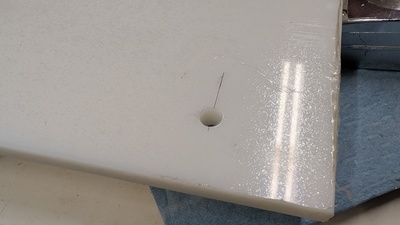
Access panel mounting screw hole
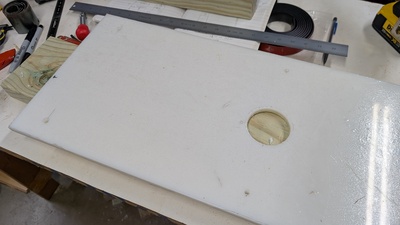
Access panel after mounting holes
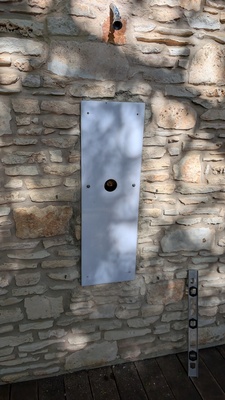
First test fit of access panel
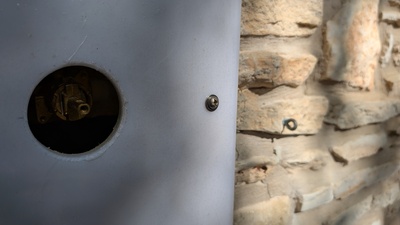
Access panel mounting screw
Recess for Escutcheon
Once the 1 inch extension kit arrived, I double checked how the escutcheon lined up to the access panel. Bad news. It was 1/4 inch too thick, i.e., the extension kit screws were 1/4 inch shorter than I needed. With the panel 1/2 inch thick, I would need to cut it down to 1/4 inch to use those screws in the area where the escutcheon would sit. Being thinner in that small area would not be any structural issue. I have the tools and skills to carve this out, but I was unhappy that my planning and/or measurements were off.
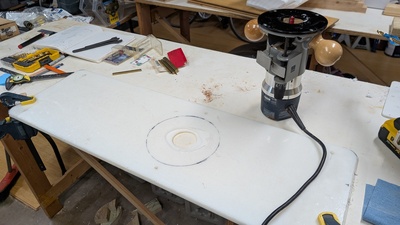
Preparing for recessed cutout
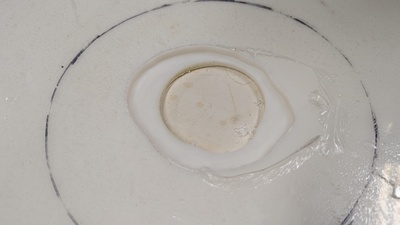
Initial test routing of access panel
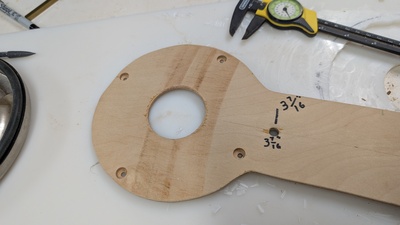
Router jig for round recess
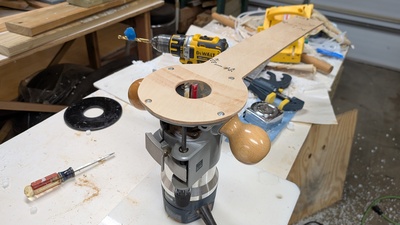
Router with circle jig
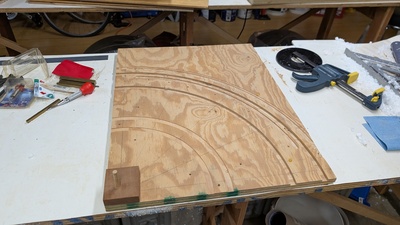
Special fixture for routing circles
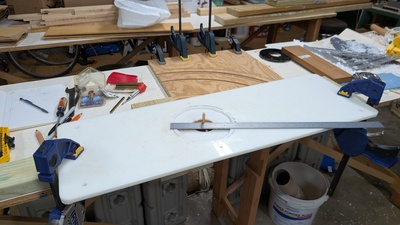
Access panel after routed recess
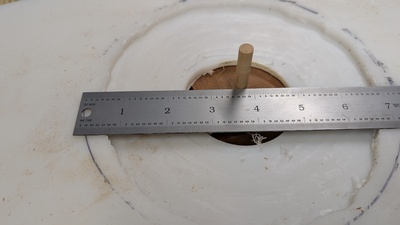
Routed recess closeup
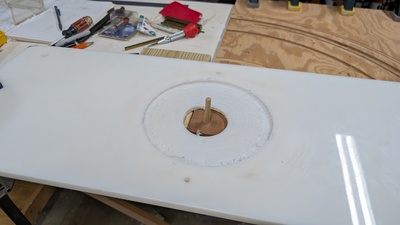
Routed recess
Access Panel: Finishing Touches
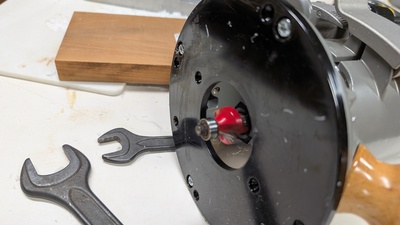
Router with rounding bit for edges
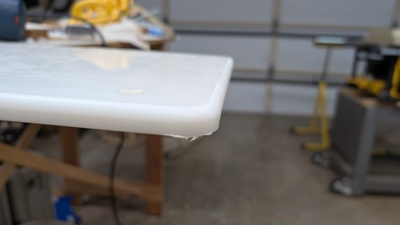
Bottom edge after rounding
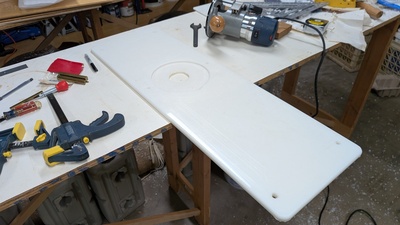
Access panel after ends rounded
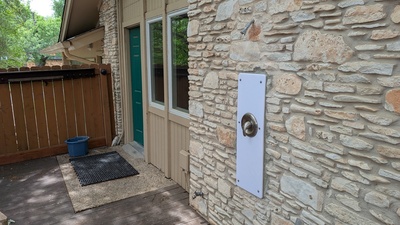
Access panel (right view)
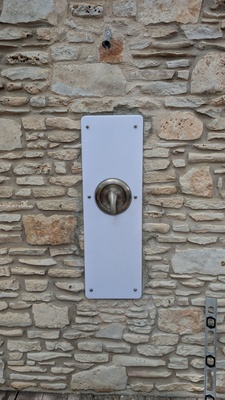
Access panel mounted
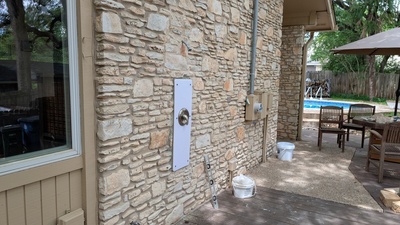
Access panel (left view)
Adding Insulation
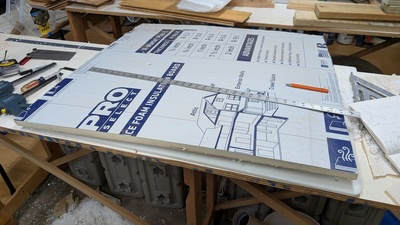
Foam board before cutting
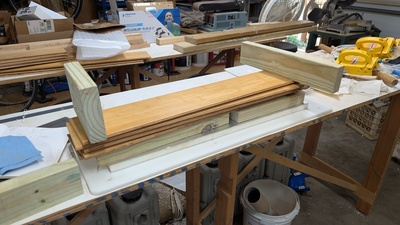
Weighted hold down of glued foam board
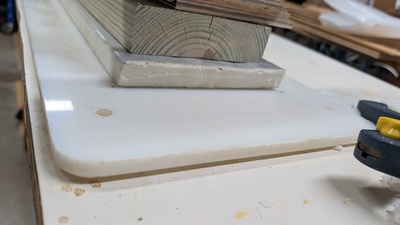
Foam board mounting closeup
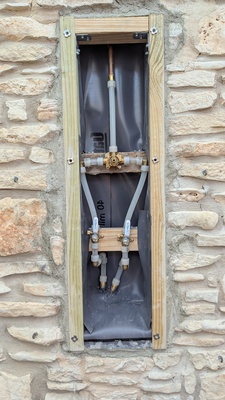
Bolt anchors in frame
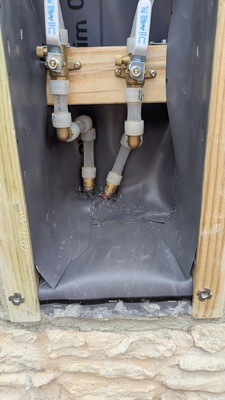
Final view of lower enclosure area
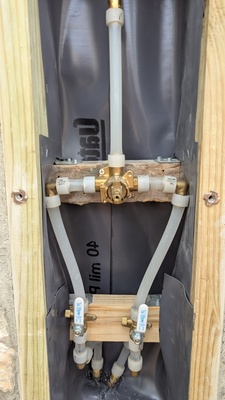
Final view of enclosure area
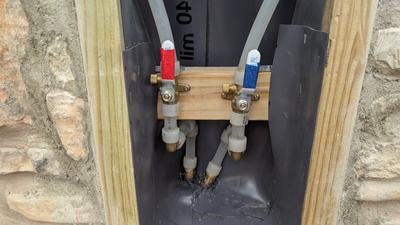
Tape to mark hot/cold lines
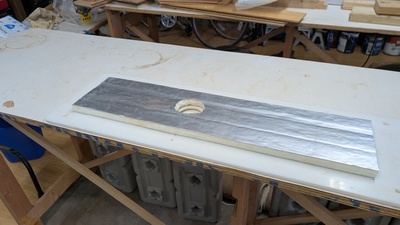
Access panel with insulating foam board
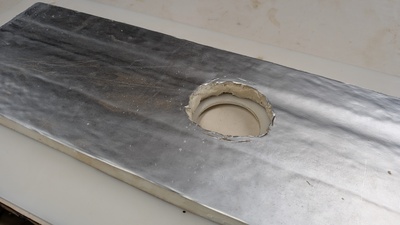
Insulating foam board closeup
Semi-final Result
This was the candidate for a final result.
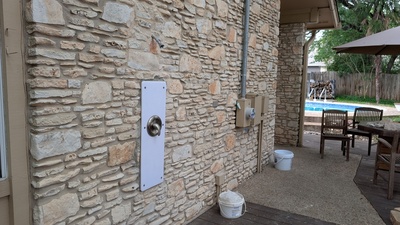
Access panel installed (left view)
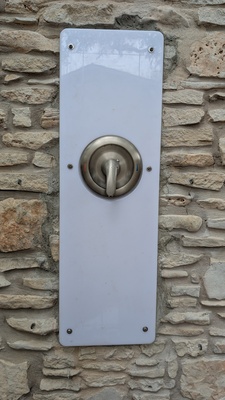
Access panel installed (closeup)
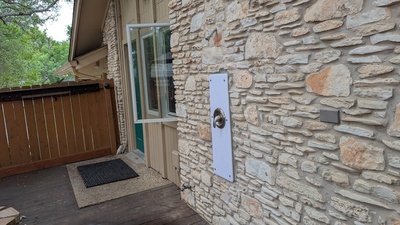
Access panel installed (right view)
It only took a day or two before I realized I really disliked how it looked. In isolation, it looks OK, but in context, it clashes with the house and nearby deck. i.e., It looks very out of place.
I decided to try adding a wood facade to match the rest of the house's trim. The house trim is rough cedar wood with tan paint. That was one of the options considered the entire time, but since it was extra work and not quite as maintenance-free, I was first trying to getting away with just the PVC panel.
Wooden Cover
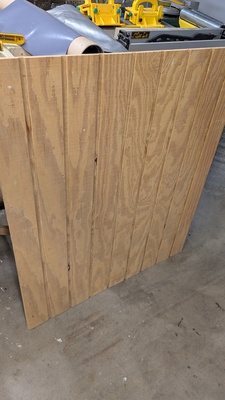
Raw panel house siding
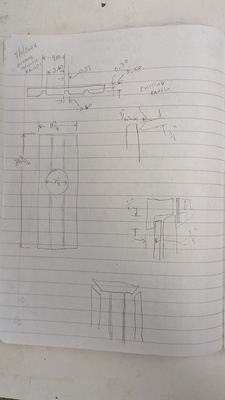
Drawing of panel in notes
After the plain white PVC, the option was to try a rough cedar wood cover to match existing house trim. From some repairs done a long time ago, in my spare lumber pile I had one of the siding panels to match the existing ones on the house.
To match the house panel styling and to give the wood panel cover more rigidity, I would also need a frame. The house panel frames are cedar 2x4s, but that is too big for this panel, so I would need to scale that down so it looked more proportional. Luckily, I had some leftover scraps of cedar that were long enough for this.
Wood Cover Frame
I wanted the frame to wrap around the panel, both to hide the 1/2'' thick white PVC edge, as well as to give have more mechanical bonding between the PVC and wood cover. This meant cutting the frame pieces length-wise so they were ``L'' shaped.
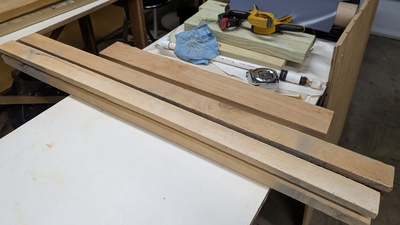
Raw cedar for cover frame
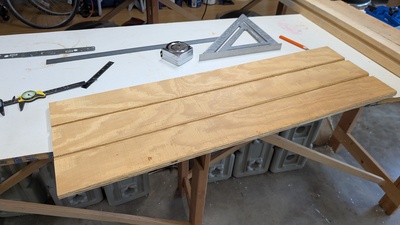
Cut cover panel
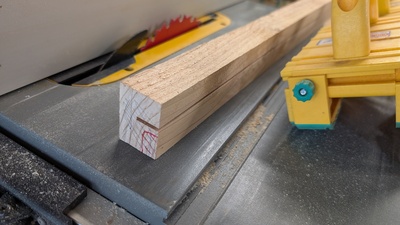
Cutting "L" endge frame pieces
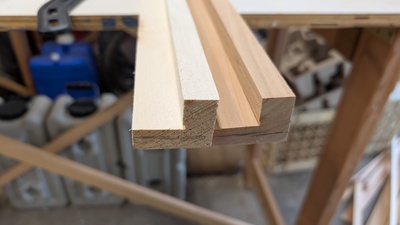
Final "L" cut frame pieces
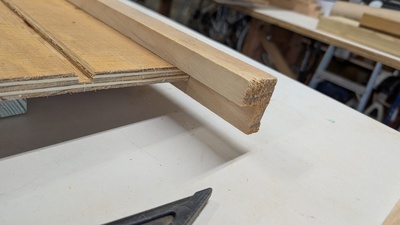
Frame to panel junction
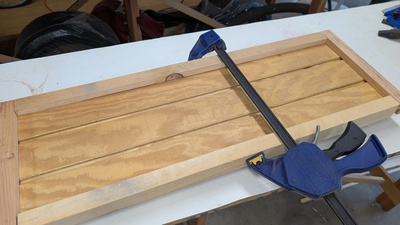
Dry fitting the frame
After cutting the top, bottom and side frame pieces to the right length, when dry fitting the frame I discovered an oversight. I was originally going to join the frame pieces with a 45 degree miter. But considering rain, it started to seem like the top member being completely over the sides would eliminate any rain-facing seam. When I looked at all the wooden frame/panel intersections of my house, I saw they had them this way. That reinforced that it was probably a better weathering strategy. I failed to realize the impact this had on the top-to-side junction.
I entertained reverting to the 45 degree miter corners, but I had already cut the sides to length and now they were too short for that. Instead, I just cut some blocks to fill in. I would glue them in place, then caulk over the seams and it would (hopefully) hardly be noticeable.
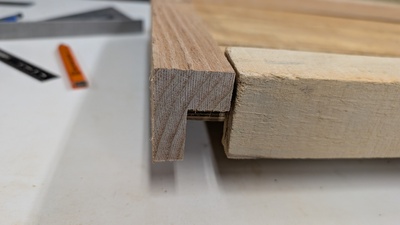
Unforseen frame issue to fix
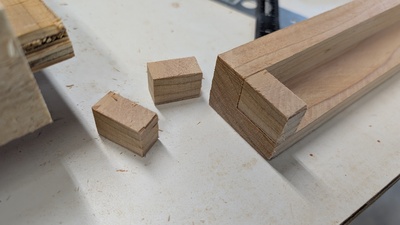
End pieces for filling frame gaps
Before doing any further work, I needed to check the overall size and how the PVC and wood cover would actually work in the real place. I added a few screws, just enough to hold the frame on, so I could test this. I still had not cut the hole for the shower controls, but this gave the initial idea of what it would look like and allowed me to see if there were any other conceptual issues to address. The only thing that came up was that some of the stones in the wall protruded too far in some places. I would need to chisel some bits of stone away to give the cover a little more space to sit flush.
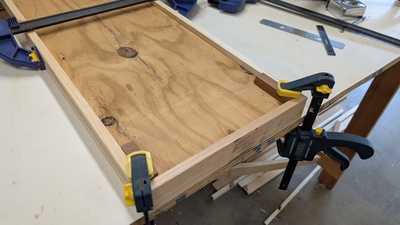
Clamping for initial frame mount screws
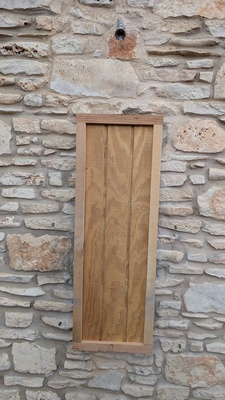
Testing placement - closeup
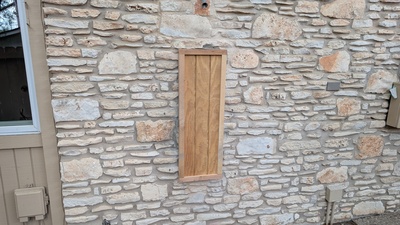
Testing placement and initial look
The 6 screws that hold the PVC panel to the wall frame are machine head screws. This means that protrude a little from the panel. Since I wanted the wood panel to site very flush against the PVC, this mean I would need to add some counterbores in the right places that these screws coudl sit in.
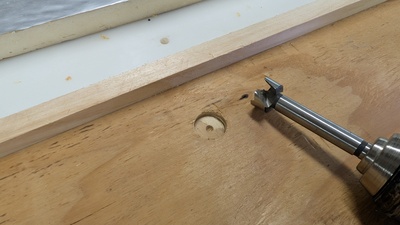
Forstner bit and recess close-up
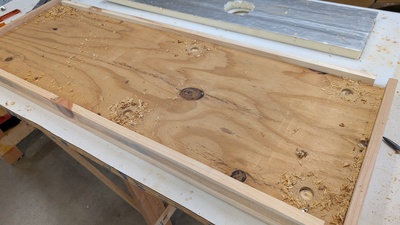
Panel after recess holes drilled
Wood Cover Center Hole
Getting the center hole of the wooden board to line up with the center recess the shower escutcheon sit in was a bit tricky, especially since I wanted a neat perfect alignment. I also needed the hole to be beveled so I could more easily grab the escutcheon if I needed to remove it.
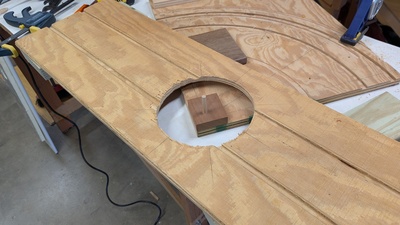
Rough jigsaw cut of opening
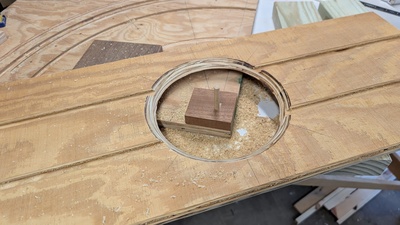
Routed and beveled opening - closeup
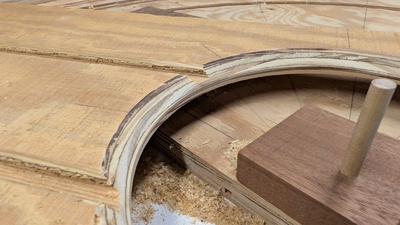
Beveling closeup
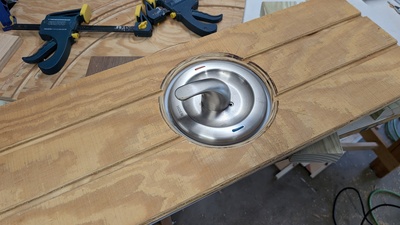
Checking shower controls fit
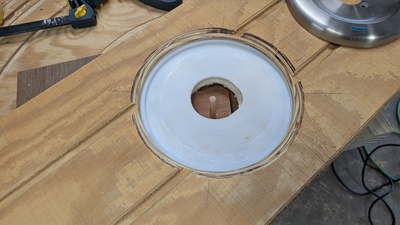
PVC and wood panel alignment check
Wood Cover Painting
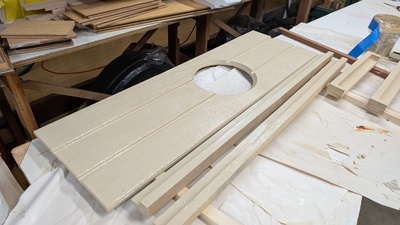
Painting panel - first coat
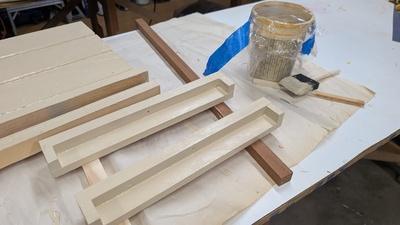
Painting frame pieces - first coat
Once assembled, I would need to caulk and paint the panel to prevent any water from getting in or sitting in the cracks and grooves of the panel. However, wanting this to be durable, I also decided to paint it before assembly. That not only means two coats of paint, by a coat of paint on surfaces that will not be reachable once it is assembled.
Wood Cover Assembly
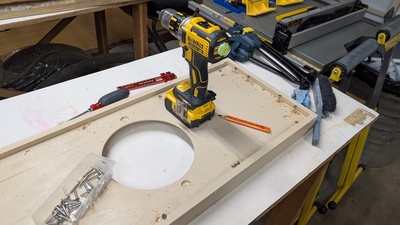
Screwing frame to panel in progress
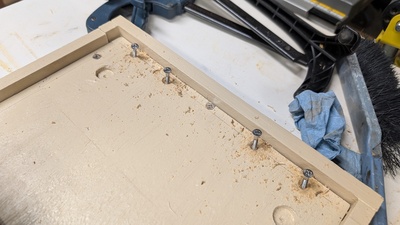
Screwing frame top to panel
I had to wait afew days for the paint to dry and for the stainless steel screws I needed to arrive, but then was ready for the final assembly.
Wood Cover Attachment
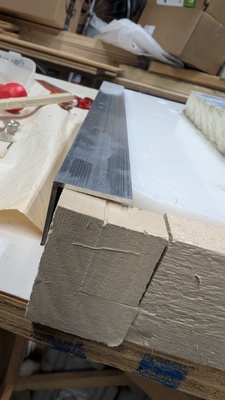
Aluminum hanger placement - side view
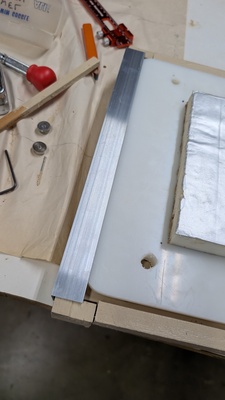
Top aluminum hanger bracket
I only had vague ideas for how the wood panel was going to attach to the PVC panel. There was enough space around and behind the PVC panel that is was mostly about clamping them together. I'd also ordered an aluminum brackets for the top clamping as it would be the thing supporting all the weight.
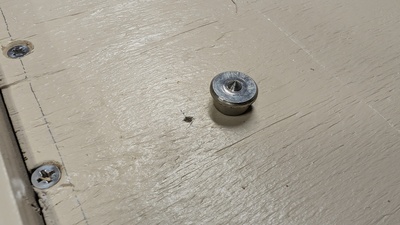
Dowel centering jog for magnet placement
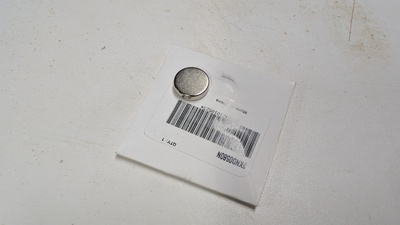
Neobium magnets
The next idea I had was to use magnets to attached the panel. A more elegant and tool-free way, but I was not sure that would be enough. I originally bought two magnet to be put on the left and right bottom sides with the aluminum bracket on the top. But given the strength of the magnets, I thought if I put one on top and one on bottom, that could be all I need. I tried this first.
I would use the magnet embedded in the wood panel, and then a magnetic metal washer embedded in the PVC panel. I need to use a dowel centering tool to make sure the holes I made in the wood and PVC panels aligned.
I drilled shallow holes for the magnets and washers so they would be flush with the panel to get a good fit. I used an outdoor-reated epocy to secure them in place.
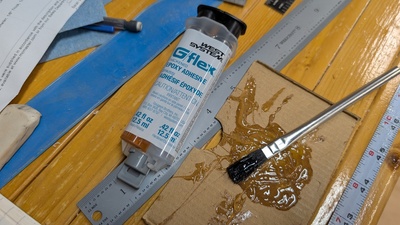
Epoxy for magnets, washers and anchors
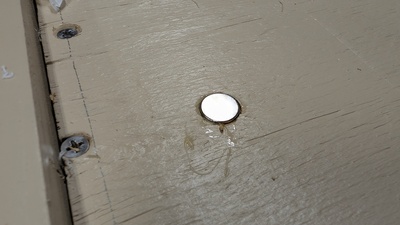
Magnet after epoxy
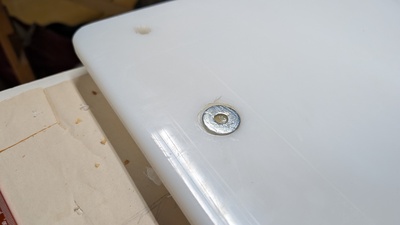
Washer after epoxy
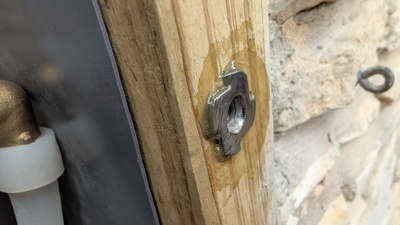
Threaded anchors after epoxy
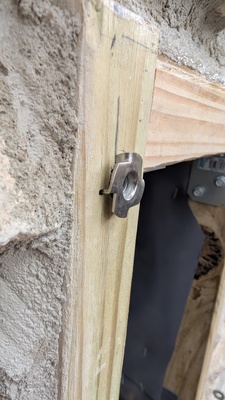
Loose PVC cover threaded anchor
When I first screwed the PVC into the wall frame, I noticed the threaded anchors were not holding that well into the wood. They just relied on hammering in some spiky things and they did not sink very deep. If I pulled with just moderate force, I could pop them out. Using epoxy on these was in my plans and I had been waiting so I could use the same batch of the (two-part) epoxy for these and the magnets. Main trick here was to not get the epoxy on the threads.
I waited 24 hours for the epoxy to cure before trying to put any force on the magnets or anchors. But now it was time to see if those two magnets would do the job. They would not. If the PVC and wood were both perfectly flat against each other, this might have worked. But in the real world, the wall frame PT wood was slightly bowed and so too was the PVC panel. The wood panel was also not perfectly flat.
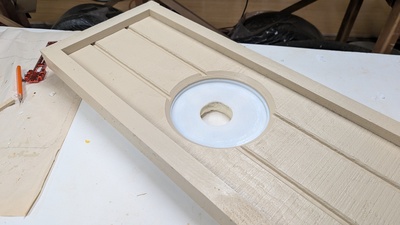
Assembled panel and PVC cover
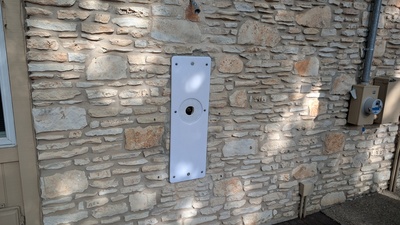
PVC cover mounted - left view
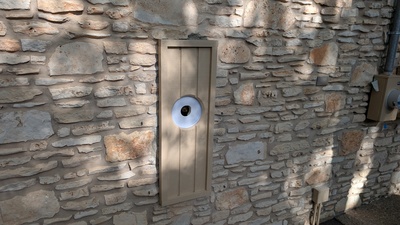
Wood panel - magnet only fitting
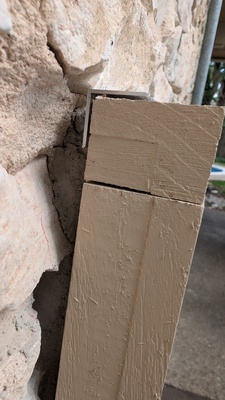
Aluminum hanger - side closeup (alt)
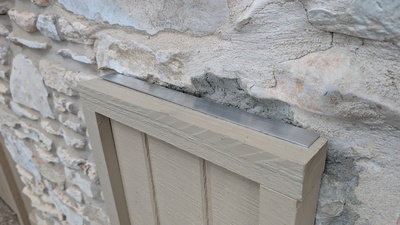
Aluminum hanger positioning and marking
They were flat enough to get some magnetic hold, but given the magnetic force decreases exponentially with distance, even small gaps greatly reduced the hold force. They could hold the panel in place lightly, but they would not in the face of a strong gust of wind. This just meant I had not wasted my money on the aluminum hanger bracket as I would be needing it after all.
I positioned the bracket in place so I could mark its location before drilling the holes for the mounting screws.
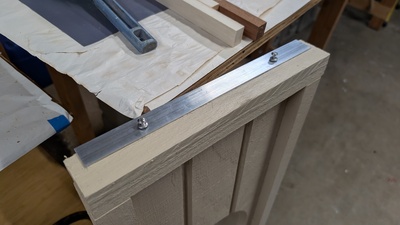
Srewing in aluminum hanger bracket
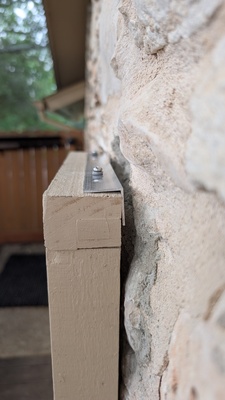
Hanger bracket initial install - side
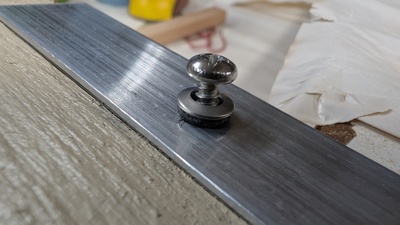
Closeup of screw for hanger bracket
Wood Cover Caulking and Final Painting
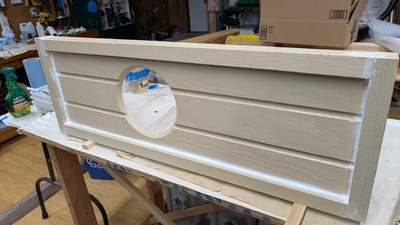
Caulking wood panel
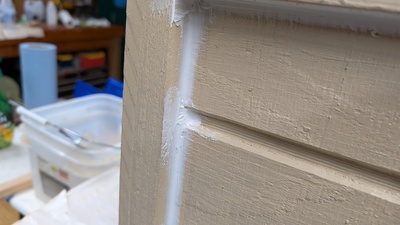
Caulking frame joint - closeup
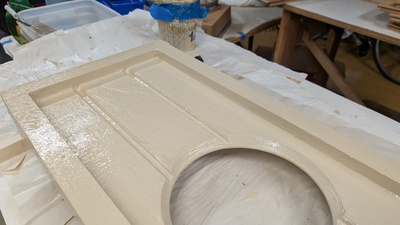
After final paint coat - closeup
Final Result
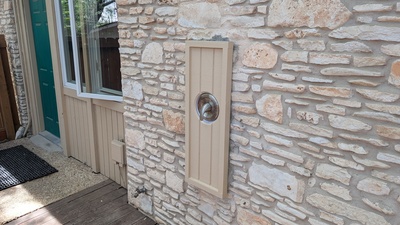
Final result - right view
Final result
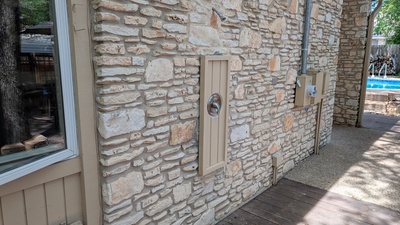
Final result - left view