 Cassandra.org
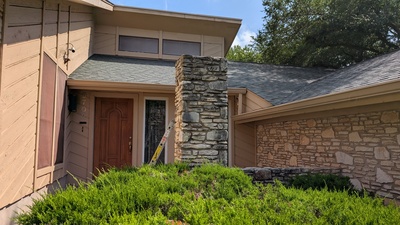
Before
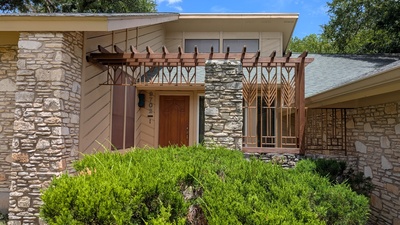
After
Background
When we bought our home, it had a decorative element that was common for my neighborhood. This consisted of three large cedar beam running horizontally over the front entryway. You can see them in these photos from 2009 where the beams come out of the house and rest on a stone square post.
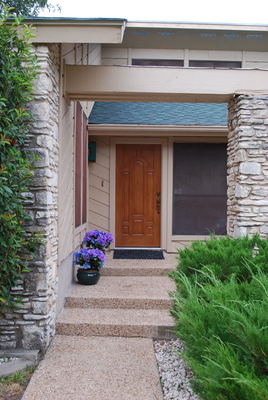
Before beams removed (path)
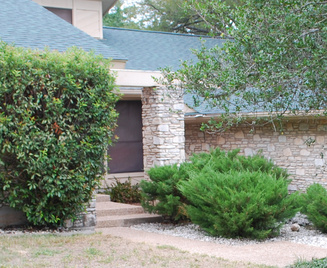
Before beams removed (wide)
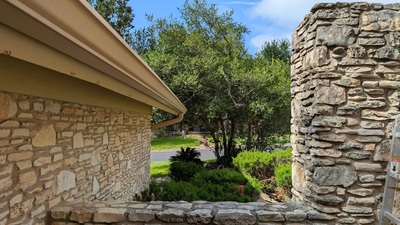
The problem is that these beams were about 6 inches wide and water would pool on top of them, eventually making its way through the paint and rotting the wood. If you look close, you can see the edge of some metal flashing I added to try to stop the rot from getting worse. However, my fix did not work well and a few years later they needed to be removed. This left the front entryway looking odd with the stone post sticking up with no purpose.
Before view from south
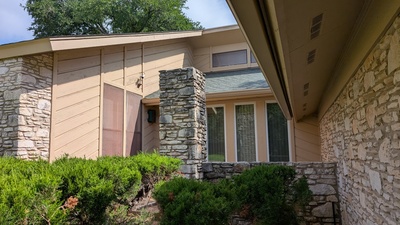
Before view from southeast
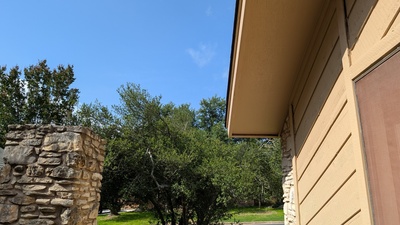
Before view from north
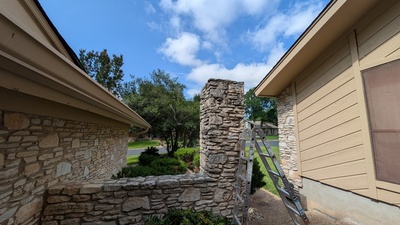
Before view from northeast
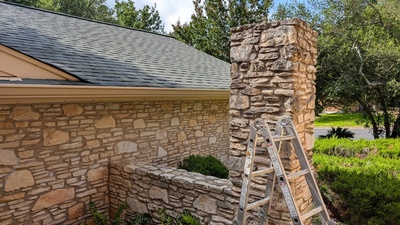
Before view from northwest
Before view from northeast (closeup)
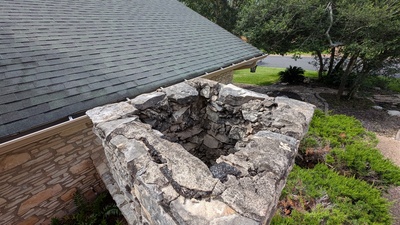
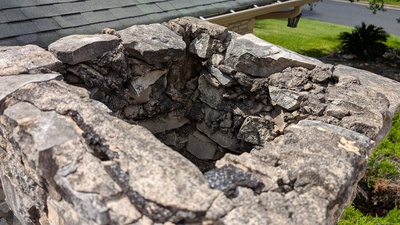
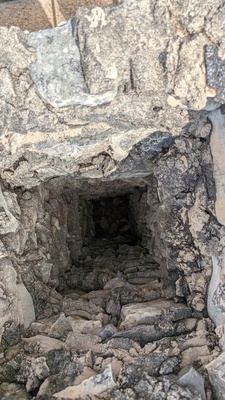
This was aesthetically very displeasing and when I got around to looking at the top of that post, I saw something that seemed like it could eventually be a problem: it was hollow and open on top. After many years of this being open to the elements, I was a little afraid to look down into it for fear of what I might see. Luckily, it seemed alright.
Post top hollow (closeup)
Post top hollow
View straight down into post hollow
Design
I did not want to demolish the stone work, but wanted to figure out something to do to make this not look so abandoned. I had vague ideas for about 10 years, but nothing motivating enough for me to do anything. I roughly had ideas about a trellis of some sort, but nothing really solidified as a plan.
In the Spring of 2025, we were on vacation in the Netherlands and as we were walking around the Dutch town of Delft, I saw this trellis on a balcony:
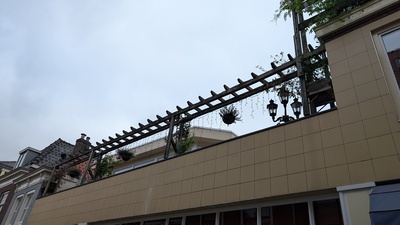
Delft inspiration
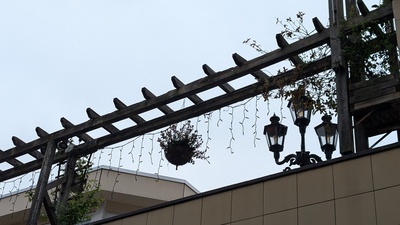
Delft inspiration (close)
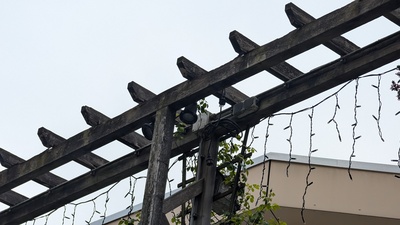
Delft inspiration (closer)
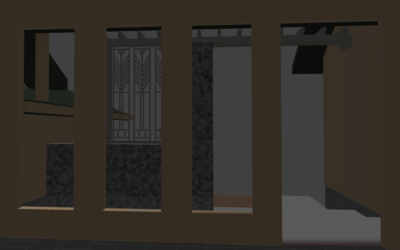
I liked the look of this and it was inspiring. That idea was quickly followed up with the idea of combining this concept with the Frank Lloyd Wright idea of a "light screen" for some non-blocking visual privacy. For most projects I now use the modeling software Blender, so I measured everything in my front entryway/courtyard, built a 3D model and went to work designing this in detail.
The design I came up with consists of three main horizontal beams supported by the house, the stone post, and two vertical posts that sit on top of the low stone wall. There will be decorative cross members on top and and decorative lattice work below (the light screen).
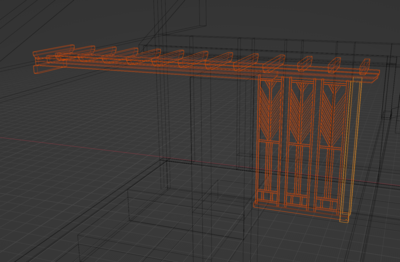
trellis-blender-modeling
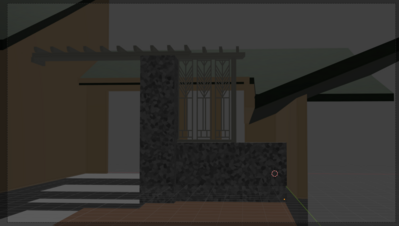
trellis-blender-render-front
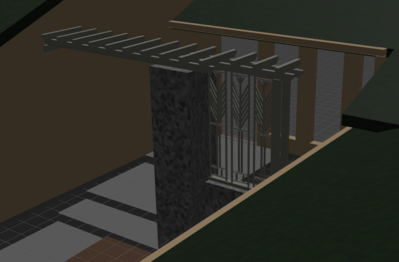
trellis-blender-render-upper-right
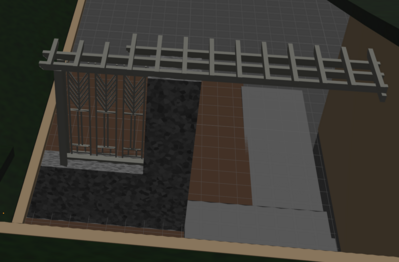
trellis-blender-render-upper-behind
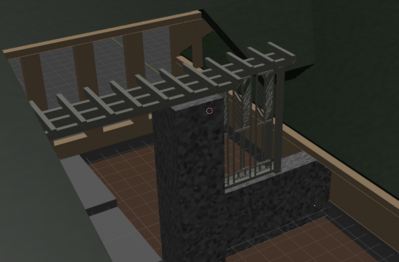
trellis-blender-render-upper-left
trellis-blender-render-inside
Wood Selection
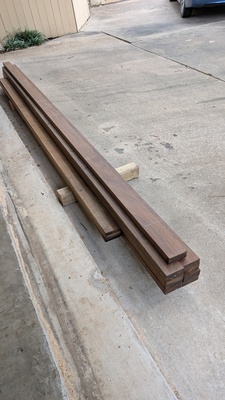
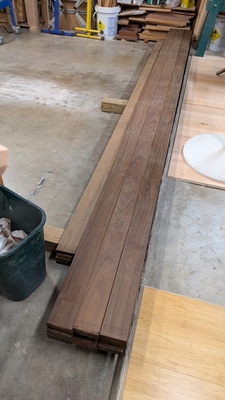
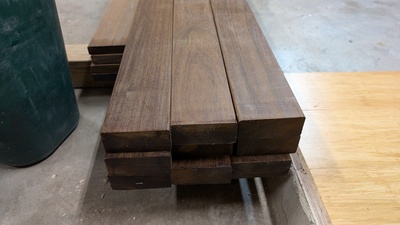
I was very happy with this design, mapped out how much wood I would need, then went shopping. I needed something that was extremely weatherproof which translated into either Teak or Ipe. I preferred Teak as Ipe is very, very dense and heavy, but Teak is crazy expensive. Ipe is not cheap by any means, but it was in the range of what I was willing to spend, while Teak was not. After quotes for both woods, I put my order in for the wood to be delivered from a local wood supplier Timbertown.
Ipe wood delivery in driveway
Ipe wood in garage
Ipe wood in garage (closeup)
Adding Cap to Post
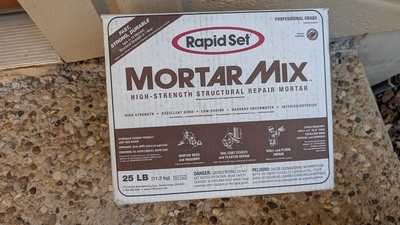
Mortar mix label
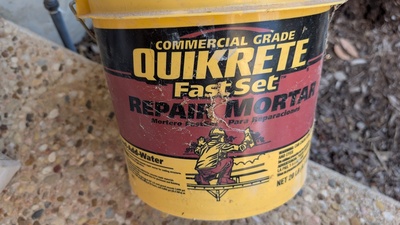
Quikrete bucket
The first task was to cap the open post top, both to prevent things from getting in as well as providing a base of support for the significant weight of three long Ipe 2x4 beams. The top courses of the stone on this pillar were loose, so I needed to repair this first before adding a cover.
I also needed to choose what I would use as the covering. I looked at single piece larger tile solutions, found one I liked, but the weight was a problem. I settled for a two piece tile solution as this would be much more manageable to hoist up and position while using a ladder. The tricky part of the installation was getting these on the rough stone surface even and level.
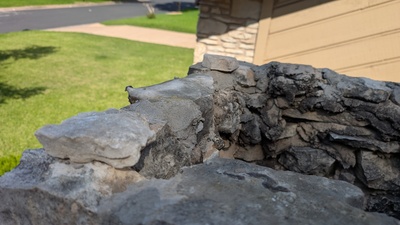
Post top surface (before closeup)
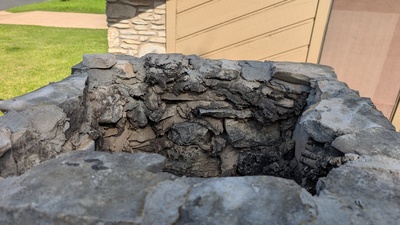
Post top surface (before)
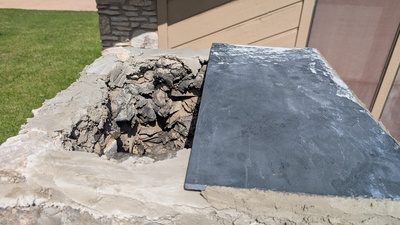
Post top first cap tile
Since there is a hollow cavity, I needed to ensure I had a weep hole so any moisture could escape.
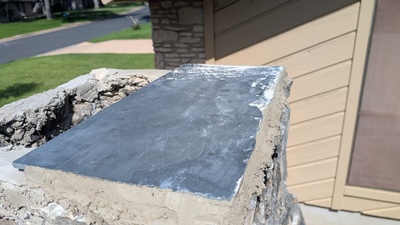
Post top first cap tile (alt)
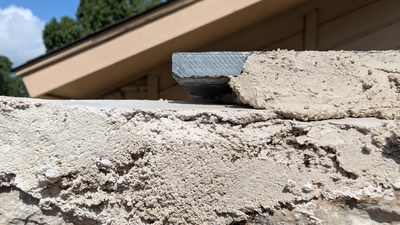
Post top tile gap closeup
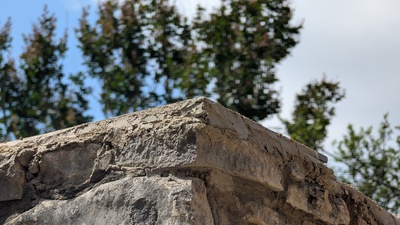
First post cap tile edge closeup
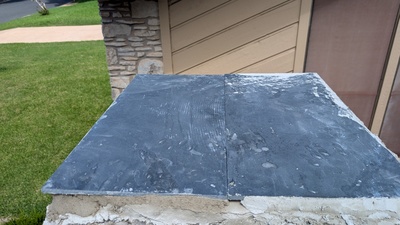
Post cap: both tiles in place
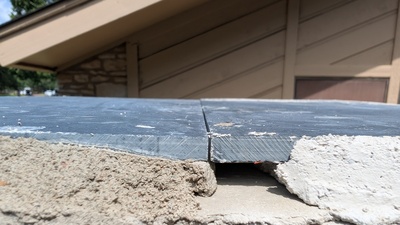
Post cap both tiles gap
Main Beam Alignment
The vertical stone post is actually attached to a low stone wall. The trellis will be supported by the house on one end, the post in the middle and the low stone wall at the other end. That means I have to make sure the main top horizontal beams are lined up with the wall and that may not be (was not) perpendicular to the house. I also needed to line up the beams to see how long the low wall vertical supports needed to be.
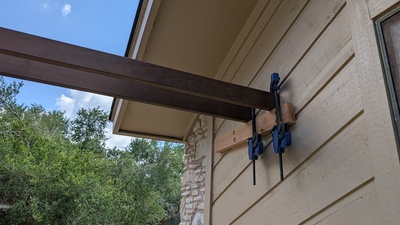
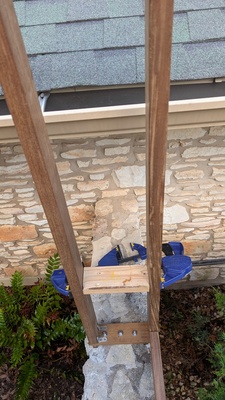
Beams clamped to house side support
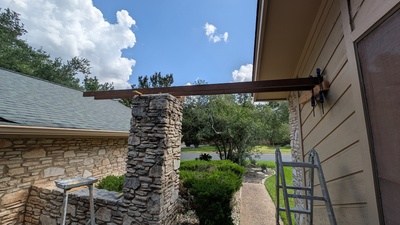
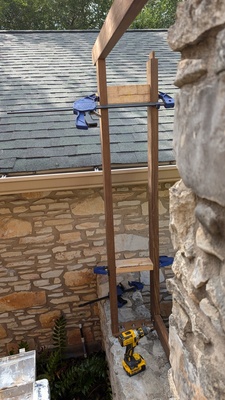
Beams positions from northwest
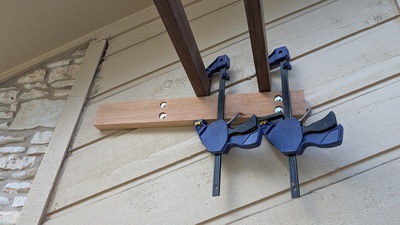
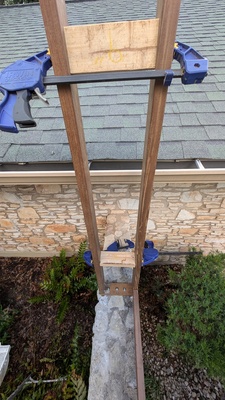
Beams clamped to house side support (lower view)
In the pictures you can also see the house wall bracket I needed to make in order to support the beams on the house end. This was a cedar 2x4 as cedar is what the rest of the non-stone parts of the house are made from. However, as you will see later, I changed my mind and eventually decided to make that support bracket out of Ipe.
Drilling Holes for Anchors
I did a lot of research and considered a lot of options for how to attach this whole trellis contraption to the stone wall. Concrete screws and molly-like things I have never trusted. The Ipe was very heavy and it will undergo stresses from the elements (e.g., wind). I decided on using 1/4" stainless steel threaded rods embedded in the stone and using anchoring adhesive. This required drilling holes in stone and the post top tiles. I bought a sintered diamond bit on Amazon.com for this purpose (not all diamond bits are created equal). The stainless hardware I got from my favorite places for hardware like this: McMaster-Carr.
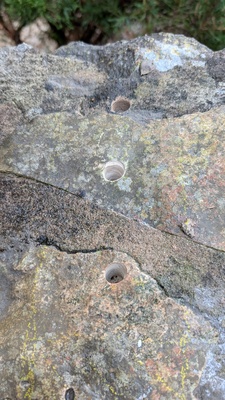
First anchor holes in wall
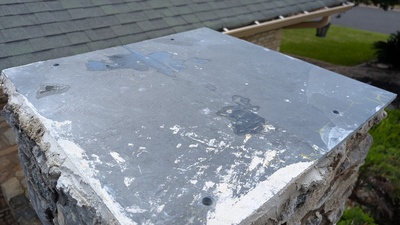
All anchor holes in post cap
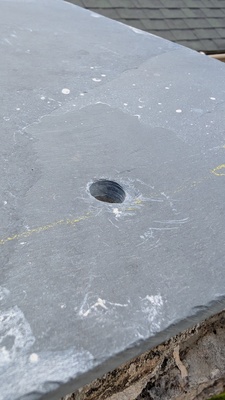
Post cap anchor hole closeup
Installing Anchor Posts
The brand Sika makes a very nice anchoring adhesive that is very strong. It comes in two varieties, one stronger than the other. For the extra couple dollars, I thought I could not go wrong with the stronger version. I was wrong. The big difference was in the curing time. The stronger stuff cures faster. The curing time is a function of temperature too. They have a nice table/chart on the tube. This was June in Austin, so in the mid-90's. That meant I had somewhere between 30 and 60 seconds of working time. Ugh.
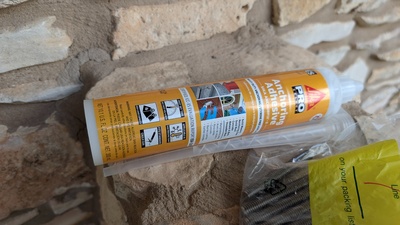
Anchoring adhesive closeup
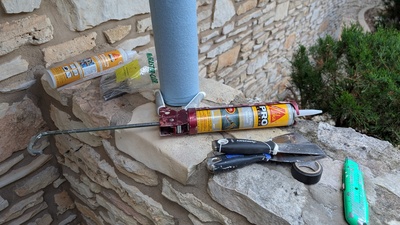
Anchor post installation materials
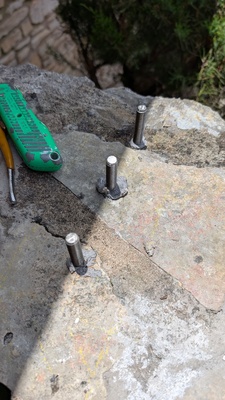
First wall posts installed
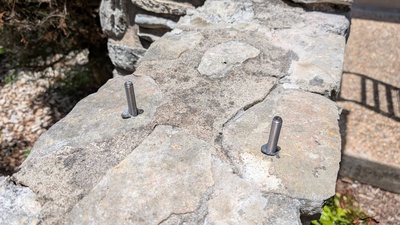
Second wall posts installed
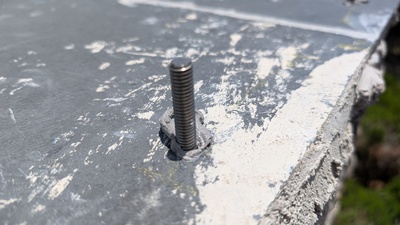
First post cap anchor installed (closeup)
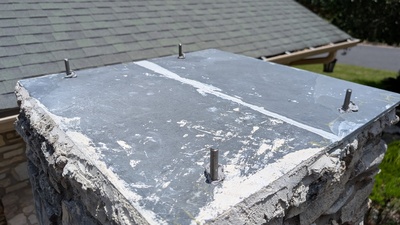
All post cap anchor posts installed
I moved quickly and did not stop for anything. You can see a lot of ooze out from rushing and overfilling. Thankfully, that excess chipped off relatively easily.
Installing Base Plates
Though I had strong anchoring in place, I still wanted the majority of support stresses to come from gravity and the natural support of the wall and stone post. The anchors were there to prevent movement in the sideway (or upward) direction. I designed this so that there would be plates that are anchored into the stonework, and the trellis itself would be mounted to the plates with stainless steel L-brackets.
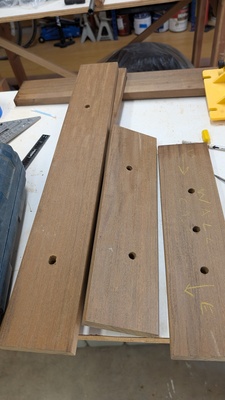
All base plates in shop
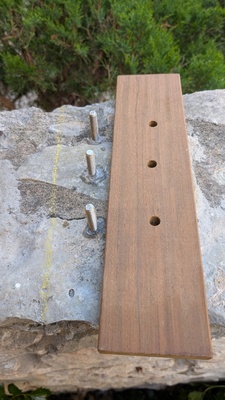
Wall base plate next to anchor posts
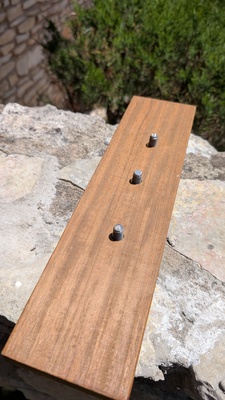
First wall base plate positioning and fitting
I needed to first line up where to drill the holes in the base plates, then I marked where to cut them to length. I deliberately did the holes first with an oversized board so I could more precisely control the final board length (which was important for supporting the vertical 2x4s).
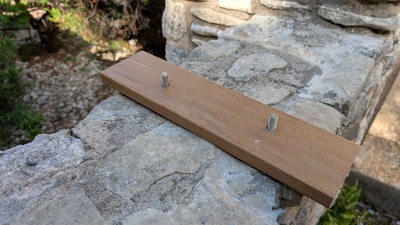
Second wall plate in place
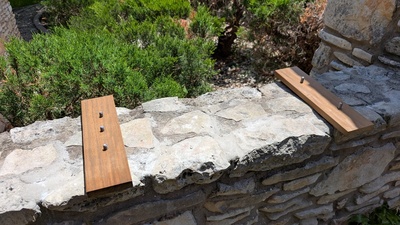
Both wall base plates positioning and fitting
The next issue I needed to deal with is that these base plates need to be level, but the wall is neither level nor even. Additionally, you do not want the wall to rest directly on the stone as that will trap moisture and lead to rotting. This required using stainless steel washers as spacers and also creating some small, contoured shims to go between the base plates and the masonry. I have a contour measuring device for such problems.
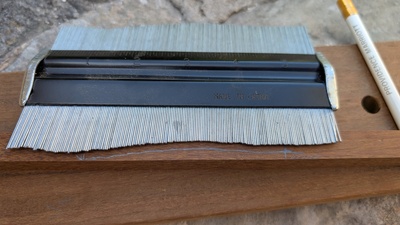
Contour measuring device
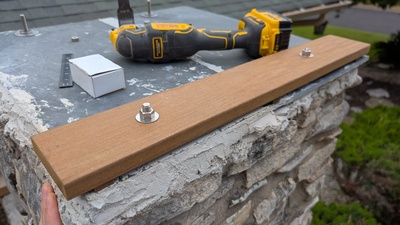
First post base plate installeds
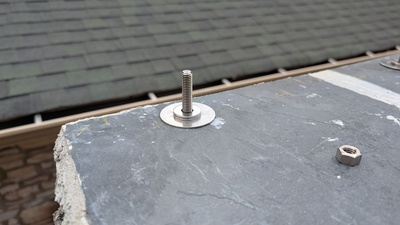
Post base plate hardware closeup
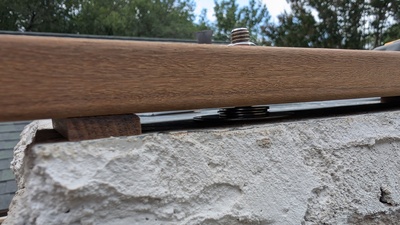
Post base plate underneath view
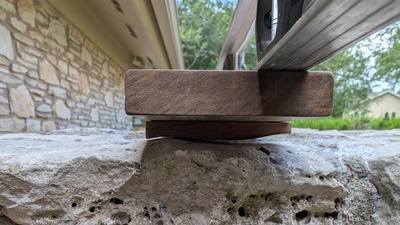
Wall base plate shim closeup
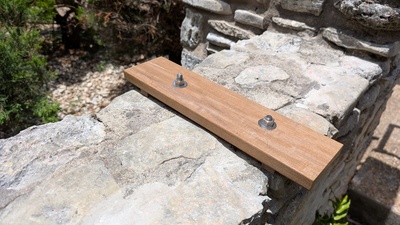
Second wall base plate in place
Vertical Support Positioning
The other nice property of using the base plates was that I still had some flexibility on exactly where the horizontal main beam lined up. My initial layout of the beams let me find out they could be lined up and roughly where they would be and that informed where I drilled the anchor holes. Now I needed to get more precise and know exactly where these beams would need to run so they aligned with the two vertical posts that would sit on top of the low stone wall.
There was a chicken and egg problem here: how long the vertical supports needed to be depended on where the horizontal beams lined up. However, the horizontal beam alignment dependent on where the vertical beams would be. With rough stone walls and uneven dirt ground as the only reference points, I could not simply measure to the accuracy I needed. My solution was to use clamps to position the vertical beams, level them, then mate the horizontal beams, and iterate until everything was level and perpendicular.
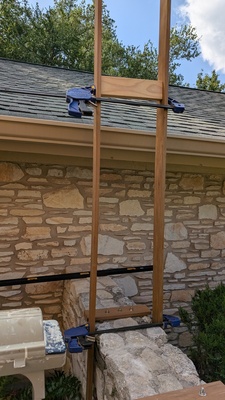
Vertical support alignment setup (closer)
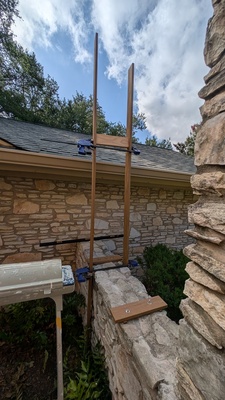
Vertical support alignment setup
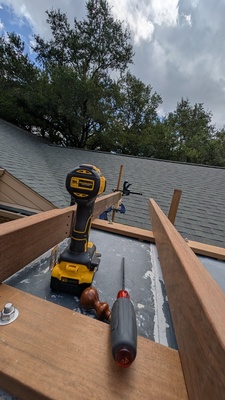
View down main beams toward vertical support alignment beams
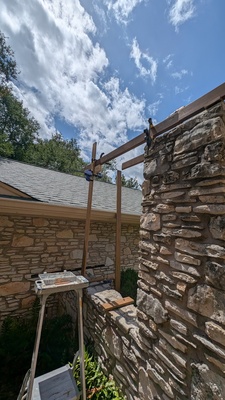
Aligning main beam extensions
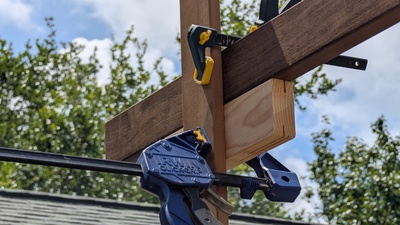
Positioning main beams to vertical supports
Once the vertical and horizontal beams were clamped in place and all measurements said things were level, I could mark the exact lengths and locations for the beams.
Beam Joinery
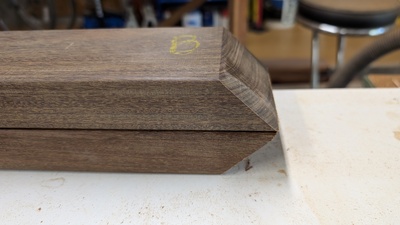
Main beam extension ends
The Ipe 2x4s I ordered were the longest I could buy, but were not quite long enough to span the entire horizontal run I needed from my design. I briefly toyed with truncating the design to accomodate the wood length I had, but I was not willing to compromise on that. This meant that the two longest horizontal beams needed to be made of two pieces. I made the joint location such that both pieces would rest on the stone post and it would mostly be hidden up there. Thus, the joint itself did not need to be weight-bearing. Still, I needed the entire joined beam to be fairly rigid. I used a scarf-type joint so that when joined you would not see daylight though it.
The more import joints needing strength were where the horizontal and vertical beams met. These would be main structural points holding the entire thing together. Though I could have simply used L-brackets, I decided to use something much stronger: a mortise and tenon joint. A bit more work, but a lot more peace of mind in terms of the structural integrity of the main supporting beams.
I used a router to cut the tenons.
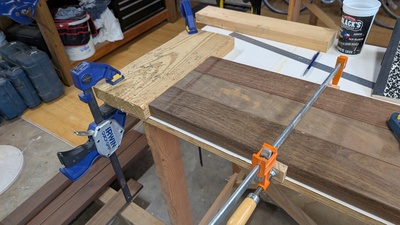
Marking tenons for support beams
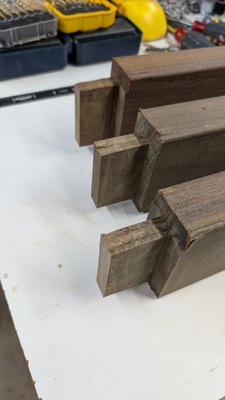
Support beam tenons completed
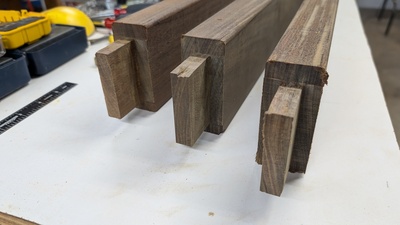
Support beam tenons completed (closer)
I used my mortising machine to cut the mortises.
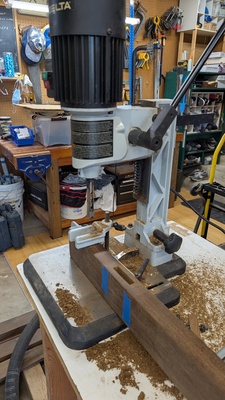
Mortise machine and main beams
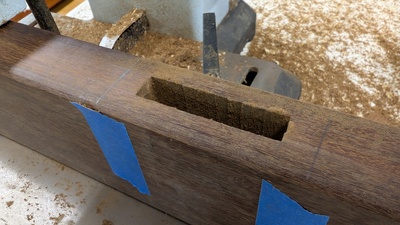
Main beam mortise closeup
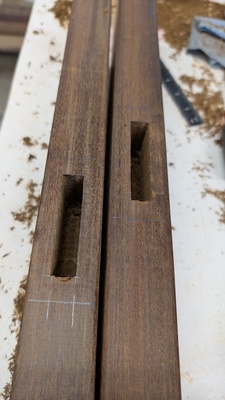
Main beams with mortises
After cutting the mortises, I found the the tenons were a little too large. It is far easier to shave off material from the tenons using a router than it is to chisel out the mortises.
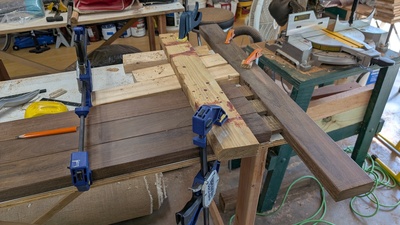
Setup to refine tenons
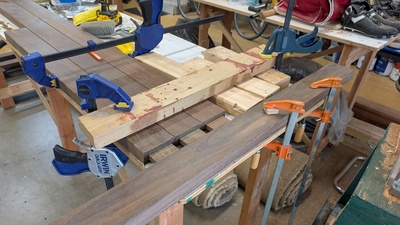
Setup to refine tenons (alt)
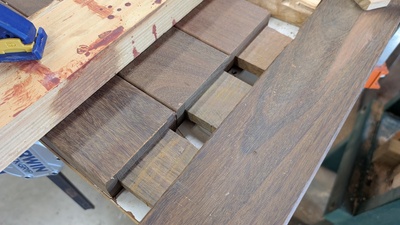
Setup to refine tenons (closer)
Main Beams: Final Positioning
All the 2x4 beams were now cut to their final sizes, at least as best I knew from the previous exercise of positioning and marking. Now it was time to try them out for real to see how things aligned and what final refinements might be needed. I would now know exactly where all the L-brackets needed to go and install those, but not tighten them fully as I would need to remove everything one last time for some additional preparation.
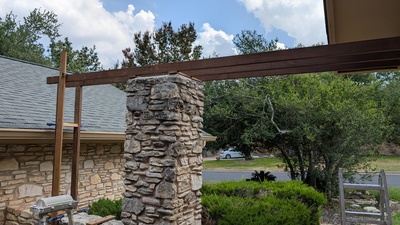
Main beams positioning (northwest view)
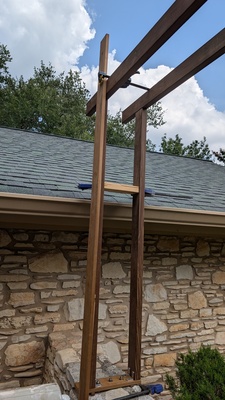
Main beams positioning (closer)
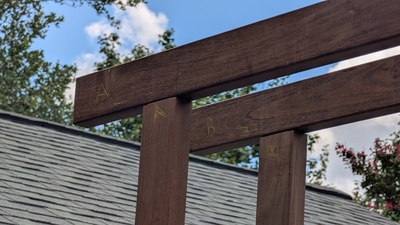
Main beams and support beams closeup
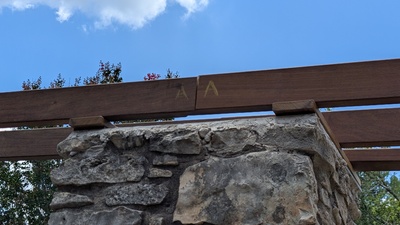
Main beams on post
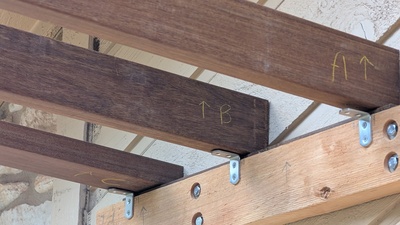
Main beams and hosue wall support bracket
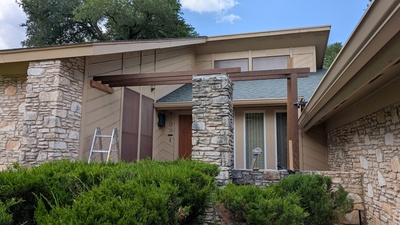
Main beams positioning (southeast view)
House Wall Bracket
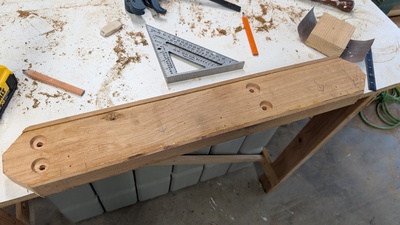
House wall bracket shims
In my leveling measurements, something was a bit off and I needed to add a 1/4 in. to the house wall bracket to raise one end of the beam up so it was level with the top of the stone post's cap. This error was due to my not accounting for the washer spacers needed to prevent the wood resting directly on a flat surface.
I now also needed to paint the house wall bracket to match the cedar sides of my house.
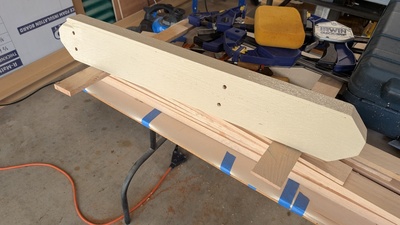
House wall bracket painted (closeup)
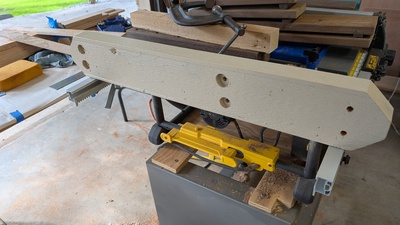
House wall bracket painted (finished)
Main Beam Joint Reinforcement
With the main horizontal beams being two pieces and a scarf joint to hide the gap somewhat, I needed some way to actually join them. Ipe is too dense for glue, and their weight meant a simple metal bracket would likely just bend if stresses were applied. I had some 1.5x2 in. pieces of Ipe that I was going to use to span the joint and just screw it into both beams with a bunch of stainless steel screws. If you could see this joint, it would be ugly, but fortunately, it will be hidden behind the beams and on top of the stone post so out of view.
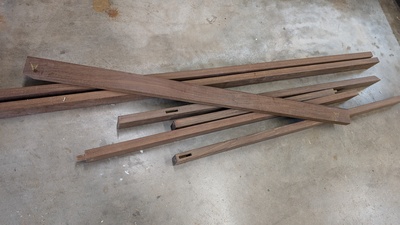
Finished beams on shop floor
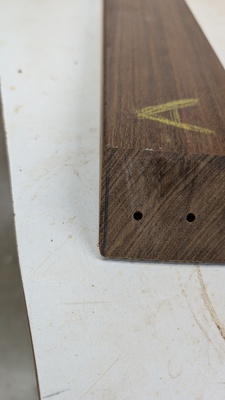
Main beam joint support bracket
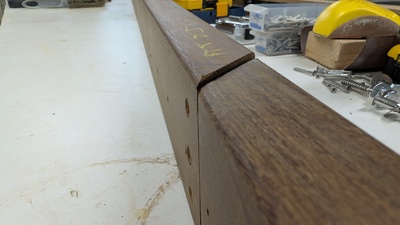
Main beam joint closeup
Trellis Cross Members
The final beam positioning gave me high confidence that all was good with the main support structure so now turned toward making the (many) cross members that would give the trellis its main look and appeal. These were simple 2 foot lengths of 2x4 Ipe with a bevel to match what I had seen in Delft. I needed a bunch of these.
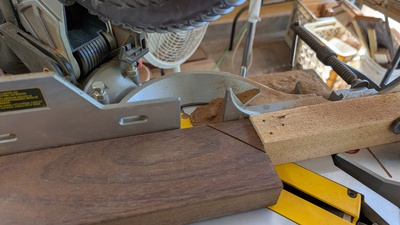
Cutting bevel of cross members
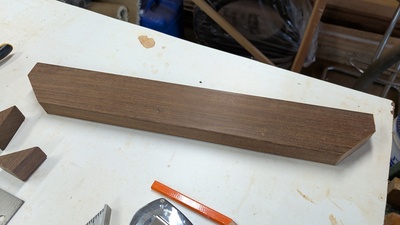
Ipe cross member
Sealing Ipe Ends
Ipe can last many decades outside with zero maintenance. It will turn a silver-grey, but that does not affect its longevity. However, Ipe does have the problem that it "checks", which means that the ends will show small gaps (looks like cracks) as the wood dries out. Because of this, you need to seal the end grain of Ipe as this prevents that high moisture differential and limits its checking.
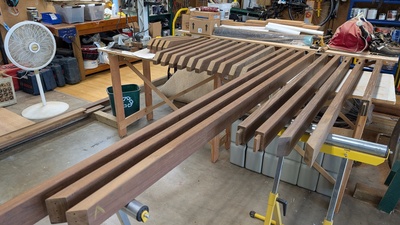
All Ipe 2x4 ready for end sealing
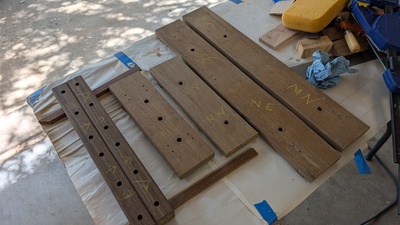
Base plates and supports read for end sealing
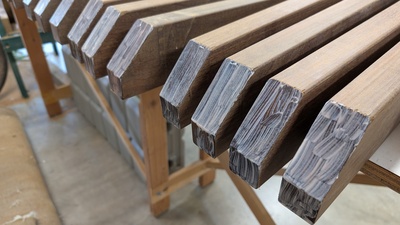
Ipe end sealant applied (closeup)
The end grain sealer is sort of like a liquid wax. It goes on white and is clear when it dries to a wax-like surface.
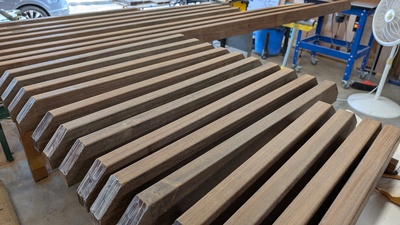
Ipe end sealant applied
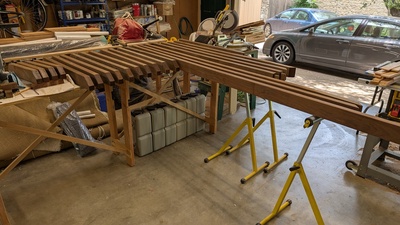
All Ipe 2x4 after end sealing
Passivation of Stainless Steel Hardware
Stainless Steel is not corrosion proof, it is corrosion resistant. It still has iron in it, but also has chromium whose oxidized state forms a protective layer so that the oxygen atoms do not find the iron atoms. But stainless steel is a soup of all these different elements, some of the iron atoms may find their way to the surface through cutting, machining, etc. The process of "passivation" uses an acid to dissolve those iron atoms on the surface so you have mostly just the protective chromium-oxide atoms. Passivation boils down to simply soaking the metal in an acid like nitric or citric acid.
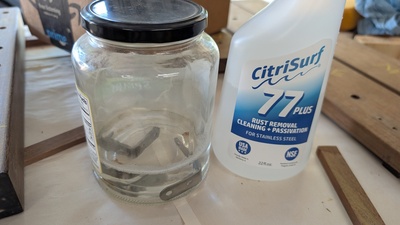
Passivation of brackets
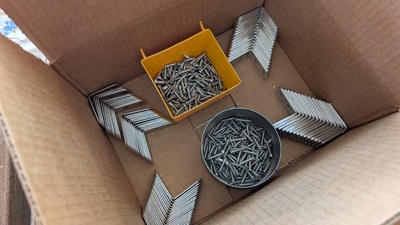
Brackets and screws ready for passivation
Did I need to do this? Probably not, but this little extra protection wouldn't hurt and seemed worth the small investment.
House Wall Bracket Installation
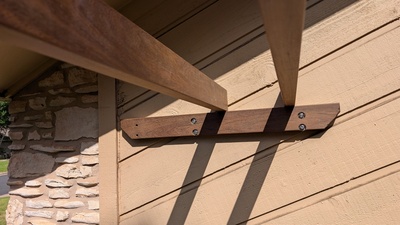
Sometime after painting the house wall bracket and this point in the project, I decided to calculate the strength of this bracket. It was a piece of 2x4 cedar using 5/16 in. lag bolts. The weak point turned out not to be the shear strength of the lag bolts, but the cedar wood itself would fail first. When I ran the same calculation for Ipe wood, it was about 4 times stronger and the bolts would likely shear first. With the shimming I had already done on the cedar bracket and with this lower strength on my mind, I decided I would replace the cedar house support bracket and make one out of Ipe instead.
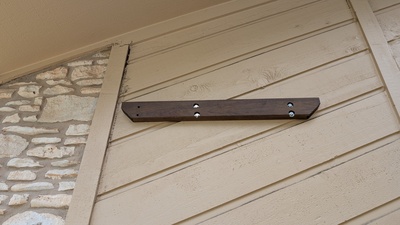
Ipe house wall bracket (straight-on)
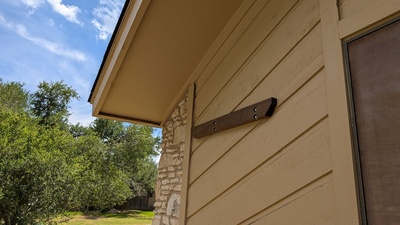
Ipe house wall bracket
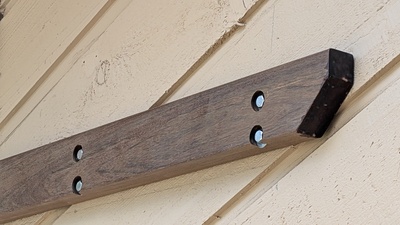
Ipe house wall bracket (closer)
Beam and Support Installation
The main beams of 2x4 Ipe are very heavy. We'd already had to take them up and down a few times to work out the positions/dimensions and to cut the joints and the final lengths. I was happy that I reached the point where the next time we struggled to get them up would be the last. (I had help from my wife.)
Vertical beam install from above
Vertical beam install spacers
First beam install view
Main beam to house install view
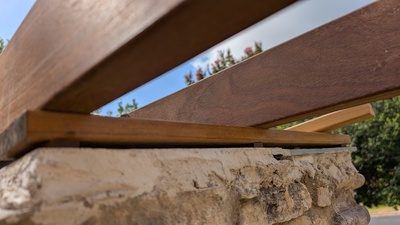
Main beam on post install view
Main Beam Joint Revision
I had affixed those 1.5x2 in. beam splicing pieces and drilled the holes when I previously had them up for the final positioning. However, it was at this point that I decided a full 2x4 would be a better option and provide more rigidity. I was trying to conserve my dwindling 2x4 Ipe stock and use some scraps when I chose to use those 1.5x2 in. I now decided this splice joint was not the place I should compromise.
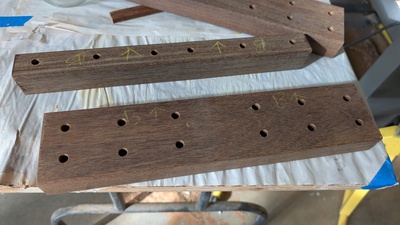
Old and new jointing parts
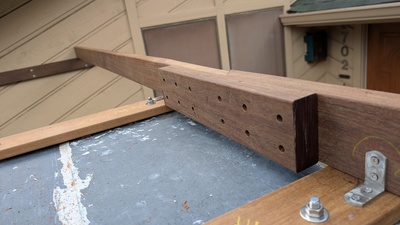
Main beam jointing in place (closeup)
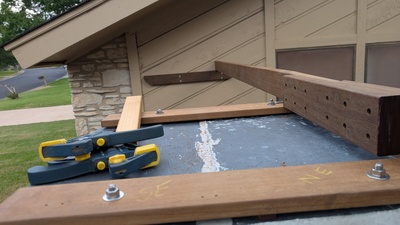
Main beam jointing in place
Trellis Cross Member Installation
I made a few spacers to make the somewhat tedious installation of all the cross members repeatable and easier. Lots of brackets and holes to drill, all of them with the drill gun over my head.
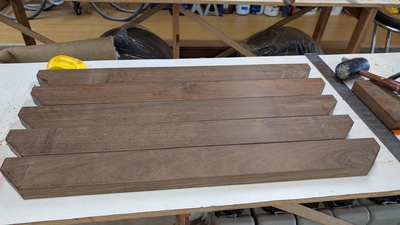
Trellis cross members
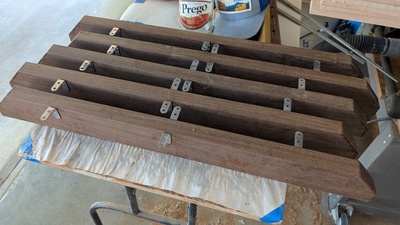
Trellis cross members with brackets
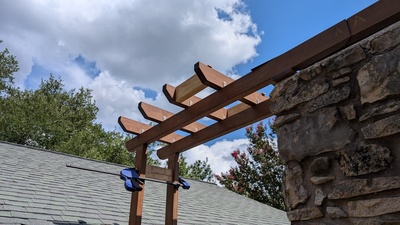
Trellis cross member initial install
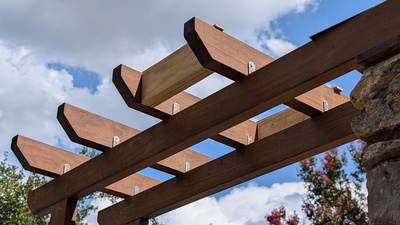
Trellis cross member initial install (closeup)
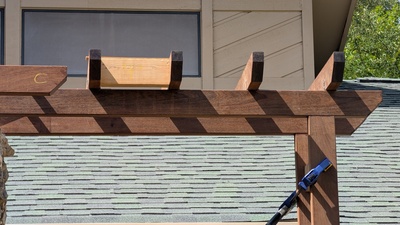
Trellis cross member initial install (south view closeup)
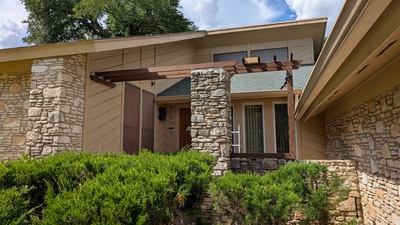
Trellis cross member initial install (southeast view)
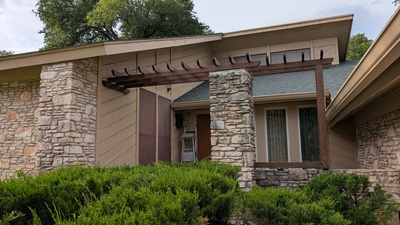
Trellis cross members installed (southeast)
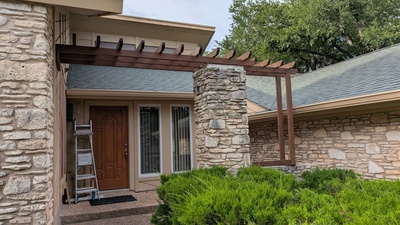
Trellis cross members installed (southwest)
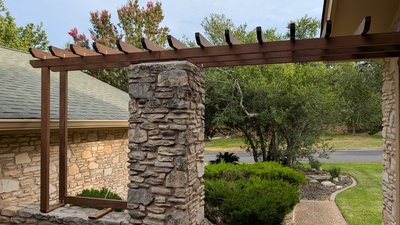
Trellis cross members installed (north closeup)
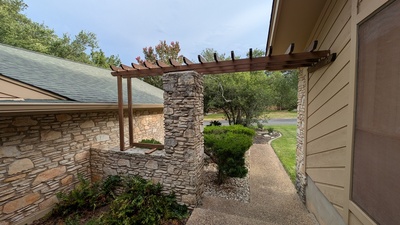
Trellis cross members installed (north)
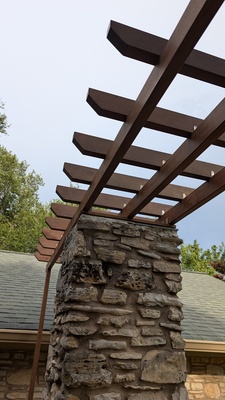
Trellis cross members installed (northwest closeup)
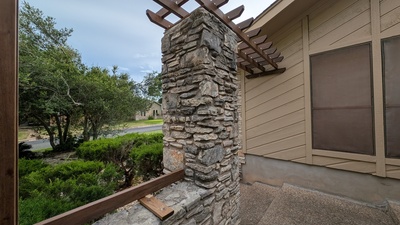
Trellis cross members installed (northeast)
Main Light Screens
With the support structure in place, I now turned toward the more decorative lattice work of the "light screens". Frank Lloyd Wright used leaded windows in his houses and he did not call them windows, but light screens. Although it sounds a little like he's just being stubborn, there is something to it. The presence of a design in the window causes your eye to focus on the design, which means you are not focusing beyond the window, so not seeing what is inside. It is surprisingly effective. Thus, I wanted to do something like that to both not block off the little courtyard area, yet make it feel a little more private. And since I was using the Frank Lloyd Wright inspiration, I went looking for one of his designed that I could adapt and would lend itself to a non-too-difficult woodworking project. I adapted his "Tree of Life" window pattern, much simplied though.
All this lattice work would be done using 3/4 in. square stock so I ripped a bunch of boards down, then chopped them into different lengths. Some pieces needed angle cuts and all would be joined with stainless steel screws.
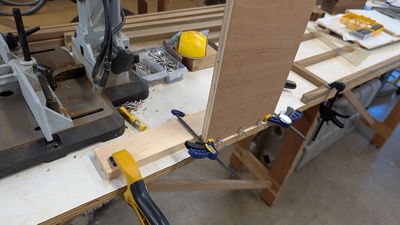
Creating angle cutting jog
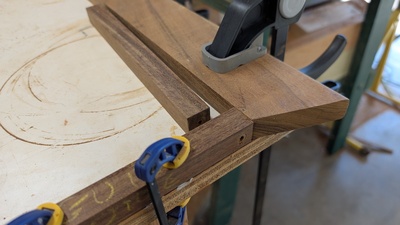
End hole drilling jig
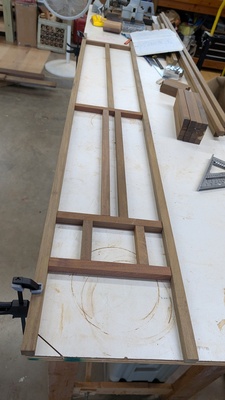
Partial light screen layout
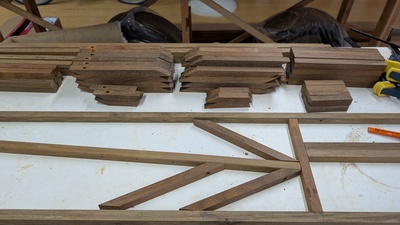
First "tree" branch assembly in progress
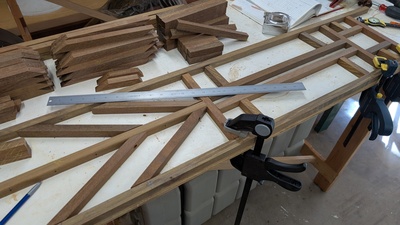
Light screen assembly
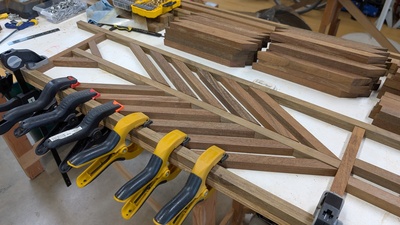
Full light screen layout (closer)
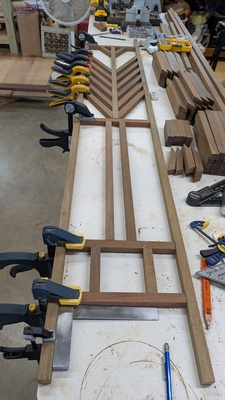
Light screen layout
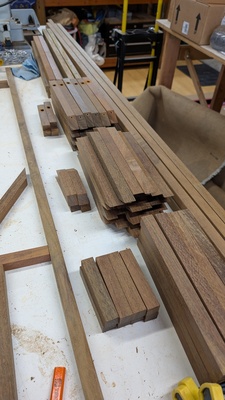
Light screen parts stacked
I decided to bevel all the pieces using a router. This would aid in making them visually look smaller as well as allow me to skip sanding the otherwise sharp edges.
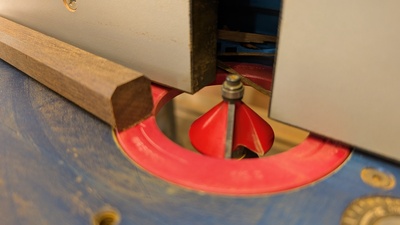
Router bit and beveling closeup
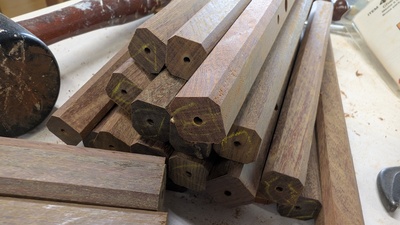
Light screen part bevel closeup
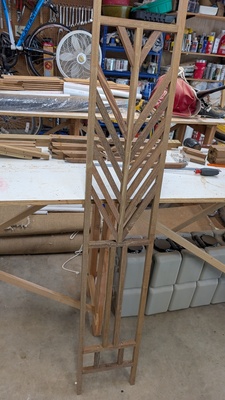
First light screen section completed
Walkway Light Screens
Unbalanced initial design
There was something starting to bother me about my original design: it felt "unbalanced". The decorative part was all on just one side and the side where a person would actually walk up to and under had nothing but plain 2x4 beams (see design at right). I decided I needed to add something to balance the decoration and worked on adding a similarly styled light screen that hung below the beams, but above where a person would walk.
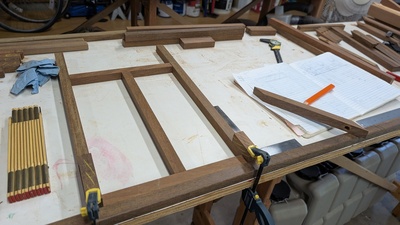
Walkway light screen assembly (alt)
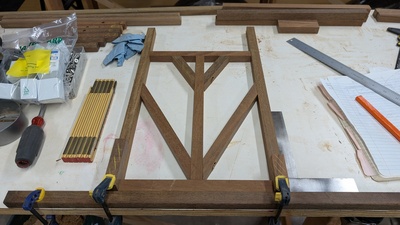
Walkway light screen assembly (full)
Final Light Screen Prep and Assembly
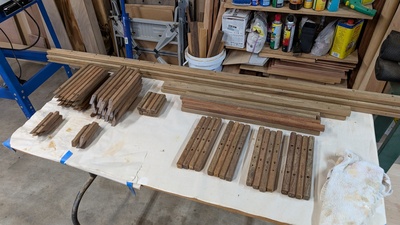
All light screen parts stacked after sanding
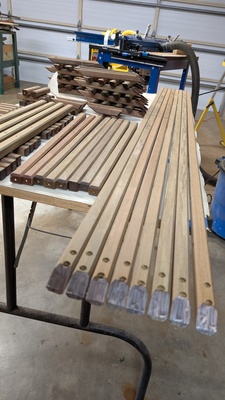
Sealing ends of light screen parts
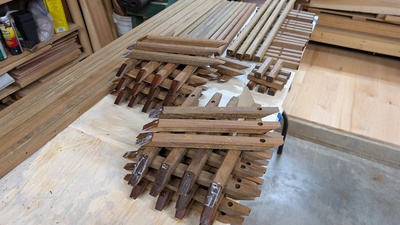
Parts for remaining light screen sections (closeup)
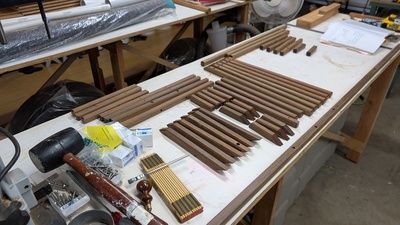
Final assembly of first light screen section
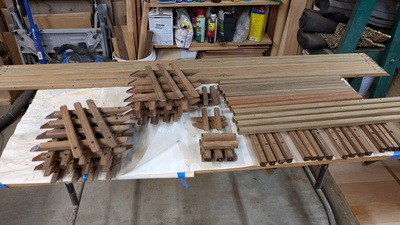
Parts for remaining light screen sections
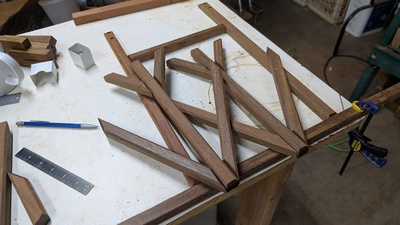
Walkway light screen final assembly
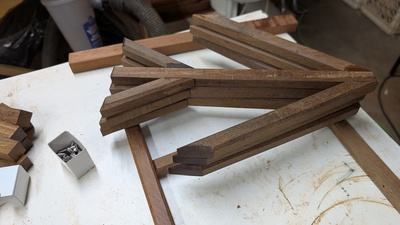
All internal parts for walkway light screen
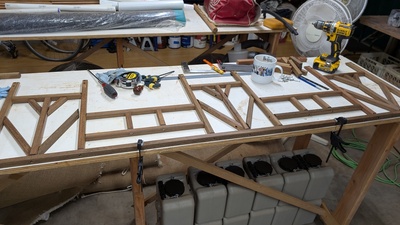
Walkway light screen on bench (flat)
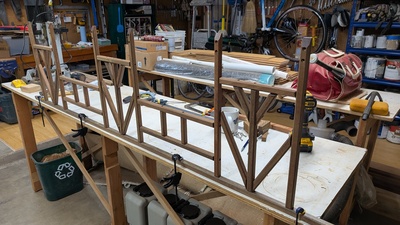
Walkway light screen on bench (upright)
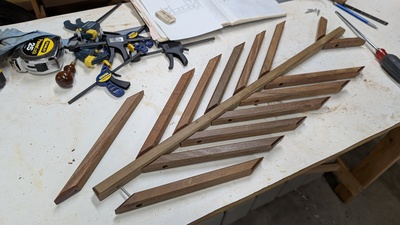
First "tree" assembly
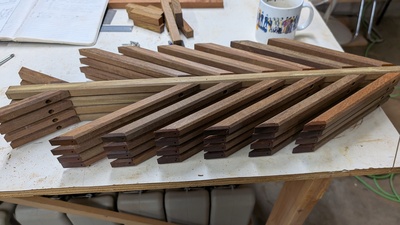
All "tree" assemblies completed
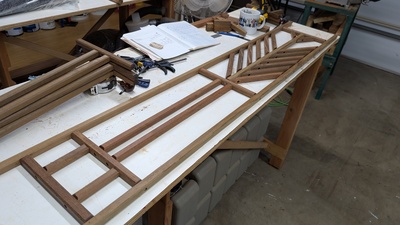
First light screen section assembled
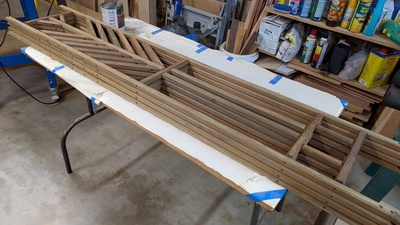
All light screen sections assembled
Light Screen Installation
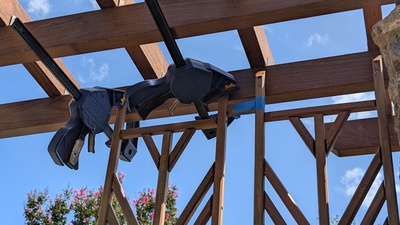
Installing light screen sections (closeup)
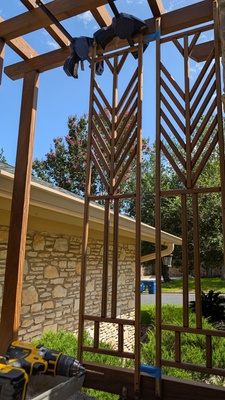
Installing light screen sections
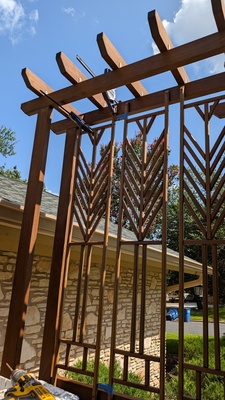
Last main lightscreen section installation
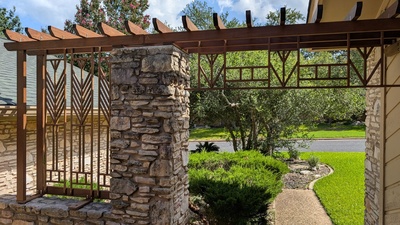
All light screens installed (north view)
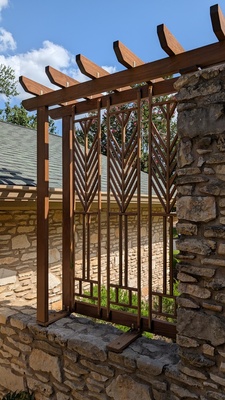
All light screens installed (northwest view)
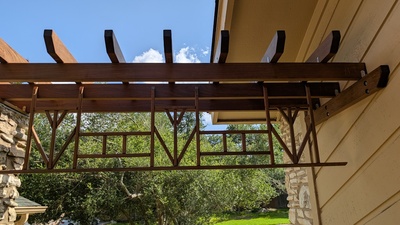
Walkway light screens installed (north view)
I had also decided to add a little bit of lattice work between the two main vertical support beams. It looked too barren and out of place without this.
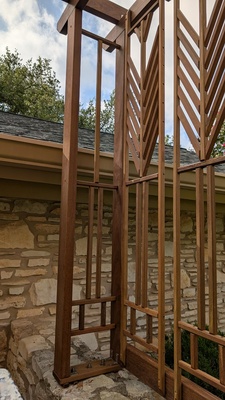
Side light screen
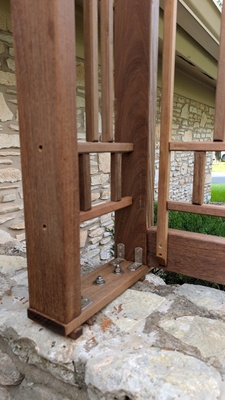
Side light screen base (closeup)
Revision 1 Completed
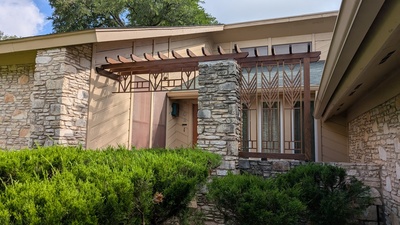
Final Rev. 1 (south wide view)
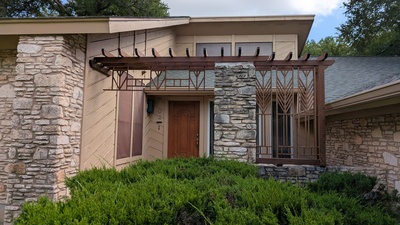
Final Rev. 1 (south view)
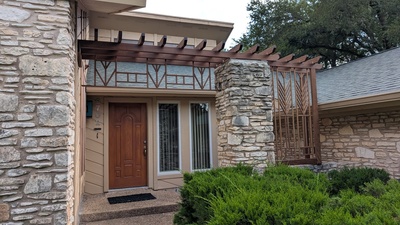
Final Rev. 1 (southwest view)
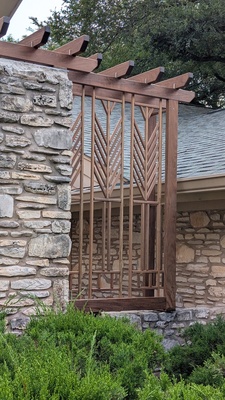
Final Rev. 1 (southwest closeup)
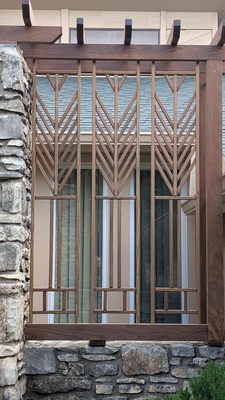
Final Rev. 1 (south closeup)
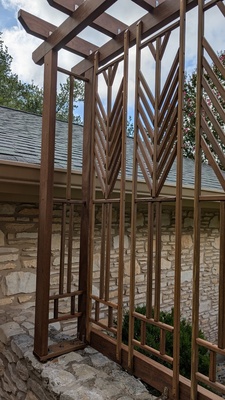
Tree light screen details
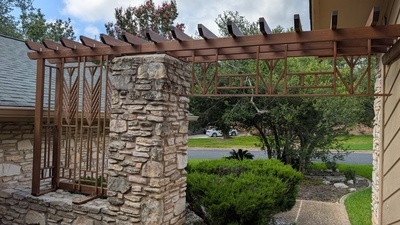
Final Rev. 1 (north)
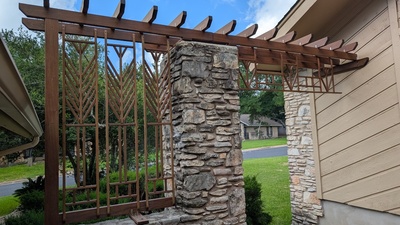
Final Rev. 1 (northeast)
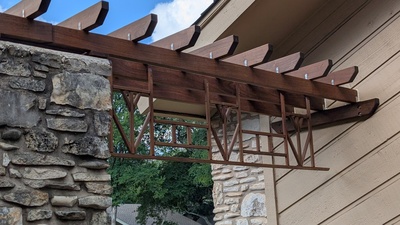
Walkway light screen details
Light Screen Extension
The more I looked at the result, the more I felt it was a not quite right. Due to the low roof line, the tall light screen sections stops abruptly, but well away from the wall and it leaves this "hole" in the design.
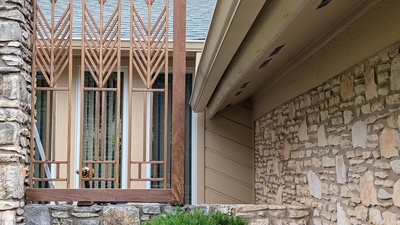
Light Screen gap (south closeup view)
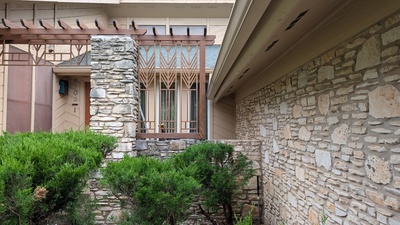
Light Screen gap (south view)
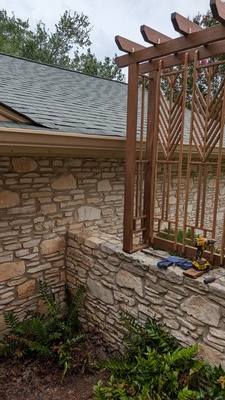
Light Screen gap (northwest view)
I decided to just continue the same design, though it would only be the lower half since the roof line was in the way. But the design flow at the level it exists at would be continuous from the main light screen areas.
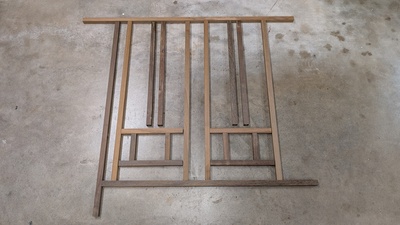
Light screen extension on floor
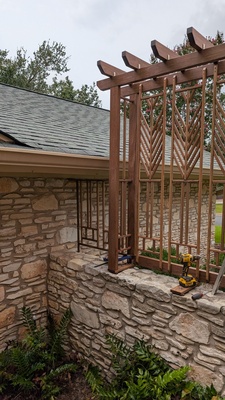
Light screen extension installed (northwest view)
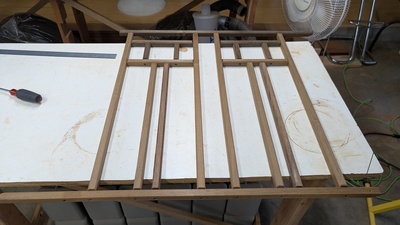
Light screen extension on bench
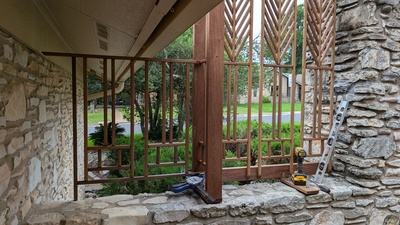
Light screen extension installed (north view)
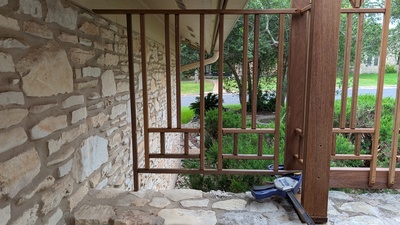
Light screen extension installed (north closeup view)
Revising Walkway Light Screen
I was more satisfied with the revision, but still not completely satisfied. The walkway light screen design was not great. I was not happy with it. It was an amalgam of some of the design elements, but still seemed out of place. The solution was to do the same thing I did with the extension: just continue the design that exists at that level.
I had to improvise to find enough wood to revise this, but eventually scrounged up the right lengths.
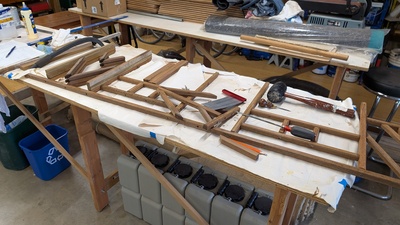
Disassembly of walkway light screen
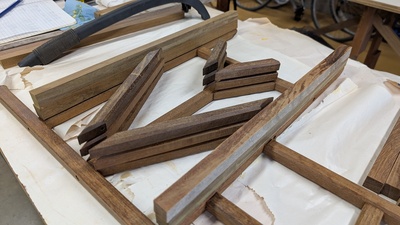
Walkway light screen - new parts
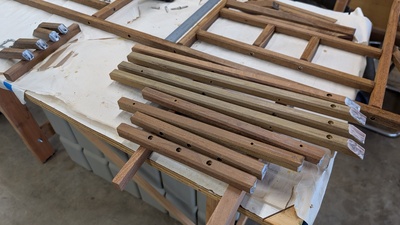
New walkway light screen parts
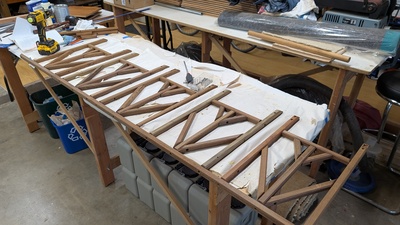
Assembly of new walkway light screen
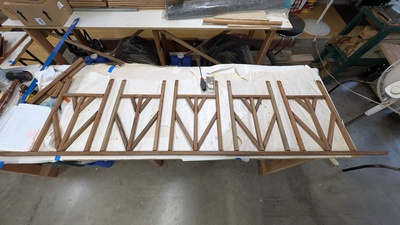
Assembled of new walkway light screen
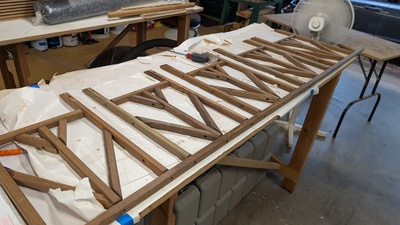
Assembled of new walkway light screen (alt)
Final Revision - Completed
Now the project was finished. The main light screen design exists in the middle, and is continued for the lower and upper extensions to its left and right. Harmonious and satisfying.
Final Rev. 3 (south)
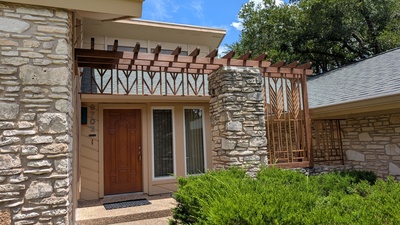
Final Rev. 3 (southwest)
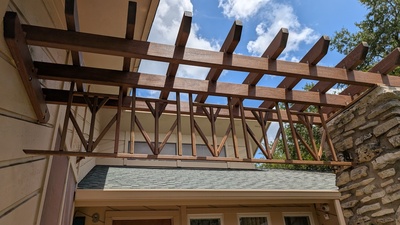
Final Rev. 3 (south closeup)
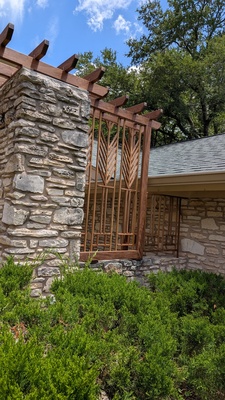
Final Rev. 3 (southwest closeup)
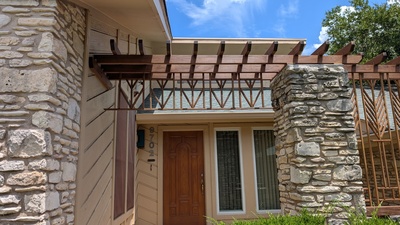
Final Rev. 3 (south alt2)
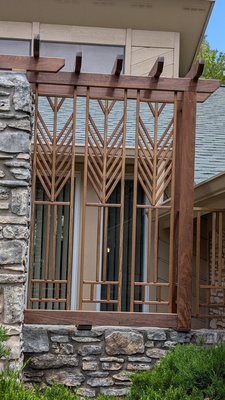
Final Rev. 3 (south closeup alt)
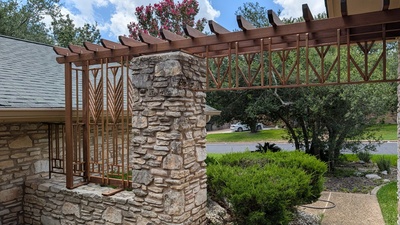
Final Rev. 3 (northwest)
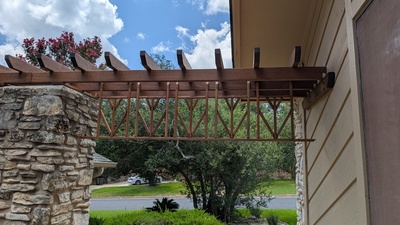
Final Rev. 3 (north closeup)
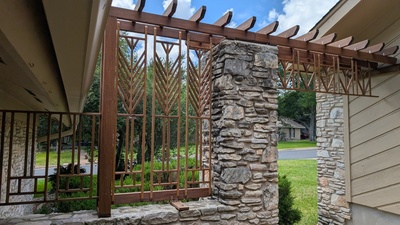
Final Rev. 3 (northeast)
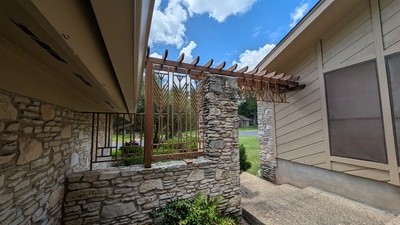
Final Rev. 3 (northeast wide)
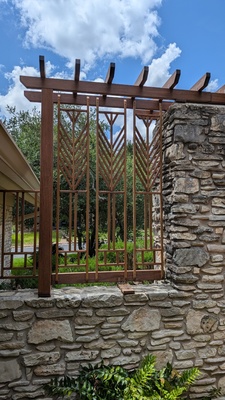
Final Rev. 3 (northeast closeup)
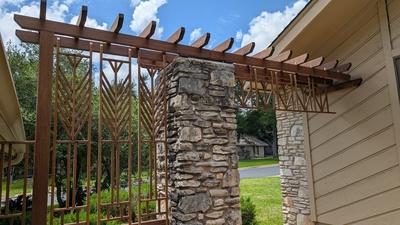
Final Rev. 3 (northeast closer)